

editor, Author at Amazon Listing Service - Page 3 of 6

Author: editor

Amazon Seller Account Verification: Complete Guide to Documents, Video Verification & Approval

Amazon Seller Account Verification

Setting up a digital storefront on the world's largest e-commerce marketplace requires passing a strict compliance review before your inventory can go live. This initial onboarding gate keeps fraudulent entities out of the catalog while protecting brand owners and everyday consumers alike. Navigating the registration steps incorrectly can cause severe delays that keep your online business from launching on schedule.

This comprehensive guide breaks down the modern onboarding workflow so you can confidently register without facing sudden rejections. You will learn how to organize your company paperwork, format your utility statements, and pass the identity checks on your very first try. Understanding these requirements protects your investment and ensures a quick path to marketplace approval.

What Is Amazon Seller Account Verification?

This specific compliance gate is a mandatory security check used to confirm that your business identity matches official government records. The automated and manual systems review your corporate filings, financial headers, and personal identification to ensure complete systemic transparency. Passing this vetting phase grants you full administrative access to your new e-commerce storefront dashboard.

  • Identity Verification: A security protocol where an automated system cross-references your state identification data against your live facial dimensions.
  • Business Verification: A detailed paperwork evaluation that ensures your company registration matches active public treasury databases.
  • Why Amazon Requires Verification: Strict enforcement of global financial transparency laws requires digital marketplaces to confirm the tax status and physical presence of all commercial merchants.

Who Needs to Verify an Amazon Seller Account?

Every merchant intent on launching an active storefront inside the global marketplace ecosystem must complete the security vetting process. Amazon applies the exact same structural standards to brand-new sole proprietors as it does to multi-national corporate conglomerates. Skipping these mandatory checks is impossible regardless of your business size or your planned monthly distribution volume.

Get expert support to complete Amazon account verification accurately and without delays.

Verify My Account

  • Individual sellers: Casual merchants trading personal goods who must validate their legal names alongside an active home address history.
  • Sole proprietors: Unincorporated business managers who operate using their personal identities combined with localized tax registration profiles.
  • LLCs: Registered limited liability entities that must provide corporate file structures alongside specific primary contact manager records.
  • Corporations: Complex commercial organizations requiring extensive ownership declarations and verified employer identification numbers.
  • International sellers: Foreign business owners who must present localized trading credentials that translate accurately across regional e-commerce marketplaces.

Amazon Seller Account Verification Process (Step-by-Step)

The digital onboarding path requires entering a specific sequence of data fields inside the global registration portal. Preparing your records before hitting the signup button stops system timeouts and reduces clerical submission mistakes. Follow these operational milestones carefully to move through the automated compliance check without issues.

Create a Seller Central Account

Begin by visiting the official registration portal to establish your primary digital access credentials. You must provide a clean email address and an active phone number capable of passing two-factor text confirmation challenges.

Enter Business Information

Select your exact entity type from the drop-down menu and input your official corporate name precisely as it appears on your state registration filings. You must also supply your active business registration number rather than your standard employer identification code.

Upload Identity Documents

Submit clean digital captures of your current government photo identification card to verify your status as the primary account manager. The platform requires high-resolution images that display all four corners of the card clearly.

Upload Business Documents

Provide your formal articles of organization or active local trading certificates to prove your enterprise is recognized by regional corporate regulators. These files must match the company name fields you filled out earlier.

Bank Account Verification

Input your commercial checking credentials to establish your future marketplace deposit destination. You must upload a fresh financial statement to prove your business actually owns that specific account line.

Address Verification

Confirm your actual location by requesting a physical postcard that contains a secure activation code. Amazon mails this item directly to your listed headquarters address to ensure your company maintains a real brick-and-mortar footprint.

Complete the Video Interview

Schedule a brief virtual appointment with a live compliance associate to verify your physical identification credentials through a webcam. You must hold your original paperwork up to the camera during this real-time session.

Final Review and Approval

Once your visual interviews and documents are submitted, internal teams will run a complete security evaluation on your profile. The system will activate your marketplace dashboard as soon as the manual background reviews pass.

Documents Required for Amazon Seller Verification

The documentation phase requires clean, recent financial and legal records that prove your business operates legally. Providing outdated paperwork or partial document statements will cause immediate system rejections. Gather these mandatory items into an organized digital folder before initiating the onboarding portal.

  • Government-Issued ID: A valid national passport or state driver's license displaying your full legal name, date of birth, and signature fields.
  • Utility Bill: A landline phone, internet, water, gas, or electricity invoice dated within the last 180 days that clearly displays your registered name and location.
  • Bank Statement: A formal financial document from your institution showing your active checking balances and transaction headers.
  • Credit Card Statement: A current statement from an internationally chargeable credit card issuer that confirms your billing address details.
  • Business Registration Documents: Official articles of incorporation, partnership agreements, or local business licenses issued by your regional department of state.
  • Tax Information: A completed W-9 form for domestic entities or a W-8BEN form for international merchants to establish proper tax reporting profiles.
  • Additional Documents Amazon May Request: Signed letters of authorization, employment certification notes, or localized registry extracts explicitly proving your company is currently in good standing.

How to Prepare Your Documents for Verification

Getting your paperwork sorted properly eliminates the formatting issues that trigger automated account rejections. The system uses advanced optical character recognition to read and check every text field across your files. Minor visual issues or cropped borders will cause the compliance tool to flag your files as altered.

  • Accepted file formats: Save all your paperwork as high-quality PDF files or clean JPEG images rather than unreadable web screenshots.
  • Image quality requirements: Ensure your uploads are fully legible, free from camera flash glare, and display all four edges of the paper.
  • Matching names and addresses: Every letter in your name and address fields must match perfectly across your ID, utility bills, and Seller Central settings.
  • Common formatting mistakes: Avoid cropping out document margins, blurring text during mobile scanning, or uploading files with password protections active.

Amazon Video Verification Explained

The final security step involves a brief video interview to confirm that the person opening the storefront matches the uploaded identification documents. You will connect with an internal risk specialist through a secure browser interface to complete this task. During the conversation, you must display your original physical paperwork directly to your computer camera.

The agent will take high-resolution snapshots of your facial profile alongside the security holograms on your government ID. To pass this test easily, sit in a brightly lit room, use a steady webcam, and avoid blocking the screen text while holding up your cards. Your Amazon seller account verification time will be significantly faster if this live video session finishes without any clarity issues.

Common Reasons Amazon Rejects Verification

Understanding why applications get turned down helps you avoid the formatting mistakes that stall new merchant accounts. Most rejections are caused by simple data typos rather than intentional bad behavior. A single mismatch across your corporate data fields can reset your application clock back to the beginning.

  • Name mismatches: Using a shortened nickname on your seller profile while your passport displays your full legal name.
  • Address inconsistencies: Listing a private mailbox address in Seller Central while your utility bills show your physical residential address.
  • Expired IDs: Submitting a driver's license that passed its validation window prior to your actual registration date.
  • Blurry uploads: Using low-resolution smartphone cameras that obscure the small barcode details printed on the back of your IDs.
  • Unsupported documents: Providing personal screenshots of digital banking apps instead of official, downloadable monthly statements.
  • Linked accounts: Attempting to build a new profile using identity details that are already attached to an older, deactivated seller account.
  • Incomplete business information: Leaving out critical middle names or leaving regional entity identification fields blank during the setup process.

What to Do If Your Verification Fails

Receiving a rejection notice can be frustrating, but you can fix the issue if you approach the problem methodically. Start by checking your performance notifications tab to see the exact reasons behind the document refusal. Avoid resubmitting the same files immediately, as this can trigger an automated spam flag within the compliance system.

Fix the specific data fields that caused the issue, or request a fresh, clear statement directly from your utility provider. If your corporate documentation structure remains stuck in an endless loop, working with an Amazon listing service can help you realign your records. Submitting a clean, verified set of paperwork is the only way to get your file reviewed and approved.

How Long Does Amazon Seller Verification Take?

The total time it takes to get approved depends on the accuracy of your paperwork and the current volume of new applicants. Most clean profiles pass through the automation tools quickly, while complex business structures require extra days for manual reviews.

  • Typical timelines: Standard domestic seller applications are usually approved within three business days after finishing the video call.
  • Factors affecting approval: Choosing a clear corporate structure rather than an unverified international setup speeds up your processing timeline.
  • Reasons for delays: Making quick address edits right after submitting your paperwork will reset your Amazon seller account verification time completely.

Tips to Speed Up Verification

You can cut down your onboarding timeline by double-checking all your details before hitting the final submit button. Organizing your records helps you pass the security checks without getting stuck in long support lines.

  • Prepare documents in advance: Collect all your active statements and corporate filings into a single folder before starting the signup flow.
  • Ensure data consistency: Match every single character of your address across your billing cards, utility statements, and company details.
  • Use high-quality scans: Use a flatbed scanner to create crisp, full-page files that show every page boundary clearly.
  • Respond promptly to requests: Reply to all performance notification emails within 24 hours to keep your review moving forward.

Conclusion

Passing the Amazon seller account verification process is the foundational milestone for launching a successful e-commerce brand. Ensuring that your text fields, utility headers, and government documents are aligned keeps your application from getting stuck in long support queues. Investing time in precise file organization ensures you pass the initial security checks without issues.

Once your identity is verified and your portal is active, your focus should shift toward building high-converting product detail pages. Working with an expert Amazon seller ensures your future asset design and catalog listings launch with maximum visibility. Prepare your corporate files carefully today to build a strong, approved foundation for your e-commerce storefront.

Frequently Asked Questions

1. How long does verification take?

The typical Amazon seller account verification time runs between three and five business days once your documents and video interviews are submitted. However, this process can stretch out for several weeks if the automated system catches matching errors or blurry files.

2. Can I use a passport instead of a driver's license?

Yes, a valid international passport is an excellent identification document for the Amazon Seller Account Verification process. Ensure the photo page is completely visible, shows all four corners, and displays a signature that matches your registration records.

3. Can I verify with a virtual address?

No, Amazon's security systems will reject virtual addresses or remote mailboxes because they violate the platform's strict physical presence rules. You must use a verifiable operational office location or a home address that can generate active utility statements.

4. What if my utility bill is in another person's name?

If your utility bill belongs to a landlord or family member, you must submit a signed lease agreement or a formal letter of authorization. This extra step helps prove your physical connection to that specific location.

5. Can I change my business details after verification?

Yes, you can edit your corporate settings inside your account info tab, but doing so within the first 90 days will trigger a brand-new review. Always verify that your new company paperwork is organized before updating sensitive data fields.

6. What happens if my account is rejected?

If your application fails, you will receive a performance notification explaining the document issues. Review your records, fix the formatting errors, and use the appeal link to upload clean files for review.

7. Do international sellers need different documents?

International merchants must provide the same basic identity files, but their paperwork must be in English or accompanied by certified translations. They also need an active bank account that works with the platform's currency converter tool.

8. When does Amazon ask for re-verification?

Amazon frequently requires re-verification to comply with consumer protection laws like the INFORM Act or when you make major profile updates. Changing your deposit account routing numbers or updating your corporate location fields will trigger a security check.

Amazon Virtual Assistant: Complete Guide to Hiring, Tasks, Costs, and Benefits

Amazon Virtual Assistant: Complete Guide To Hiring, Tasks, Costs, And Benefits

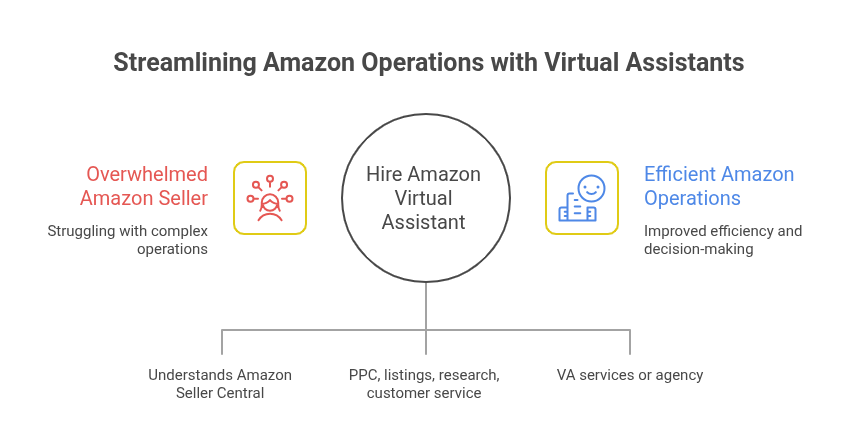
Managing an Amazon business involves far more than uploading products and waiting for sales. Sellers must continuously optimize listings, manage inventory, monitor advertising campaigns, respond to customers, track competitors, and analyze performance data. As stores grow, these responsibilities can quickly consume valuable time and limit business expansion.

An Amazon virtual assistant helps sellers delegate operational tasks while maintaining efficiency, accuracy, and profitability. Whether you are launching your first Amazon FBA business or scaling an established brand, understanding how an Amazon virtual assistant works can help you streamline operations and focus on growth.

In modern eCommerce operations, delegation has become a standard strategy for improving efficiency and scalability. Business research platforms such as Investopedia explain that outsourcing allows companies to reduce operational burden while focusing on core business activities, especially when tasks become repetitive or require specialized skills.

This guide explains responsibilities, benefits, costs, and hiring strategies for a virtual assistant Amazon workflow.

Amazon Virtual Assistant

What Is an Amazon Virtual Assistant?

An Amazon virtual assistant is a remote professional who helps Amazon sellers manage and optimize different areas of their eCommerce operations. As selling on Amazon becomes more competitive, many businesses rely on specialized virtual assistants to handle time-consuming tasks, improve listing performance, and support daily marketplace management.

Definition and Role

An Amazon virtual assistant is a trained remote specialist who supports sellers with essential Amazon-related activities such as product listing optimization, keyword research, PPC management, competitor analysis, inventory monitoring, order management, and customer service. Their role is to help sellers improve efficiency, maintain account performance, and focus more on business growth rather than repetitive operational tasks.

How Amazon VAs Differ From Traditional Virtual Assistants

Unlike general virtual assistants who handle broad administrative tasks, an Amazon VA specialist has specific knowledge of ecommerce workflows and Amazon’s selling environment. They are familiar with tools and processes such as Amazon Seller Central, product research methods, keyword optimization, listing guidelines, advertising campaigns, and marketplace performance metrics.

This specialized knowledge allows Amazon VAs to provide more strategic support compared to traditional assistants. They understand how different tasks impact search visibility, conversions, sales performance, and overall account health.

Types of Amazon Virtual Assistants

Amazon virtual assistants can specialize in different areas depending on a seller’s needs. Some focus on PPC management, helping create and optimize advertising campaigns, while others specialize in listing optimization, including keyword research, product descriptions, and backend search terms. There are also Amazon VAs focused on operations, customer support, inventory management, and product research.

Many sellers choose to use Amazon VA services or work with an Amazon VA agency to access trained professionals, structured workflows, and ongoing support. This approach allows businesses to scale operations more efficiently while ensuring critical marketplace tasks are handled by specialists.

Double your productivity and scale your business by outsourcing repetitive administrative workflows to trained remote professionals.

STREAMLINE YOUR WORKFLOW

Why Amazon Sellers Hire Virtual Assistants

Managing an Amazon business requires more than simply creating product listings and processing orders. Sellers must continuously monitor inventory, optimize listings, manage advertising campaigns, respond to customers, analyze competitors, and adapt to changing marketplace trends. As operations become more complex, many sellers turn to Amazon virtual assistants to improve efficiency and maintain consistent business performance.

Increasing Operational Complexity

Amazon operations involve multiple moving parts that require regular attention and specialized knowledge. Sellers need to manage tasks such as product research, keyword optimization, PPC campaigns, inventory tracking, review monitoring, and account health management. An Amazon virtual assistant helps handle these responsibilities, ensuring important tasks are completed accurately and consistently.

Time Constraints

Running an Amazon store can quickly become overwhelming, especially as sales volume and product catalogs grow. Many sellers struggle to balance daily operations with strategic activities such as expanding product lines, improving marketing strategies, and growing revenue. By delegating repetitive and time-consuming tasks to an Amazon VA, sellers can focus on higher-value decisions while maintaining smooth operations.

Need for Expertise

Amazon’s marketplace requires specific skills and knowledge to achieve long-term success. A trained Amazon virtual assistant understands Seller Central, listing optimization, keyword research, advertising tools, and marketplace best practices. Their expertise helps sellers improve workflows, make data-driven decisions, reduce costly mistakes, and maximize growth opportunities.

Hiring an Amazon VA allows sellers to access specialized support without the expense of building a large in-house team. Whether through individual professionals or Amazon VA services, sellers can gain the flexibility and expertise needed to scale their businesses more efficiently.

Amazon Virtual Assistant

Key Benefits of Hiring an Amazon Virtual Assistant

Hiring an Amazon virtual assistant allows sellers to delegate time-consuming marketplace tasks while focusing on business growth and strategy. As Amazon operations become more complex, a skilled VA can provide specialized support that improves efficiency, accuracy, and overall store performance.

Hiring an Amazon virtual assistant provides:

  • More time for strategy – Sellers can focus on product expansion, marketing decisions, and long-term growth instead of spending hours managing daily operations.
  • Better listing optimization – An experienced Amazon VA can improve product titles, descriptions, keywords, and backend search terms to increase visibility and conversions.
  • Reduced operational workload – Delegating repetitive tasks helps sellers manage their workload more efficiently and prevents operational bottlenecks.
  • Improved customer satisfaction – Faster responses, better order management, and consistent communication help create a stronger customer experience.
  • Scalable business operations – Amazon VA services allow sellers to increase support as their business grows without immediately hiring additional in-house employees.

Using Amazon VA services ensures more consistent task management and helps sellers maintain better performance across different areas of their Amazon business.

Tasks an Amazon Virtual Assistant Can Handle

An Amazon virtual assistant can support various aspects of marketplace management, from daily operations to growth-focused activities. By handling specialized tasks, Amazon VAs help sellers improve productivity while maintaining better control over their store performance.

An Amazon virtual assistant manages:

  • Product listing optimization – Improving titles, bullet points, descriptions, images, and keywords to increase search visibility and conversion potential.
  • Keyword research – Identifying relevant search terms and competitor keywords to improve organic rankings and product discoverability.
  • Inventory tracking – monitoring stock levels, identifying inventory issues, and helping prevent stockouts or overstocking.
  • Customer service – Managing buyer messages, addressing common concerns, and supporting better customer experiences.
  • PPC campaign support – Assisting with campaign monitoring, keyword analysis, bid adjustments, and performance tracking.
  • Competitor analysis – Researching competitors’ pricing, listings, reviews, and strategies to identify opportunities.
  • Reporting and analytics – Preparing performance reports and analyzing sales, advertising, and operational data.

These Amazon VA services help sellers improve efficiency, make better decisions, and increase profitability.

Amazon Virtual Assistant vs General Virtual Assistant

A general virtual assistant typically handles broad administrative responsibilities such as scheduling, email management, and basic data entry. An Amazon virtual assistant, however, specializes in eCommerce operations and understands the specific systems and processes required to manage an Amazon store.

A trained Amazon VA understands areas such as SEO, PPC advertising, keyword optimization, product research, and Amazon Seller Central. This specialized knowledge makes Amazon VA services more effective for sellers who need marketplace-specific support rather than general administrative assistance.

Signs It’s Time to Hire an Amazon VA

Many sellers reach a point where managing every aspect of their Amazon business becomes difficult and limits growth. Hiring an Amazon virtual assistant can help improve efficiency when operational demands begin affecting sales performance and strategic planning.

You need an Amazon virtual assistant if:

  • You spend more time managing than growing – Daily operational tasks prevent you from focusing on expansion and business strategy.
  • Customer response times are slow – Delayed responses can affect customer satisfaction, reviews, and account performance.
  • Inventory problems increase – Poor inventory tracking can lead to missed sales opportunities or unnecessary storage costs.
  • PPC campaigns underperform – Advertising requires ongoing monitoring and optimization to maintain profitability.

At this stage, Amazon VA services or an Amazon VA agency can provide the specialized support needed to improve operations and scale effectively.

Essential Skills to Look For

A strong Amazon virtual assistant should have a combination of technical knowledge, marketplace experience, and analytical skills. These abilities allow them to handle Amazon-related responsibilities efficiently and contribute to better business outcomes.

A strong Amazon virtual assistant should have:

  • Seller Central experience – Familiarity with Amazon’s seller dashboard, listing management, reports, and account functions.
  • PPC knowledge – Understanding of Amazon advertising campaigns, keywords, bids, and performance metrics.
  • Keyword research skills – Ability to identify search terms that improve product visibility.
  • Data analysis ability – Capability to interpret sales data, advertising results, and performance trends.
  • Inventory management experience – Knowledge of stock monitoring and inventory planning processes.

These skills define effective Amazon VA performance and help sellers achieve stronger marketplace results.

How to Hire an Amazon Virtual Assistant

Hiring the right Amazon VA requires a clear process to ensure you find someone with the necessary skills and experience. A structured approach helps sellers avoid costly hiring mistakes and build reliable long-term support.

Steps include:

  • Define needs – Identify which tasks you want to delegate and the type of support required.
  • Create a task list – Clearly outline responsibilities, expectations, and required skills.
  • Assess skills – Review experience, technical knowledge, and familiarity with Amazon tools.
  • Interview candidates – Evaluate communication, problem-solving ability, and marketplace understanding.
  • Run trial tasks – Test practical skills before making a long-term commitment.

Many sellers choose an Amazon VA agency to access pre-vetted professionals and structured Amazon VA services.

Amazon Virtual Assistant Pricing and Costs

The cost of hiring an Amazon virtual assistant depends on experience level, responsibilities, location, and the hiring model. Some sellers choose freelancers for lower costs, while others prefer agencies for reliability, management support, and access to trained specialists.

Freelancers may offer more affordable pricing, while Amazon VA services from agencies often provide stronger continuity, backup support, and structured processes. A skilled Amazon virtual assistant can deliver strong ROI by saving time, improving operations, and helping sellers increase revenue opportunities.

How to Onboard and Train an Amazon VA

Proper onboarding helps an Amazon VA understand your business processes, brand standards, and operational expectations. A clear training system reduces mistakes and allows the assistant to become productive faster.

Onboarding includes:

  • SOP documentation – Creating step-by-step instructions for recurring tasks.
  • Task assignment – Defining responsibilities and priorities.
  • Communication setup – Establishing tools, reporting methods, and update schedules.
  • Reporting systems – Creating performance tracking and accountability processes.

Proper onboarding ensures smooth Amazon VA integration and improves long-term productivity.

Managing Amazon Virtual Assistants Effectively

Effective management helps Amazon VAs stay aligned with business goals and maintain consistent performance. Regular communication, clear expectations, and ongoing improvement are essential for successful collaboration.

Management includes:

  • Weekly reviews – Evaluating progress, challenges, and completed tasks.
  • Task tracking tools – Monitoring workload and deadlines.
  • Goal setting – Establishing measurable performance objectives.
  • Continuous training – Keeping skills updated with Amazon changes and best practices.

Strong Amazon VA services improve accountability, efficiency, and overall output.

KPIs and Success Metrics

Tracking performance helps sellers understand the impact of their Amazon virtual assistant and identify areas for improvement. The right metrics provide insight into productivity, marketplace performance, and business growth.

Track your Amazon virtual assistant using:

  • Conversion rate – Measures how effectively listings turn visitors into buyers.
  • Click-through rate – Shows how well listings and ads attract customer attention.
  • ACoS and ROAS – Evaluate PPC campaign profitability and advertising efficiency.
  • Inventory turnover – Measures how effectively products move through inventory.
  • Response time – Tracks customer service efficiency and communication speed.

These KPIs help measure the effectiveness of Amazon VA services and ensure tasks contribute to business goals.

Common Challenges and How to Avoid Them

While Amazon VAs provide valuable support, businesses may face challenges without proper systems and communication processes. Addressing these issues early helps maintain productivity and protect business operations.

Challenges include:

  • Poor communication – Lack of clear updates can lead to misunderstandings and missed tasks.
  • Lack of SOPs – Without proper instructions, quality and consistency may suffer.
  • Inconsistent reporting – Limited visibility into performance can make management difficult.
  • Security risks – Improper access control can expose sensitive business information.

An Amazon VA agency can help reduce these risks by providing structured Amazon VA services, trained professionals, and established management processes.

Why Outsourcing Amazon Operations Is Growing

More sellers are outsourcing Amazon operations as competition increases and marketplace management becomes more demanding. Instead of handling every task internally, businesses are using Amazon virtual assistants to access specialized skills while controlling costs.

Outsourcing using an Amazon virtual assistant is growing due to:

  • Access to global talent – Sellers can work with skilled professionals from different regions.
  • Lower operational costs – Outsourcing reduces the need for additional in-house employees.
  • Business scalability – Support can increase as sales volume and responsibilities grow.
  • Competitive advantage – Sellers can focus on strategy while experts manage operational tasks.

Many sellers now rely on an Amazon VA agency for consistent Amazon VA services that support efficiency, growth, and long-term marketplace success.

Conclusion

An Amazon virtual assistant is a powerful asset for sellers aiming to scale efficiently. Whether through freelancers or an Amazon VA agency, structured Amazon VA services reduce workload and improve performance.

A well-trained Amazon professional virtual assistant helps transform daily operations into a scalable, efficient system that supports long-term growth.

FAQ

1. Can Amazon Virtual Assistants work in different time zones?

Yes, most Amazon virtual assistants are flexible and can work across time zones. This allows sellers to maintain 24-hour operations and faster customer response times using structured Amazon VA services.

2. What industries besides Amazon use virtual assistants?

While this guide focuses on Amazon, virtual assistants are also used in real estate, healthcare administration, eCommerce, and marketing. However, virtual assistant Amazon specialists are uniquely trained for marketplace operations.

3. How do I measure if my Amazon VA is performing well?

Performance is measured using KPIs such as conversion rates, ACoS, response time, and inventory accuracy. High-quality Amazon VA services will show measurable improvements in these areas.

4. Can I scale multiple stores with one Amazon VA?

Yes, but the workload depends on complexity. A skilled Amazon virtual assistant can manage multiple stores if systems and processes are well structured through clear Amazon VA services.

Top 10 Amazon SEO Providers in 2026

Top 10 Amazon Seo Providers In 2026

Amazon has become one of the most competitive digital marketplaces, where product visibility directly determines sales performance. Sellers who fail to optimize their listings often struggle to gain traction even with high-quality products. This is why structured optimization through Amazon listing services has become essential for long-term growth.

Success in online marketplaces depends heavily on how product information is structured and how effectively it supports customer decision-making. Research in consumer behavior shows that the perceived quality of product information significantly influences trust and purchase intention in digital environments.

The demand for Amazon product listing services continues to grow as sellers recognize the importance of professional optimization. Businesses now rely on specialists to improve ranking, increase conversions, and maintain consistent visibility. In this article, we explore the top providers and what defines a strong Amazon listing service provider in 2026.

Amazon product listing services

What Is an Amazon SEO Agency and Why Brands Hire Them?

An Amazon SEO agency specializes in improving product visibility and discoverability within Amazon’s search ecosystem. Unlike traditional SEO, Amazon SEO focuses on optimizing product listings based on factors that influence marketplace rankings, including keyword relevance, conversion rates, customer behavior, and listing quality. These agencies help brands improve their chances of appearing in front of more potential buyers while creating a better shopping experience.

Brands invest in Amazon listing services because organic visibility on the marketplace can directly influence sales performance. Even high-quality products can struggle to generate revenue if they are not optimized for Amazon’s search algorithm and are difficult for customers to find. Proper optimization helps improve rankings, increase traffic, and create stronger opportunities for conversions.

A reliable Amazon listing service provider typically supports key optimization activities such as keyword research, competitor analysis, product title improvement, bullet point optimization, backend search term management, image enhancements, and listing restructuring. Many providers also conduct conversion testing and performance analysis to identify areas where listings can generate better results.

Businesses often choose Amazon product listing services when they do not have specialized marketplace expertise internally or when they need to optimize multiple products at scale. By working with experienced professionals, brands can maintain consistent listing quality, adapt to algorithm changes, and improve overall Amazon performance.

Quick Comparison Table: Top 10  Amazon SEO Providers

Provider Strength Best For Pricing
Amazon Listing Services End-to-end service Global sellers Flexible
Jungle Scout Product research Beginners Low-Medium
Viral Launch Ranking boosts Launches Medium
AMZ Pathfinder Full funnel Scaling brands High
SellerApp Analytics SMEs Medium
Incrementum CRO Conversion-focused brands High
Thrive Agency scale Enterprises High
Disruptive Ads PPC integration Competitive niches High
eCom Engine Catalog ops Large inventories Medium
Seller Interactive Growth Strategy Product Marketing Medium

How We Evaluated the Amazon SEO Providers

To identify the most effective Amazon SEO providers, we evaluated each professional Amazon listing service using a structured framework focused on expertise, performance, scalability, and long-term results. Since Amazon’s marketplace is constantly changing, providers were assessed not only on their ability to optimize product listings but also on how effectively they support ongoing growth and adapt to algorithm updates.

The evaluation criteria are:

Amazon Marketplace Expertise

We assessed each provider’s understanding of Amazon’s search ecosystem, ranking factors, buyer behavior, and marketplace requirements. Providers with deeper Amazon expertise are better equipped to improve product visibility and develop strategies that align with how customers search and purchase.

SEO and Ranking Capabilities

We reviewed their ability to perform keyword research, optimize product titles, enhance bullet points, manage backend search terms, and improve listing structures. Strong SEO capabilities help products achieve better organic visibility and increase the likelihood of higher rankings.

Client Portfolio and Case Studies

We considered previous client experience, industry results, and demonstrated success in improving product performance. Case studies provide insight into how effectively a provider applies optimization strategies in real Amazon selling environments.

Service Scope and Scalability

We evaluated whether providers offer comprehensive Amazon listing services beyond basic optimization, including competitor analysis, conversion improvement, catalog management, and ongoing monitoring. Scalability was also considered to determine whether they can support brands with multiple products or expanding catalogs.

Industry Specialization

Different product categories require different optimization approaches due to varying competition, customer expectations, and compliance requirements. Providers with experience in specific industries may offer more targeted strategies for improving marketplace performance.

Reporting Transparency

We reviewed whether providers offer clear reporting, performance tracking, and actionable insights. Transparent reporting helps brands understand ranking improvements, traffic changes, conversion performance, and areas for further optimization.

We also assessed how each Amazon listing service provider responds to Amazon algorithm changes and whether they provide continuous optimization rather than one-time listing creation. Ongoing updates, keyword refinement, performance monitoring, and strategic adjustments are essential for maintaining visibility and competitiveness in the marketplace.

Maximize organic visibility with data-driven Amazon listing services.

Choose A Web Partner

Top 10 Amazon SEO Providers in 2026

Choosing the right Amazon SEO provider is essential for brands looking to improve product visibility, increase conversions, and compete effectively in Amazon’s crowded marketplace. The best providers go beyond basic listing creation by combining keyword research, competitor analysis, conversion optimization, catalog management, and performance tracking. While each Amazon listing service provider has different strengths, the right choice depends on a brand’s goals, product category, catalog size, and level of marketplace support required.

1. Amazon Listing Service

Amazon Listing Service specializes in professional Amazon listing optimization designed to improve product visibility, search rankings, and conversion performance. Its services focus on key areas such as keyword research, product title optimization, bullet point enhancement, backend search term optimization, image improvement, and catalog management. The company helps brands strengthen their Amazon presence by creating data-driven listings that are optimized for both Amazon’s search algorithm and customer buying behavior.

This makes Amazon Listing Service a strong option for businesses looking for dedicated Amazon product listing support, especially brands that need assistance improving existing listings, managing product catalogs, and scaling optimization efforts across multiple products.

2. Jungle Scout Agency Solutions

Jungle Scout Agency Solutions focuses on helping brands improve product research, market validation, and listing performance. The platform’s approach combines product insights with listing structure improvements to help sellers create more competitive product pages. It is particularly useful for businesses that need support identifying market opportunities and optimizing listings based on customer demand and competitor activity.

3. Viral Launch Services

Viral Launch specializes in Amazon growth strategies, including product launch support, keyword optimization, and ranking improvement initiatives. Its services are designed to help brands increase product visibility during launch periods and build stronger organic rankings over time. The provider focuses on combining market intelligence with optimization strategies to help sellers gain traction in competitive categories.

4. AMZ Pathfinder

AMZ Pathfinder provides a more comprehensive Amazon optimization approach that connects SEO efforts with conversion improvement strategies. Its services typically focus on improving listing quality, enhancing customer engagement, and aligning product pages with buyer search behavior. This makes it suitable for brands looking for a full-funnel approach that considers both traffic generation and sales performance.

5. SellerApp Optimization Team

SellerApp offers analytics-driven Amazon listing services focused on improving product performance through data insights. Its optimization process includes keyword analysis, listing improvements, competitor research, and performance monitoring. Brands can use SellerApp’s approach to identify areas affecting visibility and conversion rates while making more informed optimization decisions.

6. Incrementum Digital

Incrementum Digital specializes in Amazon growth strategies with a strong focus on conversion optimization and listing improvements. The company helps brands refine product content, enhance customer experience, and improve listing effectiveness. Its services are designed for businesses that want to optimize existing listings and create stronger opportunities for increased sales.

7. Thrive Internet Marketing Amazon Division

Thrive Internet Marketing’s Amazon division provides scalable Amazon product listing services designed to support growing brands. Its approach combines marketplace optimization with broader digital marketing strategies to improve product discoverability and customer engagement. This makes it a potential fit for businesses looking for Amazon support alongside wider online marketing efforts.

8. Disruptive Advertising Amazon Team

Disruptive Advertising combines Amazon advertising expertise with listing optimization strategies to help brands improve both paid and organic performance. By connecting advertising insights with product page improvements, the team helps businesses identify opportunities to increase conversions and maximize marketing efficiency. This integrated approach is valuable for brands investing heavily in Amazon PPC and marketplace growth.

9. eCom Engine Services

eCom Engine focuses on Amazon catalog management, listing organization, and bulk optimization for brands managing larger product inventories. Its services are designed to improve catalog accuracy, streamline product updates, and maintain consistent listing quality across multiple SKUs. This makes it useful for businesses that require efficient management of extensive Amazon product catalogs.

10. Seller Interactive

Seller Interactive provides comprehensive Amazon listing services focused on improving product visibility, conversion rates, and overall marketplace performance. The company supports brands with listing optimization, keyword research, catalog management, competitor analysis, and Amazon account support to help improve organic rankings. Its services are designed for businesses looking for ongoing Amazon growth strategies rather than one-time listing adjustments.

Each Amazon listing service provider offers different capabilities depending on specialization, pricing structure, industry experience, and execution depth. Brands should evaluate providers based on their specific Amazon goals, whether that involves improving rankings, increasing conversions, managing large catalogs, or building a long-term marketplace growth strategy.

Conclusion

The Amazon marketplace is increasingly competitive, making optimization essential for sustained growth. Businesses that invest in Amazon listing services gain a measurable advantage in visibility and conversions.

As competition increases, Amazon product listing services become critical for maintaining ranking stability and improving discoverability.

Choosing the right Amazon listing service provider is a strategic decision, while a professional Amazon listing service ensures long-term optimization and scalable performance.

FAQs

1. How does Amazon SEO differ from traditional website SEO?

Amazon SEO focuses on conversion-driven ranking factors such as sales velocity, click-through rate, and relevance within the marketplace, whereas traditional SEO prioritizes backlinks and domain authority.

2. Do Amazon listing services improve new product launches?

Yes. Optimized listings help new products gain early visibility by improving keyword alignment and conversion signals during the critical launch phase.

3. Can Amazon SEO improve long-term brand growth?

Yes. Consistent optimization builds stronger organic rankings, which reduces dependency on paid ads and improves long-term profitability.

4. What role do keywords play in Amazon listings?

Keywords help Amazon’s algorithm match products to customer searches. Proper placement improves relevance, visibility, and ultimately conversion rates.

Everything You Need to Know About Amazon Marketplace Management Services

Everything You Need To Know About Amazon Marketplace Management Services

Selling on Amazon has evolved into a highly competitive ecosystem where success depends on strategy, optimization, and continuous management. Businesses often struggle to keep up with listing updates, advertising performance, inventory control, and policy compliance.
Amazon Marketplace Management Services
This is where marketplace management services become essential. These services help sellers streamline operations, improve visibility, and increase profitability across Amazon’s ecosystem.

According to research on digital commerce transformation and evolving consumer behavior, businesses that adopt structured marketplace strategies and data-driven optimization are better positioned to scale efficiently and sustain long-term performance improvements:

Businesses that invest in Amazon Marketplace services gain structured operational support that helps them scale more efficiently and reduce costly errors.

Amazon Marketplace Management Services

What Are Amazon Marketplace Management Services?

Amazon marketplace management services refer to end-to-end solutions designed to manage and optimize a seller’s overall Amazon operations. These services cover a wide range of activities, including product listing optimization, keyword research, pricing strategy, inventory monitoring, customer service support, advertising management, and performance tracking. By handling these critical functions, providers help brands maintain a more efficient and competitive presence within Amazon’s marketplace.

An Amazon marketplace management service acts as an operational partner that supports sellers in improving marketplace performance while ensuring compliance with Amazon’s seller requirements and performance standards. These services help optimize product visibility, increase organic rankings, improve conversion rates, and create a more consistent customer experience.

Businesses increasingly use marketplace management services because managing Amazon operations requires continuous monitoring, data analysis, and strategic adjustments. By outsourcing these responsibilities, sellers can reduce operational complexity, improve efficiency, and focus more on business growth while experienced professionals handle day-to-day marketplace execution.


Streamline your product catalog with Amazon Marketplace management services.

STREAMLINE AMAZON OPERATIONS

How Amazon Marketplace Management Services Work

Amazon marketplace management services typically begin with a comprehensive account analysis and marketplace audit. During this stage, providers assess current performance, identify operational inefficiencies, and uncover growth opportunities. This evaluation serves as the foundation for developing a customized marketplace optimization strategy.

The initial audit often includes:

  • Product listing quality assessment
  • Keyword performance analysis
  • Competitor and category benchmarking
  • Advertising campaign evaluation
  • Account health review
  • Inventory and fulfillment analysis

Once performance gaps and optimization opportunities are identified, Amazon marketplace management services implement targeted improvements designed to increase visibility and conversions. These optimizations help align product listings with Amazon's search algorithm while improving the overall customer shopping experience.

Common optimization activities include:

  • Product title optimization
  • Bullet point restructuring
  • Product description enhancements
  • Image and creative improvements
  • Backend search term optimization
  • Catalog organization and variation management
  • Pricing and promotion strategy adjustments

Following implementation, providers shift their focus to ongoing account management and performance monitoring. Amazon's marketplace is highly dynamic, requiring continuous adjustments to maintain competitiveness and adapt to algorithm changes.

Ongoing management typically includes:

  • PPC campaign optimization
  • Inventory monitoring and forecasting
  • Account health management
  • Performance tracking and reporting
  • Customer service oversight
  • Competitive analysis
  • Conversion rate optimization

By combining strategic optimization with continuous operational support, Amazon Marketplace services help sellers improve visibility, increase sales performance, and maintain long-term marketplace growth. This ongoing cycle of analysis, optimization, and monitoring ensures that marketplace strategies remain aligned with changing customer behavior and Amazon's evolving platform requirements.

Amazon Marketplace Management Services vs Self-Managed Selling

For Amazon sellers, one of the most important decisions is whether to manage marketplace operations internally or work with a professional Amazon marketplace management service provider. Both approaches have advantages, but they differ significantly in terms of expertise, resource requirements, scalability, and long-term operational efficiency. Understanding these differences can help businesses choose the model that best aligns with their goals and available resources.


Factor Amazon Marketplace Management Services Self-Managed Selling
Expertise Provides access to specialists in Amazon SEO, PPC advertising, catalog management, inventory planning, and account optimization. Relies on the seller's internal knowledge and ability to stay current with Amazon best practices and platform changes.
Time Commitment Reduces the amount of time business owners and internal teams spend on daily marketplace operations. Requires significant ongoing involvement in listing updates, advertising management, inventory monitoring, and compliance tasks.
Listing Optimization Professional teams continuously optimize product titles, keywords, images, and content to improve visibility and conversions. Optimization depends on internal resources and may be performed less frequently due to competing priorities.
Advertising Management Dedicated specialists manage PPC campaigns, bidding strategies, budget allocation, and performance analysis. Sellers must create, monitor, and optimize advertising campaigns themselves.
Inventory Management Ongoing monitoring helps reduce stockouts, excess inventory, and fulfillment-related issues. Inventory planning and forecasting must be handled internally, which can become challenging as sales volumes increase.
Scalability Designed to support business growth, larger catalogs, and expanding product portfolios. Scaling operations often requires additional staff, training, and internal systems.
Cost Structure Involves management fees but provides access to specialized expertise and operational support. Lower direct costs initially but may require significant investments in staffing, software, and training over time.
Performance Monitoring Includes regular reporting, analytics, and strategic recommendations based on marketplace data. Reporting and analysis depend on the seller's available tools, expertise, and time.


Self-managed selling offers complete control over Amazon operations and may be suitable for smaller sellers with limited product catalogs or strong in-house marketplace expertise. However, managing SEO, advertising, inventory, customer experience, and compliance internally can become increasingly complex as a business grows.

In contrast, Amazon marketplace management services provide specialized knowledge, established processes, and ongoing optimization designed to improve operational performance. While outsourcing may involve higher upfront costs, many businesses find that professional management delivers greater efficiency, stronger marketplace visibility, and improved scalability over the long term. Ultimately, the best choice depends on a company's growth objectives, internal capabilities, and willingness to dedicate resources to Amazon marketplace management.

Fully Managed vs Unmanaged Amazon Marketplace Operations

Businesses selling on Amazon can either outsource marketplace management to a specialized provider or handle all operations internally. Each approach offers distinct advantages and challenges depending on a company's resources, expertise, and growth objectives. Understanding the differences can help sellers determine which model best supports their long-term success.

Fully Managed Amazon Marketplace Operations

With a fully managed approach, an Amazon marketplace management service provider oversees most day-to-day marketplace activities on behalf of the seller.

Key characteristics include:

  • Complete operational support for Amazon marketplace activities
  • Product listing optimization and ongoing catalog management
  • Keyword research and SEO updates to improve visibility
  • PPC campaign management and optimization
  • Inventory monitoring and forecasting support
  • Account health management and compliance oversight
  • Performance tracking and reporting
  • Access to Amazon marketplace specialists and industry expertise
  • Scalable support as product catalogs and sales volumes grow

Best suited for brands seeking expert-driven execution, operational efficiency, and the ability to focus on broader business growth rather than daily marketplace management.

Unmanaged Amazon Marketplace Operations

With an unmanaged approach, the seller maintains full responsibility for all Amazon-related activities and decision-making.

Key characteristics include:

  • Full internal control over marketplace operations
  • In-house management of listings, content, and catalog updates
  • Self-managed keyword research and SEO efforts
  • Internal responsibility for PPC advertising
  • Direct oversight of inventory planning and fulfillment
  • Management of account health and compliance requirements
  • Internal reporting and performance analysis
  • Greater dependence on internal expertise and resources
  • Additional staffing and training may be required as the business grows

Best suited for smaller sellers, startups, or businesses with experienced internal teams that have the time and expertise to manage Amazon operations independently.

Which Approach Is Right?

  • Choose fully managed Amazon marketplace operations if you want specialized expertise, streamlined execution, and support for scaling your business.
  • Choose unmanaged Amazon marketplace operations if you prefer complete control and have the internal resources to manage Amazon activities effectively.
  • Many growing brands eventually adopt Amazon marketplace management services because they provide structure, consistency, and professional optimization across all marketplace functions. This often allows businesses to improve performance while freeing internal teams to focus on strategic initiatives.

Types of Amazon Marketplace Management Services

Effective Amazon marketplace management requires a combination of optimization, monitoring, and operational support to maintain strong performance. These services help sellers improve visibility, protect account health, manage operations, and maximize sales opportunities.

  • Listing and Catalog Management: Focuses on improving product data, optimizing keywords, and enhancing listings to increase search visibility and conversions. This includes updating titles, descriptions, images, backend keywords, and catalog information to align with Amazon’s ranking factors.
  • Security and Account Compliance Management: Ensures sellers follow Amazon’s policies, guidelines, and performance requirements to reduce the risk of account issues or suspensions. Providers monitor account health, compliance updates, and potential risks to help maintain a stable selling environment.
  • Monitoring and Performance Management: Tracks important marketplace metrics such as conversion rate, click-through rate (CTR), sales performance, and ACOS. Regular performance analysis helps identify improvement areas and allows sellers to make data-driven decisions.
  • Inventory and Order Management: Helps maintain proper inventory levels, prevent stockouts, and support smoother fulfillment operations. Effective inventory monitoring ensures products remain available while reducing the risk of overstocking or missed sales opportunities.
  • Advertising and Cost Optimization: Manages Amazon PPC campaigns by improving targeting, keyword selection, bidding strategies, and budget allocation. The goal is to increase advertising efficiency, improve return on ad spend (ROAS), and reduce unnecessary spending.

All of these functions work together as core components of marketplace management services, helping brands improve operational efficiency, maintain marketplace performance, and achieve sustainable Amazon growth.

While Amazon marketplace management services provide significant advantages, businesses should also consider potential challenges before partnering with a provider. Service costs can vary depending on the scope of support required, and some companies may experience concerns around relying on third-party teams for critical marketplace activities. Other considerations include differences in service quality, communication processes, and the level of control businesses maintain over daily execution.

Common challenges include:

  • Higher Service Costs: Professional marketplace management services require investment, which may be a consideration for smaller sellers with limited budgets. However, the cost can often be justified through improved efficiency, better optimization, and reduced operational workload.
  • Dependence on Third-Party Providers: Outsourcing marketplace operations means relying on an external team for important business functions. Choosing a reliable provider with strong communication and reporting processes helps minimize this risk.
  • Variability in Service Quality: Not all providers offer the same level of expertise, strategy, or execution quality. Businesses should evaluate experience, client results, and service capabilities before making a decision.
  • Limited Control Over Execution: Some sellers may feel they have less direct involvement in daily marketplace decisions. Clear communication, regular reporting, and defined responsibilities can help maintain visibility and alignment.
    Amazon Marketplace Management Services
    Despite these limitations, Amazon marketplace management services remain a valuable solution for businesses looking to scale operations, improve marketplace performance, and access specialized expertise.

These services are especially beneficial for:

  • Small businesses entering Amazon: New sellers can benefit from professional guidance when navigating listing optimization, advertising, compliance, and marketplace requirements.
  • Growing brands scaling operations: Businesses expanding their product lines can use marketplace management support to handle increased complexity and maintain consistent performance.
  • Enterprises managing large catalogs: Companies with extensive product inventories often require specialized support for catalog management, optimization, and performance tracking.
  • Sellers struggling with performance optimization: Brands experiencing low visibility, weak conversions, or inefficient advertising can benefit from expert analysis and improvement strategies.

When selecting an Amazon marketplace management service provider, businesses should evaluate factors such as:

  • Proven Amazon experience: Look for providers with demonstrated knowledge of Amazon’s marketplace ecosystem and proven results.
  • Transparent reporting systems: Reliable providers should offer clear performance tracking, analytics, and regular updates.
  • Advertising expertise: Strong PPC management capabilities are important for improving ad performance and controlling costs.
  • Listing optimization capability: Providers should have experience improving keywords, content, images, and product page performance.
  • Client success history: Reviewing case studies and previous results can help determine whether a provider can deliver measurable improvements.

The right Amazon marketplace management services partner should align with your business goals, operational requirements, and long-term growth strategy.

Conclusion

Amazon has become a highly competitive ecosystem where success depends on precision, optimization, and continuous management. Businesses that invest in marketplace management services gain a structured advantage in visibility, efficiency, and scalability.

Whether through listing optimization, advertising management, or account health monitoring, an Amazon marketplace management service helps sellers navigate complexity and improve performance.

As competition continues to grow, leveraging Amazon Marketplace services is no longer optional for serious sellers aiming for long-term success.

Frequently Asked Questions

1. Do Amazon marketplace management services guarantee sales growth?

No service can guarantee sales. However, structured optimization improves visibility, conversion rates, and advertising efficiency, which often leads to measurable performance improvements over time with consistent execution and strategy refinement.

2. Can these services manage international Amazon marketplaces?

Yes, many providers support global marketplaces. They help with localization, pricing strategies, and compliance requirements, making international expansion more manageable for sellers aiming to scale beyond their domestic market.

3. Are marketplace management services suitable for new sellers?

Yes, new sellers benefit significantly because these services reduce early-stage mistakes. They help establish strong listings, optimize product visibility, and ensure compliance from the beginning of the selling journey.

4. What metrics are most important in Amazon marketplace management?

Key metrics include conversion rate, click-through rate, advertising cost of sales, inventory turnover, and account health score. These indicators help measure performance and guide optimization strategies effectively.

Why Your Amazon Products Aren’t Ranking (And How to Fix It)

Why Your Amazon Products Aren't Ranking (and How To Fix It)

Amazon is one of the most competitive search engines in eCommerce, and ranking on page one requires more than keyword placement. Modern Amazon ranking systems depend on relevance, conversion behavior, and listing quality signals that determine visibility and sales performance.

To succeed in this environment, sellers increasingly rely on amazon seo services to improve listing structure, keyword targeting, and conversion performance. Without proper optimization, even strong products fail to gain visibility.

Amazon Products Aren't Ranking

How Amazon Search Rankings Actually Work

Amazon’s search ranking system is designed to connect shoppers with products that are most likely to meet their needs and generate successful purchases. Industry professionals often refer to this system as A9 or A10, although Amazon has not officially confirmed these as separate algorithms. Instead, Amazon’s ranking process focuses on two main priorities: product relevance and customer conversion performance.

Across industry research and marketplace analysis, the common conclusion is that Amazon does not rank products based on keywords alone. While keywords help Amazon understand what a product is and when it should appear in search results, ranking performance depends heavily on how customers interact with the listing.

Amazon rankings are influenced by factors such as:

  • Keyword Relevance: Proper keyword optimization helps Amazon index a product and match it with relevant customer searches. Without strong keyword alignment, even high-quality products may struggle to appear for the right search terms.
  • Conversion Performance: Amazon rewards listings that consistently turn visitors into buyers. Factors such as product page quality, pricing, reviews, images, and customer experience can influence conversion rates.
  • Sales History and Velocity: Products with consistent sales performance are more likely to maintain stronger rankings over time. A stable sales history signals to Amazon that the product is valuable and relevant to shoppers.
  • Customer Engagement Signals: Click-through rates, customer interactions, reviews, and overall shopping behavior can impact how Amazon evaluates product performance.

This is why sellers invest in Amazon search engine optimization strategies that go beyond keyword stuffing. Effective Amazon SEO combines keyword targeting, listing optimization, conversion improvement, and ongoing performance management to build stronger organic visibility.

Understanding Relevance and Conversion Signals

Amazon’s search algorithm evaluates products based on multiple signals that determine both visibility and ranking performance. Two of the most important factors are relevance and conversion, which work together to decide whether a product appears in search results and continues to maintain its position. A well-optimized listing must not only match customer search intent but also encourage shoppers to take action and complete a purchase.

Relevance helps Amazon understand what your product is, who it is for, and which searches it should appear for. Conversion signals show Amazon whether customers find the product valuable after clicking on the listing. A product that performs well in both areas has a stronger chance of achieving and maintaining higher organic rankings.

Relevance factors include:

  • Keyword placement in titles and bullet points: Strategic keyword usage helps Amazon identify the product’s purpose and match it with relevant customer searches.
  • Backend search terms: Hidden keywords provide additional opportunities for indexing without affecting the visible customer-facing content.
  • Category alignment: Proper product categorization helps Amazon place listings in the correct search environments and reach more relevant shoppers.

Conversion factors include:

  • Click-through rate (CTR): A strong CTR indicates that shoppers find the product appealing when it appears in search results.
  • Conversion rate (CVR): A higher conversion rate signals that the listing effectively turns visitors into buyers.
  • Reviews and ratings: Positive customer feedback builds trust and can influence purchasing decisions.
  • Price competitiveness: Competitive pricing can improve conversion potential by making products more attractive compared to similar offers.

This is where Amazon SEO Optimization becomes critical because even small improvements in listing structure, content quality, and keyword strategy can significantly impact both CTR and CVR. If a listing is relevant but fails to convert, Amazon may gradually reduce its visibility because the product is not generating the expected customer response. Conversely, optimized listings that consistently attract and convert shoppers are more likely to achieve stronger long-term rankings.

Partner with an Amazon SEO specialist to drive sustainable sales velocity.

REQUEST AN SEO AUDIT

Key Ranking Signals Amazon Uses

Amazon’s search ranking system evaluates multiple signals to determine which products appear higher in search results. These signals go beyond keyword usage and include factors related to product relevance, sales performance, customer satisfaction, and traffic quality. Understanding these ranking factors helps sellers create stronger Amazon SEO strategies that improve visibility and long-term performance.

Based on combined insights from Aura and Amalytix, Amazon’s ranking signals can be grouped into four main categories:

Relevance Signals: Keyword indexing and Search term match quality.

  • Relevance signals help Amazon determine whether a product matches a shopper’s search intent. Proper keyword placement and optimized listing content improve the chances of appearing for relevant customer searches.

Performance Signals: Sales velocity and Conversion rate.

  • Performance signals measure how effectively a product generates sales after receiving traffic. Products with consistent sales activity and strong conversion rates are more likely to maintain higher search visibility.

Customer Experience Signals: Reviews, return rate, and product satisfaction.

  • Amazon considers customer experience when evaluating product quality and reliability. Positive reviews, lower return rates, and strong customer satisfaction indicate that a product provides value to shoppers.

Traffic Quality Signals: External traffic and organic vs paid sales ratio.

  • Traffic quality shows Amazon how effectively a product attracts and converts visitors from different sources. Strong external traffic and healthy sales performance can support improved ranking potential.

This is why working with an Amazon SEO specialist often delivers faster results than basic DIY optimization. Specialists understand how these ranking signals interact and can develop strategies that improve visibility, conversions, and overall marketplace performance.

Amazon SEO vs Listing Optimization

Many sellers use the terms Amazon SEO and listing optimization interchangeably, but they serve different purposes within an Amazon growth strategy. While both are essential for improving marketplace performance, they focus on different stages of the customer journey. Amazon SEO helps products get discovered, while listing optimization helps convince shoppers to purchase.

What Is Amazon SEO?

Amazon SEO focuses on improving a product’s visibility within Amazon search results by helping the algorithm understand product relevance. It involves strategies such as:

Keyword targeting
Identifying and placing relevant search terms that match customer intent.

Search visibility improvement
Increasing the chances of appearing for valuable customer searches.

Indexing optimization
Ensuring Amazon correctly understands and categorizes the product.

What Is Amazon Listing Optimization?

Amazon listing optimization focuses on improving the product page experience to increase conversions after shoppers discover the product. It includes:

Conversion-focused content
Creating compelling titles, bullet points, and descriptions that highlight product benefits.

Images and A+ content
Enhancing visual elements and brand content to improve customer understanding and trust.

Pricing and positioning
Ensuring the offer remains competitive compared to similar products in the marketplace.

Key Difference

Amazon SEO brings qualified traffic to a product listing, while optimization helps convert that traffic into sales. A product may rank well but still struggle if the listing does not persuade customers to buy.

This is why effective Amazon SEO services combine both technical SEO strategies and conversion optimization. The strongest results come from improving visibility while creating a product experience that encourages shoppers to complete a purchase.

Common Reasons Your Products Aren’t Ranking

Achieving higher rankings on Amazon requires more than simply creating a product listing and adding a few keywords. Amazon’s algorithm evaluates multiple performance signals, including relevance, customer engagement, sales activity, and overall shopping experience. When products fail to rank, it is often due to optimization gaps that prevent Amazon from recognizing their value and showing them to the right customers.

Most ranking failures come from predictable issues:

  • Poor Keyword Targeting: Using irrelevant or low-performing keywords can prevent products from appearing in the searches made by potential buyers.
  • Weak Product Titles: Titles that lack important keywords, clarity, or strong product information can reduce both search visibility and customer interest.
  • Incomplete Product Listings: Missing details, weak descriptions, or poorly optimized content can limit Amazon’s ability to understand the product and match it with shopper searches.
  • Low Conversion Rates: Even if a product receives traffic, poor conversions signal to Amazon that shoppers may not find the listing valuable or relevant.
  • Insufficient Reviews: A lack of customer feedback can reduce buyer trust and make it harder for products to compete with established listings.
  • Poor Product Images: Low-quality or unclear images can negatively impact click-through rates and purchasing decisions.
  • Inventory Stockouts: Frequent availability issues can interrupt sales history and weaken ranking performance.
  • Low Sales Velocity: Products with limited or inconsistent sales activity may struggle to maintain strong search positions.

These issues directly affect Amazon SEO Optimization effectiveness because Amazon considers customer engagement and sales performance when determining rankings. When a listing receives low clicks, weak conversions, or limited sales activity, the algorithm may interpret this as reduced relevance and gradually decrease visibility.

How to Fix Amazon Ranking Issues

Improving Amazon rankings requires a combination of keyword strategy, listing improvements, and conversion-focused optimization. Since Amazon evaluates products based on both relevance and customer behavior, sellers need to optimize every part of the buying journey, from search visibility to purchase decisions. The following actions can help improve ranking performance and strengthen overall marketplace visibility.

  • Conduct Keyword Research: Identify search terms that match customer intent instead of focusing only on high-volume keywords. Effective keyword research helps products appear for more relevant searches and attracts shoppers who are more likely to convert.
  • Optimize Product Titles: Place the most important and high-intent keywords near the beginning of the title while keeping the wording clear and customer-friendly. A well-structured title improves indexing while helping shoppers quickly understand the product.
  • Improve Bullet Points: Focus on customer benefits rather than simply listing product features. Strong bullet points should highlight solutions, use cases, and key selling points that encourage shoppers to continue exploring the listing.
  • Enhance Product Images: High-quality images can improve click-through rates and influence purchase decisions. Use clear visuals that showcase product details, usage scenarios, size, features, and value.
  • Optimize Backend Search Terms: Add keyword variations, synonyms, alternative phrases, and long-tail search terms that may not fit naturally into the visible listing content. This helps expand indexing opportunities without affecting the customer-facing copy.
  • Improve Pricing Strategy: Competitive pricing can increase the likelihood of conversions, especially when shoppers compare multiple similar products. Regularly analyzing competitor pricing and customer expectations can help maintain marketplace competitiveness.
  • Increase Reviews and Ratings: Positive reviews build trust and provide social proof that influences buyer decisions. Consistently delivering a good customer experience helps improve review quality and long-term product credibility.
  • Boost Conversion Rate: A strong conversion rate signals to Amazon that shoppers find the product relevant and valuable. Improving listing quality, pricing, images, and customer experience can reduce lost opportunities and increase sales velocity.

Many brands work with an Amazon SEO specialist to implement these improvements consistently, monitor ranking performance, and adjust strategies based on Amazon algorithm changes and marketplace trends. A continuous optimization approach is often more effective than making one-time listing updates.

Amazon SEO Optimization Throughout the Product Lifecycle

Amazon SEO is not a one-time activity completed when a product listing goes live. Effective optimization requires continuous adjustments throughout the product lifecycle, as ranking factors, customer behavior, competition, and sales goals change over time. Professional Amazon SEO services use a lifecycle-based approach to ensure products remain visible, competitive, and optimized at every stage of growth.
Amazon Products Aren 039 T Ranking

Launch Stage

The primary focus during the launch stage is improving product indexing and generating initial traffic. This includes optimizing keywords, building a strong listing structure, creating compelling content, and using early sales strategies to help Amazon understand product relevance.

Growth Stage

As the product gains traction, optimization shifts toward improving click-through rate (CTR), conversion rate (CVR), and expanding keyword reach. Sellers refine listings based on performance data, identify new ranking opportunities, and strengthen strategies to increase organic visibility.

Mature Stage

Once a product achieves stable rankings, the focus becomes maintaining performance and protecting market position. This involves monitoring competitors, updating keywords, improving profitability, managing advertising efficiency, and optimizing pricing strategies.

Reviving Declining Products

Products that experience ranking drops require targeted optimization to recover visibility and sales momentum. Common actions include improving conversion issues, refreshing listing content, updating keywords, enhancing images, and addressing factors that may reduce customer engagement.

This lifecycle approach is the foundation of effective Amazon SEO services, helping brands continuously adapt to marketplace changes and maintain long-term product performance rather than relying on short-term ranking improvements.

Amazon SEO Checklist

A successful Amazon SEO strategy requires multiple optimization elements working together to improve visibility, attract qualified shoppers, and increase conversions. Use this checklist to ensure your product listings are optimized for both Amazon’s search algorithm and customer buying behavior.

  • Keyword-Rich Product Title: Include relevant, high-intent keywords while keeping the title clear and customer-friendly. A well-optimized title helps Amazon understand product relevance and improves visibility for targeted searches.
  • Optimized Bullet Points: Create benefit-focused bullet points that highlight key product advantages, features, and solutions. Strong bullet points improve customer understanding and can positively influence conversion rates.
  • High-Quality Product Images: Use clear, professional images that showcase product details, usage, features, and value. Strong visuals improve click-through rates and help shoppers make confident purchase decisions.
  • Completed Backend Search Terms: Add relevant keyword variations, synonyms, and long-tail search terms that support product indexing. Backend optimization helps capture additional search opportunities without overcrowding visible content.
  • Competitive Pricing Strategy: Maintain pricing that aligns with customer expectations and marketplace competition. Competitive pricing can improve conversion potential and increase the likelihood of winning customer purchases.
  • Strong Review Profile: Build positive reviews and ratings through consistent product quality and customer satisfaction. Reviews increase trust and can influence both conversion performance and purchasing decisions.
  • High Conversion Rate: Optimize the entire listing experience to turn visitors into buyers. A strong conversion rate signals to Amazon that the product is relevant and valuable to shoppers.
  • Consistent Sales Velocity: Maintain steady sales performance to strengthen ranking stability over time. Consistent demand signals to Amazon that the product continues to satisfy customer needs.

Conclusion

Amazon ranking is no longer just about keywords. It is a complex system driven by relevance, conversion behavior, and long-term performance signals.

To succeed, sellers must combine technical SEO, listing optimization, and customer-focused improvements. Whether you are hiring an Amazon SEO specialist or using professional Amazon SEO services, the goal is the same: improve relevance and conversion simultaneously.

Businesses that invest in structured Amazon SEO optimization consistently outperform competitors who rely on outdated keyword stuffing tactics.

Frequently Asked Questions

1. Why do Amazon products suddenly stop ranking?

Products often lose ranking due to declining conversion rates, stock issues, or increased competition. Amazon prioritizes performance consistency, so even minor drops in sales velocity or CTR can significantly affect organic visibility.

2. How long does it take to improve Amazon rankings?

Ranking improvements usually take 2 to 6 weeks, depending on competition, keyword strength, and listing quality. Strong Amazon SEO optimization combined with steady sales velocity accelerates this process significantly.

3. Do ads help improve organic ranking?

Yes, but indirectly. Ads increase traffic and sales velocity, which can improve ranking signals. However, without proper listing optimization, ads alone will not sustain long-term organic visibility.

4. Can new products rank quickly on Amazon?

Yes, but only with strong keyword targeting, competitive pricing, and conversion-focused listings. New products require aggressive Amazon search engine optimization strategies to compete with established listings.