


Last updated on July 21st, 2026
Transitioning from a traditional retail setup to a first-party wholesale relationship with the world's largest online marketplace changes your entire corporate distribution strategy. Operating as a direct supplier streamlines your inventory pipeline by moving large quantities of stock in single transactions rather than managing thousands of individual customer sales. This business shift requires a complete understanding of logistical compliance and institutional scaling.
This detailed guide maps out the structural requirements needed to catch the eye of marketplace category managers and expand your wholesale reach. You will discover the operational milestones required to secure an official onboarding link and how to maintain high-performance metrics after your launch. Understanding this enterprise path helps you prepare your supply chain for massive purchase orders.
Table of Contents
Amazon Vendor vs Amazon Seller
Can Anyone Become an Amazon Vendor?
Requirements to Become an Amazon Vendor
Step-by-Step Process to Become an Amazon Vendor
How to Increase Your Chances of Getting Invited
What Happens After You Receive an Invitation?
Understanding Amazon Purchase Orders
Benefits of Becoming an Amazon Vendor
What Is an Amazon Vendor?
An Amazon vendor acts as a first-party (1P) wholesale supplier that provides physical inventory directly to Amazon's retail division rather than selling to public shoppers. Once a purchase order clears, Amazon takes full legal ownership of the items, dictates the public listing prices, and handles customer service. Your products will display the premium badge indicating they are shipped from and sold by Amazon.
The centralized communication hub for these wholesale transactions is a specialized enterprise dashboard separate from standard seller channels. Becoming an Amazon vendor means your primary business objective shifts from consumer marketing to managing large-scale freight logistics and supply chain efficiency. This operational framework allows manufacturing brands to move high inventory volumes without managing daily consumer storefront returns.
Amazon Vendor vs Amazon Seller
Understanding the difference between first-party supply lines and third-party marketplace management is essential for long-term strategic brand planning. While a third-party merchant retains full asset ownership and sets their own retail prices, a wholesale partner passes those administrative responsibilities directly to the marketplace retail teams. This choice changes your weekly cash flow, margin structures, and fulfillment workflows.
Manage Amazon Vendor workflows with expert support for smoother operations and growth.
| Feature | Amazon Vendor (1P) | Amazon Seller (3P) |
| Pricing Control | Controlled entirely by Amazon retail algorithms | Set directly by the brand owner |
| Inventory Ownership | Transferred to Amazon upon warehouse receipt | Retained by the seller until purchased by a consumer |
| Customer Relationship | Managed fully by Amazon customer service teams | Handled by the seller or via FBA channels |
| Fulfillment Duty | Bulk freight delivery to local distribution centers | Individual order packing or standard FBA usage |
| Payment Timelines | Net 30 to Net 90 wholesale invoice windows | Bi-weekly marketplace account disbursements |
Pricing ControlControlled entirely by Amazon retail algorithmsSet directly by the brand ownerInventory OwnershipTransferred to Amazon upon warehouse receiptRetained by the seller until purchased by a consumerCustomer RelationshipManaged fully by Amazon customer service teamsHandled by the seller or via FBA channelsFulfillment DutyBulk freight delivery to local distribution centersIndividual order packing or standard FBA usagePayment TimelinesNet 30 to Net 90 wholesale invoice windowsBi-weekly marketplace account disbursements
Can Anyone Become an Amazon Vendor?
Access to the first-party wholesale platform is strictly regulated through an invite-only model controlled by corporate category managers. There is no open application form or public registration portal where a brand can independently request a wholesale partnership. If you want to discover how to become an Amazon vendor, you must optimize your current operations so that automated tracking tools flag your brand for manual review.
The evaluation process looks closely at category performance metrics, overall supply chain reliability, and existing customer demand within specific product niches. Amazon commonly invites high-volume manufacturers, category-leading consumer brands, and exclusive product distributors who can support large wholesale supply orders. Smaller brands must build a strong independent sales history before catching the attention of corporate procurement teams.
Requirements to Become an Amazon Vendor
Qualifying for a corporate procurement contract requires meeting strict manufacturing and legal compliance standards. Amazon expects its wholesale partners to integrate cleanly into automated logistical ecosystems without manual communication errors. Your business infrastructure must be fully prepared to handle rapid inventory scale shifts before an official contract can be issued.
Established Brand
Your company must possess verified trademark protections and hold a clean standing certificate within your primary country of operation. Category managers look for active brands that already command customer loyalty and maintain clean digital assets.
Proven Sales History
The retail procurement systems look for consistent transaction velocity and stable month-over-month growth patterns within your existing sales channels. Demonstrating high demand proves to procurement teams that your catalog warrants bulk wholesale purchases.
Wholesale Capability
Your financial structures must be built to support lower-margin profiles in exchange for massive, guaranteed order volumes. This requires stable capital reserves that can withstand longer invoice fulfillment timelines.
Manufacturing Capacity
Your production facilities must have the ability to scale output rapidly whenever seasonal purchase orders spike. Failing to deliver promised bulk stock levels will quickly lead to heavy operational chargeback penalties.
Retail-Ready Packaging
Every product unit must arrive at the warehouse inside durable, consumer-facing containers that feature permanent, GS1-certified barcodes. Packaging designs must comply with strict drop-test standards to prevent shipping damage.
Compliance Documents
You must keep active material safety data sheets, localized laboratory testing records, and regional consumer safety certifications updated for your entire catalog. Amazon will hold up product setups if the required regulatory safety marks are missing.
Business Registration
Sellers must operate a legally registered corporate entity complete with active state tax identification numbers and verified employer tracking codes. The legal details on your business filings must match your enterprise banking profiles perfectly.
Insurance Requirements
Wholesale suppliers must maintain comprehensive commercial general liability coverage that names Amazon as an additional insured party. Your policy limits must match the specific category thresholds set by corporate risk management teams.
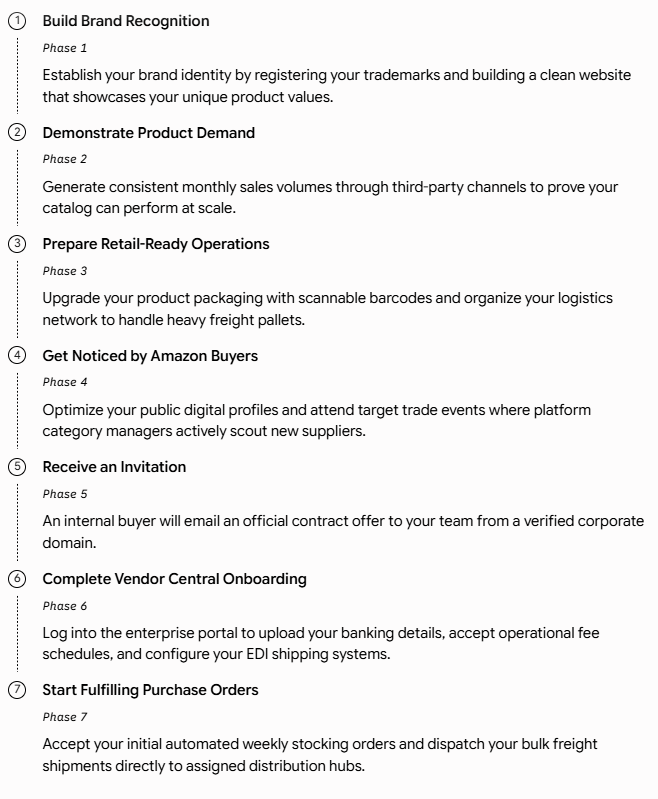
Step-by-Step Process to Become an Amazon Vendor
Moving from an independent brand to an authorized wholesale supplier requires hitting a series of operational milestones. The process begins with building market presence and finishes with technical EDI setup inside your new platform dashboard. Following this path ensures your production teams stay aligned with marketplace logistics.
How to Increase Your Chances of Getting Invited
While you cannot apply directly for a first-party wholesale account, you can implement strategic adjustments to get noticed by procurement teams. Optimizing your current marketplace positioning makes your brand an attractive asset for internal category managers looking to grow their inventory lines.
- Build Omnichannel Retail Presence: Establish active sales relationships with other major department stores and online retailers to prove your supply chain is retail-ready.
- Strengthen Amazon Sales Performance: Maintain excellent account health metrics, low defect rates, and high review scores within your third-party storefront accounts.
- Attend Trade Shows: Exhibit your catalog at major industrial conventions like CES or Toy Fair, where Amazon procurement buyers regularly look for new products.
- Optimize Branding: Ensure your digital listings feature crisp product graphics, detailed bullet points, and clean A+ Content layouts to prove your brand quality.
- Generate External Demand: Drive consistent off-platform traffic to your product listings through social media campaigns and influencer partnerships.
- Network with Amazon Retail Teams: Connect professionally with category managers on corporate networks to share your unique product capabilities.
What Happens After You Receive an Invitation?
Receiving a first-party signup link marks the beginning of a detailed corporate setup process. Your administrative team must review complex vendor agreements that cover allowance fees, freight costs, and co-op marketing budgets.
Once you accept the core platform terms, you will enter your primary tax profiles and link your business banking lines for future wholesale payouts. Next, you will upload your full product catalog data and match your items with the correct category browse nodes. Passing these initial verification gates allows the automated purchasing algorithms to analyze your stock and generate your first batch of wholesale orders.
Understanding Amazon Purchase Orders
Managing automated purchase orders is the core day-to-day focus of a first-party Amazon vendor workflow. The internal buying algorithms generate these procurement requests weekly, usually on Monday mornings, based on real-time consumer demand projections.
Your operations team must log into the portal within 24 hours to confirm what stock you can fulfill and highlight any temporary shortages. Once confirmed, you must generate advance shipping notices and book freight routing windows that fit within your assigned delivery dates. Meeting these exact shipping windows prevents costly chargebacks and keeps your wholesale relationship in good standing.
Benefits of Becoming an Amazon Vendor
Transitioning into a first-party supplier relationship offers powerful brand validation and logistical advantages that help your business scale. Handing over consumer-facing management duties allows your enterprise to focus on product design and manufacturing efficiency.
- Sold by Amazon Credibility: Listings carry maximum buyer trust, which naturally improves customer conversion metrics across all traffic channels.
- Bulk Purchasing: Amazon buys your products in large quantities, giving you predictable revenue lines and lower per-unit fulfillment costs.
- Reduced Fulfillment Workload: Your warehouse team handles bulk pallet freight instead of managing small, individual consumer shipments.
- Marketing Opportunities: Access advanced promotional features like premium A+ Content formats and exclusive vendor display ad networks.
- Vendor Analytics: Gain clear insight into high-level category traffic trends and long-term search data directly from internal retail reports.
Challenges and Risks
While wholesale volume offers great scaling opportunities, the first-party ecosystem introduces complex operational rules and margin pressures. Brands must balance top-line revenue gains against strict compliance fees and limited price control.
- Pricing Control: Amazon's pricing algorithms will automatically lower your retail prices to match competitors, which can disrupt your MAP agreements.
- Chargebacks: Minor labeling mistakes or late freight deliveries will trigger expensive compliance chargebacks that eat into your profits.
- Margin Pressure: Annual vendor negotiations often include requests for higher co-op marketing contributions and damage allowances.
- Operational Complexity: Managing advanced EDI connections and strict pallet configurations requires experienced logistics staff.
- Inventory Forecasting: Weekly order volumes can fluctuate sharply, requiring careful production planning to avoid sudden overstock issues.
Amazon Vendor Central vs Hybrid Selling
Many growing brands use a hybrid operational strategy that combines first-party and third-party models to protect their margins. This model involves selling high-volume items through a wholesale account while using a separate seller account to launch new or premium products.
This dual approach gives you a handy logistical safety net if your wholesale order volumes fluctuate during the off-season. It also allows you to protect your strict MAP pricing policies on premium items while utilizing bulk distribution channels for your core catalog. However, managing two distinct platforms requires excellent internal data tracking to prevent your inventory streams from competing against each other.
Vendor Readiness Checklist
Before accepting a wholesale invitation, you must verify that your business operations can handle strict electronic compliance and fast pallet turnarounds. Use this operational checklist to confirm your business is fully prepared for first-party wholesale logistics.
- Business Documentation: Active tax certifications, corporate insurance policies, and global trademark records must be fully organized.
- Packaging: Every SKU must feature a certified barcode and durable master carton packaging built for freight transit.
- Inventory: Warehouse facilities must maintain deep safety stock levels to handle sudden spikes in weekly purchase orders.
- Compliance: Production networks must be fully certified to meet all regional product safety and environmental rules.
- Logistics: Freight teams must be trained to navigate advanced shipping systems and manage strict delivery windows.
- Financial Readiness: Cash flow cycles must be strong enough to support 60-to-90-day wholesale payment terms easily.
Frequently Asked Questions
1. Is Amazon Vendor Central free?
There is no direct sign-up fee to use the platform, but Amazon automatically deducts specific cooperative fees directly from your wholesale payouts. These baseline deductions include co-op marketing allowances, damage provisions, and freight distribution fees that are negotiated during account setup.
2. Can I apply for Vendor Central?
No, there is no public application page or registration form available for the corporate procurement program. If you are researching how to become an Amazon vendor, you must focus on building your sales performance on third-party channels to catch the eye of category managers.
3. How long does it take to get invited?
There is no fixed timeline for receiving an official procurement invite, as selections depend entirely on category performance and current inventory needs. Some high-growth brands earn an invitation within six months of launch, while other specialized manufacturers can operate for years before catching a buyer's attention.
4. Can I have both Vendor and Seller accounts?
Yes, brands can utilize a hybrid model by running both a wholesale profile and an independent seller account simultaneously. This dual setup allows you to move high-volume items through bulk wholesale lines while keeping direct pricing control over your premium products.
5. What happens if Amazon stops ordering?
If automated purchase orders drop off, it usually means consumer demand has slowed or your listing has lost visibility to competing brands. If this occurs, you must run promotions and optimize your advertising campaigns to rebuild search velocity.
6. Is Vendor Central better than Seller Central?
Neither platform is universally better, as the right option depends entirely on your corporate structure and cash flow goals. Larger manufacturers often prefer the bulk simplicity of a wholesale setup, while agile brands lean toward the fast payouts and pricing control of a seller account.
7. Can small businesses become Amazon Vendors?
While the first-party program is built primarily for large manufacturers, agile small businesses can earn invitations if they offer unique, patented items. Your logistics team must be fully prepared to handle strict retail compliance rules regardless of your total company size.