



Last updated on June 23rd, 2026
Managing an Amazon business involves far more than uploading products and waiting for sales. Sellers must continuously optimize listings, manage inventory, monitor advertising campaigns, respond to customers, track competitors, and analyze performance data. As stores grow, these responsibilities can quickly consume valuable time and limit business expansion.
An Amazon virtual assistant helps sellers delegate operational tasks while maintaining efficiency, accuracy, and profitability. Whether you are launching your first Amazon FBA business or scaling an established brand, understanding how an Amazon virtual assistant works can help you streamline operations and focus on growth.
This guide explains responsibilities, benefits, costs, and hiring strategies for a virtual assistant Amazon workflow.
Table of Contents
What Is an Amazon Virtual Assistant?
Why Amazon Sellers Hire Virtual Assistants
Key Benefits of Hiring an Amazon Virtual Assistant
Tasks an Amazon Virtual Assistant Can Handle
Amazon Virtual Assistant vs General Virtual Assistant
Signs It’s Time to Hire an Amazon VA
How to Hire an Amazon Virtual Assistant
Amazon Virtual Assistant Pricing and Costs
How to Onboard and Train an Amazon VA
Managing Amazon Virtual Assistants Effectively
Common Challenges and How to Avoid Them

What Is an Amazon Virtual Assistant?
An Amazon virtual assistant is a remote professional who helps Amazon sellers manage and optimize different areas of their eCommerce operations. As selling on Amazon becomes more competitive, many businesses rely on specialized virtual assistants to handle time-consuming tasks, improve listing performance, and support daily marketplace management.
Definition and Role
An Amazon virtual assistant is a trained remote specialist who supports sellers with essential Amazon-related activities such as product listing optimization, keyword research, PPC management, competitor analysis, inventory monitoring, order management, and customer service. Their role is to help sellers improve efficiency, maintain account performance, and focus more on business growth rather than repetitive operational tasks.
How Amazon VAs Differ From Traditional Virtual Assistants
Unlike general virtual assistants who handle broad administrative tasks, an Amazon VA specialist has specific knowledge of ecommerce workflows and Amazon’s selling environment. They are familiar with tools and processes such as Amazon Seller Central, product research methods, keyword optimization, listing guidelines, advertising campaigns, and marketplace performance metrics.
This specialized knowledge allows Amazon VAs to provide more strategic support compared to traditional assistants. They understand how different tasks impact search visibility, conversions, sales performance, and overall account health.
Types of Amazon Virtual Assistants
Amazon virtual assistants can specialize in different areas depending on a seller’s needs. Some focus on PPC management, helping create and optimize advertising campaigns, while others specialize in listing optimization, including keyword research, product descriptions, and backend search terms. There are also Amazon VAs focused on operations, customer support, inventory management, and product research.
Many sellers choose to use Amazon VA services or work with an Amazon VA agency to access trained professionals, structured workflows, and ongoing support. This approach allows businesses to scale operations more efficiently while ensuring critical marketplace tasks are handled by specialists.
Double your productivity and scale your business by outsourcing repetitive administrative workflows to trained remote professionals.
Why Amazon Sellers Hire Virtual Assistants
Managing an Amazon business requires more than simply creating product listings and processing orders. Sellers must continuously monitor inventory, optimize listings, manage advertising campaigns, respond to customers, analyze competitors, and adapt to changing marketplace trends. As operations become more complex, many sellers turn to Amazon virtual assistants to improve efficiency and maintain consistent business performance.
Increasing Operational Complexity
Amazon operations involve multiple moving parts that require regular attention and specialized knowledge. Sellers need to manage tasks such as product research, keyword optimization, PPC campaigns, inventory tracking, review monitoring, and account health management. An Amazon virtual assistant helps handle these responsibilities, ensuring important tasks are completed accurately and consistently.
Time Constraints
Running an Amazon store can quickly become overwhelming, especially as sales volume and product catalogs grow. Many sellers struggle to balance daily operations with strategic activities such as expanding product lines, improving marketing strategies, and growing revenue. By delegating repetitive and time-consuming tasks to an Amazon VA, sellers can focus on higher-value decisions while maintaining smooth operations.
Need for Expertise
Amazon’s marketplace requires specific skills and knowledge to achieve long-term success. A trained Amazon virtual assistant understands Seller Central, listing optimization, keyword research, advertising tools, and marketplace best practices. Their expertise helps sellers improve workflows, make data-driven decisions, reduce costly mistakes, and maximize growth opportunities.
Hiring an Amazon VA allows sellers to access specialized support without the expense of building a large in-house team. Whether through individual professionals or Amazon VA services, sellers can gain the flexibility and expertise needed to scale their businesses more efficiently.
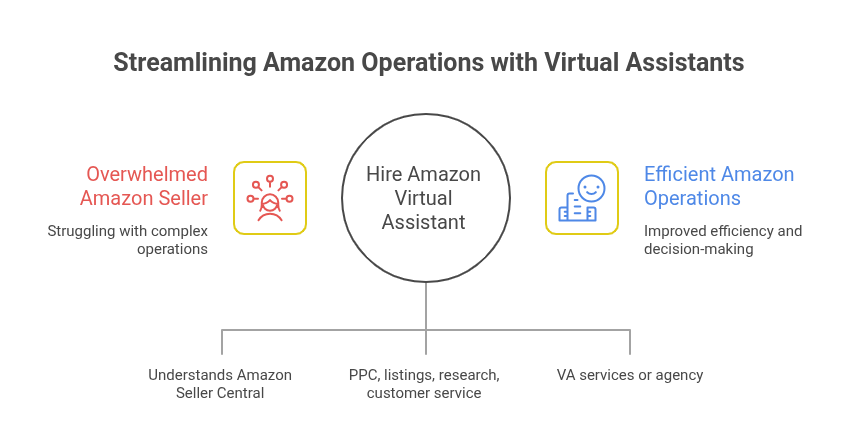
Key Benefits of Hiring an Amazon Virtual Assistant
Hiring an Amazon virtual assistant allows sellers to delegate time-consuming marketplace tasks while focusing on business growth and strategy. As Amazon operations become more complex, a skilled VA can provide specialized support that improves efficiency, accuracy, and overall store performance.
Hiring an Amazon virtual assistant provides:
- More time for strategy – Sellers can focus on product expansion, marketing decisions, and long-term growth instead of spending hours managing daily operations.
- Better listing optimization – An experienced Amazon VA can improve product titles, descriptions, keywords, and backend search terms to increase visibility and conversions.
- Reduced operational workload – Delegating repetitive tasks helps sellers manage their workload more efficiently and prevents operational bottlenecks.
- Improved customer satisfaction – Faster responses, better order management, and consistent communication help create a stronger customer experience.
- Scalable business operations – Amazon VA services allow sellers to increase support as their business grows without immediately hiring additional in-house employees.
Using Amazon VA services ensures more consistent task management and helps sellers maintain better performance across different areas of their Amazon business.
Tasks an Amazon Virtual Assistant Can Handle
An Amazon virtual assistant can support various aspects of marketplace management, from daily operations to growth-focused activities. By handling specialized tasks, Amazon VAs help sellers improve productivity while maintaining better control over their store performance.
An Amazon virtual assistant manages:
- Product listing optimization – Improving titles, bullet points, descriptions, images, and keywords to increase search visibility and conversion potential.
- Keyword research – Identifying relevant search terms and competitor keywords to improve organic rankings and product discoverability.
- Inventory tracking – monitoring stock levels, identifying inventory issues, and helping prevent stockouts or overstocking.
- Customer service – Managing buyer messages, addressing common concerns, and supporting better customer experiences.
- PPC campaign support – Assisting with campaign monitoring, keyword analysis, bid adjustments, and performance tracking.
- Competitor analysis – Researching competitors’ pricing, listings, reviews, and strategies to identify opportunities.
- Reporting and analytics – Preparing performance reports and analyzing sales, advertising, and operational data.
These Amazon VA services help sellers improve efficiency, make better decisions, and increase profitability.
Amazon Virtual Assistant vs General Virtual Assistant
A general virtual assistant typically handles broad administrative responsibilities such as scheduling, email management, and basic data entry. An Amazon virtual assistant, however, specializes in eCommerce operations and understands the specific systems and processes required to manage an Amazon store.
A trained Amazon VA understands areas such as SEO, PPC advertising, keyword optimization, product research, and Amazon Seller Central. This specialized knowledge makes Amazon VA services more effective for sellers who need marketplace-specific support rather than general administrative assistance.
Signs It’s Time to Hire an Amazon VA
Many sellers reach a point where managing every aspect of their Amazon business becomes difficult and limits growth. Hiring an Amazon virtual assistant can help improve efficiency when operational demands begin affecting sales performance and strategic planning.
You need an Amazon virtual assistant if:
- You spend more time managing than growing – Daily operational tasks prevent you from focusing on expansion and business strategy.
- Customer response times are slow – Delayed responses can affect customer satisfaction, reviews, and account performance.
- Inventory problems increase – Poor inventory tracking can lead to missed sales opportunities or unnecessary storage costs.
- PPC campaigns underperform – Advertising requires ongoing monitoring and optimization to maintain profitability.
At this stage, Amazon VA services or an Amazon VA agency can provide the specialized support needed to improve operations and scale effectively.
Essential Skills to Look For
A strong Amazon virtual assistant should have a combination of technical knowledge, marketplace experience, and analytical skills. These abilities allow them to handle Amazon-related responsibilities efficiently and contribute to better business outcomes.
A strong Amazon virtual assistant should have:
- Seller Central experience – Familiarity with Amazon’s seller dashboard, listing management, reports, and account functions.
- PPC knowledge – Understanding of Amazon advertising campaigns, keywords, bids, and performance metrics.
- Keyword research skills – Ability to identify search terms that improve product visibility.
- Data analysis ability – Capability to interpret sales data, advertising results, and performance trends.
- Inventory management experience – Knowledge of stock monitoring and inventory planning processes.
These skills define effective Amazon VA performance and help sellers achieve stronger marketplace results.
How to Hire an Amazon Virtual Assistant
Hiring the right Amazon VA requires a clear process to ensure you find someone with the necessary skills and experience. A structured approach helps sellers avoid costly hiring mistakes and build reliable long-term support.
Steps include:
- Define needs – Identify which tasks you want to delegate and the type of support required.
- Create a task list – Clearly outline responsibilities, expectations, and required skills.
- Assess skills – Review experience, technical knowledge, and familiarity with Amazon tools.
- Interview candidates – Evaluate communication, problem-solving ability, and marketplace understanding.
- Run trial tasks – Test practical skills before making a long-term commitment.
Many sellers choose an Amazon VA agency to access pre-vetted professionals and structured Amazon VA services.
Amazon Virtual Assistant Pricing and Costs
The cost of hiring an Amazon virtual assistant depends on experience level, responsibilities, location, and the hiring model. Some sellers choose freelancers for lower costs, while others prefer agencies for reliability, management support, and access to trained specialists.
Freelancers may offer more affordable pricing, while Amazon VA services from agencies often provide stronger continuity, backup support, and structured processes. A skilled Amazon virtual assistant can deliver strong ROI by saving time, improving operations, and helping sellers increase revenue opportunities.
How to Onboard and Train an Amazon VA
Proper onboarding helps an Amazon VA understand your business processes, brand standards, and operational expectations. A clear training system reduces mistakes and allows the assistant to become productive faster.
Onboarding includes:
- SOP documentation – Creating step-by-step instructions for recurring tasks.
- Task assignment – Defining responsibilities and priorities.
- Communication setup – Establishing tools, reporting methods, and update schedules.
- Reporting systems – Creating performance tracking and accountability processes.
Proper onboarding ensures smooth Amazon VA integration and improves long-term productivity.
Managing Amazon Virtual Assistants Effectively
Effective management helps Amazon VAs stay aligned with business goals and maintain consistent performance. Regular communication, clear expectations, and ongoing improvement are essential for successful collaboration.
Management includes:
- Weekly reviews – Evaluating progress, challenges, and completed tasks.
- Task tracking tools – Monitoring workload and deadlines.
- Goal setting – Establishing measurable performance objectives.
- Continuous training – Keeping skills updated with Amazon changes and best practices.
Strong Amazon VA services improve accountability, efficiency, and overall output.
KPIs and Success Metrics
Tracking performance helps sellers understand the impact of their Amazon virtual assistant and identify areas for improvement. The right metrics provide insight into productivity, marketplace performance, and business growth.
Track your Amazon virtual assistant using:
- Conversion rate – Measures how effectively listings turn visitors into buyers.
- Click-through rate – Shows how well listings and ads attract customer attention.
- ACoS and ROAS – Evaluate PPC campaign profitability and advertising efficiency.
- Inventory turnover – Measures how effectively products move through inventory.
- Response time – Tracks customer service efficiency and communication speed.
These KPIs help measure the effectiveness of Amazon VA services and ensure tasks contribute to business goals.
Common Challenges and How to Avoid Them
While Amazon VAs provide valuable support, businesses may face challenges without proper systems and communication processes. Addressing these issues early helps maintain productivity and protect business operations.
Challenges include:
- Poor communication – Lack of clear updates can lead to misunderstandings and missed tasks.
- Lack of SOPs – Without proper instructions, quality and consistency may suffer.
- Inconsistent reporting – Limited visibility into performance can make management difficult.
- Security risks – Improper access control can expose sensitive business information.
An Amazon VA agency can help reduce these risks by providing structured Amazon VA services, trained professionals, and established management processes.
Why Outsourcing Amazon Operations Is Growing
More sellers are outsourcing Amazon operations as competition increases and marketplace management becomes more demanding. Instead of handling every task internally, businesses are using Amazon virtual assistants to access specialized skills while controlling costs.
Outsourcing using an Amazon virtual assistant is growing due to:
- Access to global talent – Sellers can work with skilled professionals from different regions.
- Lower operational costs – Outsourcing reduces the need for additional in-house employees.
- Business scalability – Support can increase as sales volume and responsibilities grow.
- Competitive advantage – Sellers can focus on strategy while experts manage operational tasks.
Many sellers now rely on an Amazon VA agency for consistent Amazon VA services that support efficiency, growth, and long-term marketplace success.
Conclusion
An Amazon virtual assistant is a powerful asset for sellers aiming to scale efficiently. Whether through freelancers or an Amazon VA agency, structured Amazon VA services reduce workload and improve performance.
A well-trained Amazon professional virtual assistant helps transform daily operations into a scalable, efficient system that supports long-term growth.
FAQ
1. Can Amazon Virtual Assistants work in different time zones?
Yes, most Amazon virtual assistants are flexible and can work across time zones. This allows sellers to maintain 24-hour operations and faster customer response times using structured Amazon VA services.
2. What industries besides Amazon use virtual assistants?
While this guide focuses on Amazon, virtual assistants are also used in real estate, healthcare administration, eCommerce, and marketing. However, virtual assistant Amazon specialists are uniquely trained for marketplace operations.
3. How do I measure if my Amazon VA is performing well?
Performance is measured using KPIs such as conversion rates, ACoS, response time, and inventory accuracy. High-quality Amazon VA services will show measurable improvements in these areas.
4. Can I scale multiple stores with one Amazon VA?
Yes, but the workload depends on complexity. A skilled Amazon virtual assistant can manage multiple stores if systems and processes are well structured through clear Amazon VA services.