



Last updated on April 25th, 2026
Managing an Amazon catalog with hundreds or thousands of SKUs can quickly become a full-time job that pulls you away from actually growing your business. Every suppressed listing, broken variation, or misassigned category represents lost sales and hours spent troubleshooting instead of selling.
Amazon product cataloging services take on the challenging task of organizing, optimizing, and maintaining your product data, ensuring that your listings remain visible, compliant, and ready for conversion. This guide covers what these services include, how they work, and how to evaluate whether outsourcing makes sense for your operation.
If you’re looking for quick service to streamline your catalog, fix listing issues fast, and boost your product visibility, then contact us today.
Table of Contents
What is Amazon product cataloging?
Why Amazon catalog management improves seller efficiency
Amazon catalog challenges that reduce seller efficiency
What Amazon cataloging services include
How Amazon cataloging services work
Benefits of outsourcing Amazon catalog management
How to choose an Amazon cataloging service provider
What is Amazon product cataloging?
Amazon product cataloging is the process of managing, structuring, and optimizing product listings to boost visibility, conversion rates, and compliance with Amazon's policies. This work includes creating SEO-friendly titles and content, setting up parent-child variations, enhancing the Amazon A+ content setup service, and fixing suppressed listings. Specialized agencies handle large catalogs while ensuring data accuracy and consistent branding across every product page.
So what exactly is a "catalog" in the Amazon context? It's the complete database of product information tied to your seller account; titles, descriptions, images, backend keywords, and technical attributes all live here. Each product gets assigned an ASIN (Amazon Standard Identification Number), which is Amazon's unique identifier for that listing.
Think of cataloging as the foundation beneath your entire Amazon storefront. Without accurate, well-structured data, even great products can remain invisible to shoppers.
Why Amazon catalog management improves seller efficiency
A well-organized catalog directly reduces operational friction. Instead of constantly fixing errors and chasing down data problems, you can focus on growth. Let's look at the specific efficiency gains.
- Reduced manual data entry and repetitive tasks
Professional Amazon product data upload services automate bulk uploads, template-based entries, and syndication across product variations. Rather than manually entering the same information dozens of times, you can rely on flat file uploads and standardized workflows.
A well-executed Amazon pricing strategy setup service ensures your products are competitively positioned from day one, reducing the need for constant manual price adjustments.
- Fewer listing errors and suppressed products
Accurate cataloging prevents common errors, missing attributes, incorrect dimensions, or policy violations that lead to suppressed or stranded listings. A suppressed listing is hidden from search results, while stranded inventory sits in FBA warehouses without an active listing.
Both scenarios halt sales and rack up storage fees. Catching these issues proactively means you avoid the time-consuming process of troubleshooting and submitting appeals to Amazon.
- Improved product discoverability and search rankings
Properly structured data, correct browse nodes, and optimized attributes help products appear in relevant searches. Browse nodes are the categories within Amazon's massive classification tree; selecting the right one determines where your product shows up.
Better organic visibility means less reliance on paid advertising to drive traffic. Your products simply appear where shoppers are already looking.
- Faster time to market for new products
Streamlined cataloging workflows accelerate product launches significantly. When your data processes are already in place, including a well-defined Amazon pricing strategy setup service, adding new products becomes a matter of following established templates rather than starting from scratch.
This speed allows you to respond quickly to market trends, seasonal opportunities, and inventory changes.
Amazon catalog challenges that reduce seller efficiency
Sellers often encounter catalog problems that drain time and resources. 59% of sellers report concern about listing suppression alone. Understanding these common pain points helps clarify why professional cataloging support can be valuable. Without a structured Amazon pricing strategy setup service, sellers often resort to reactive discounting that erodes margins and disrupts catalog consistency.
Suppressed or stranded listings
A suppressed listing is a product hidden from Amazon search results due to data issues, perhaps a missing image, incomplete description, or policy violation. Stranded inventory, meanwhile, refers to products physically held in an FBA warehouse but lacking an active listing to sell them.
Both situations have an immediate financial impact:
- Sales stop completely: No active listing means no revenue from that product
- Storage fees accumulate: FBA charges continue even when products aren't selling
- Resolution takes time: Navigating Amazon's case management system often requires multiple back-and-forth exchanges
Broken parent-child variations
Parent-child ASIN relationships allow customers to see all product options, sizes, colors, and styles on a single product page. When these relationships break, each variation appears as a separate listing.
This fragmentation confuses customers and splits your product reviews across multiple pages, diluting social proof and making comparison shopping harder.
Incorrect product attributes and data
Missing or incorrect attributes, dimensions, materials, brand names, and weight lead to product misclassification. Amazon's algorithm relies on this data to match products with customer searches.
When attributes are wrong, your products may not appear for relevant queries, even if your titles and descriptions are well-written.
Category and browse node misassignment
Incorrect browse node assignment buries products in the wrong categories. A kitchen gadget listed under office supplies, for example, will rarely reach its intended audience.
Selecting the most strategic browse node requires understanding Amazon's taxonomy and how shoppers navigate categories.
Compliance violations and policy warnings
Amazon enforces strict content policies covering everything from prohibited claims to image requirements. Non-compliant listings risk suspension or removal.
Resolving these issues requires time-consuming appeals and can result in lost revenue during the review period.
What Amazon cataloging services include
A professional Amazon product cataloguing service offers end-to-end support covering the full product data lifecycle. Here's what that typically involves.
Product listing creation and optimization
This includes writing SEO-friendly titles, bullet points, and descriptions while selecting high-value keywords. With a professional Amazon product data upload service, all content follows Amazon's style guidelines to maximize both compliance and conversion potential.
Amazon product catalogues editing services
Ongoing editing covers price changes, description refreshes, image swaps, and seasonal content updates. Continuous maintenance ensures your catalog remains current and accurate as your business evolves.
Variation and parent-child ASIN management
Structuring product families correctly ensures all variations display together on a single product page. This consolidates reviews and allows customers to easily compare options like size and color.
Attribute and data accuracy management
A reliable Amazon product data upload service populates all required and optional fields accurately, including dimensions, weight, material, and brand, to improve searchability and meet Amazon's data standards.
Category and browse node optimization
Experts select the most relevant browse nodes to maximize discoverability within Amazon's complex taxonomy. Strategic placement ensures products appear where the right customers are searching.
Compliance monitoring and policy adherence
Proactive monitoring for Amazon policy changes and restricted content prevents violations before they occur. This protects your account health and avoids costly disruptions.
AI-ready and GEO-optimized product data
Modern cataloging prepares products to surface in AI recommendations and voice search. Generative Engine Optimization (GEO) structures data for AI-driven search engines and platforms like ChatGPT or Google's AI overviews. This is increasingly important as 80% of consumers plan to use GenAI to discover products through AI-powered tools.
Ongoing catalog maintenance and governance
Catalog management isn't a one-time project. Regular audits, error monitoring, and updates ensure sustained performance and data integrity over time.
How Amazon cataloging services work
Engaging a professional provider typically follows a clear, multi-step process.
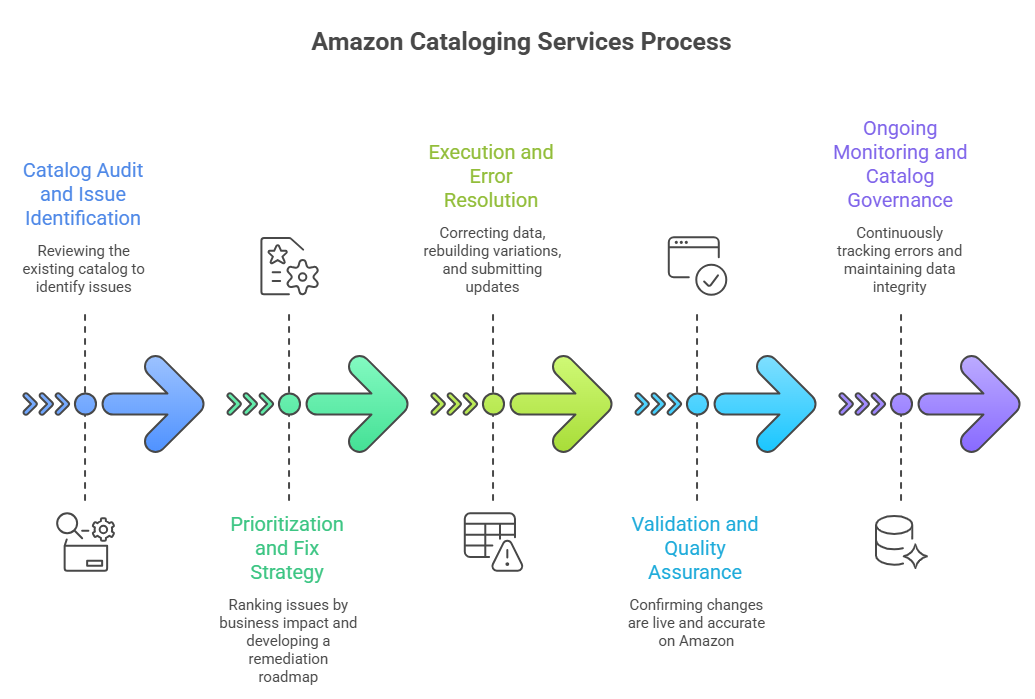
1. Catalog audit and issue identification
The process begins with a comprehensive review of your existing catalog. This audit identifies suppressed listings, data gaps, broken variations, and compliance risks.
2. Prioritization and fix strategy
Issues are ranked by business impact; revenue-affecting suppressions typically come first. A detailed remediation roadmap outlines what gets fixed and when. This is also the ideal stage to define your Amazon pricing strategy setup service, ensuring competitive positioning is built into the catalog from the ground up.
3. Execution and error resolution
This is the hands-on work: correcting data, rebuilding variations, submitting flat files for bulk product updates, and opening cases with Amazon Seller Support for complex issues.
4. Validation and quality assurance
After changes are made, validation confirms they're live and correct on Amazon. Dual-layer QA processes help guarantee accuracy before moving on.
5. Ongoing monitoring and catalog governance
Continuous oversight tracks new errors, responds to Amazon policy updates, and maintains data integrity. This prevents the same issues from recurring.
Benefits of outsourcing Amazon catalog management
Many sellers choose to outsource catalog management to improve efficiency and achieve better returns on their time investment. Sellers who invest in an Amazon A+ content setup service alongside accurate cataloging consistently see higher conversion rates and lower return rates.
Access to Amazon catalog experts
Outsourcing provides access to specialists who understand Amazon's complex systems, flat file formats, and Seller Central workflows. This expertise is difficult and expensive to build in-house.
Scalable support for growing product catalogs
Outsourced teams can ramp up or down based on your SKU count, seasonal needs, or expansion into new categories. You're not locked into a fixed headcount.
Cost savings compared to in-house teams
Outsourcing eliminates hiring, training, and management costs while providing specialized expertise. For many sellers, this means 40 to 70% in operational cost savings compared to equivalent in-house resources.
More time to focus on core business growth
By offloading time-consuming catalog operations, from Amazon A+ content setup services to data uploads, your internal team can concentrate on product sourcing, marketing, and customer experience.
How to choose an Amazon cataloging service provider
When evaluating potential partners, consider these key criteria:
- Amazon platform expertise: Look for proven experience with Seller Central, flat files, and case management
- Data accuracy guarantees: Ask about QA processes and error rate commitments
- Scalability: Ensure the provider can handle your current and future SKU volume
- Security certifications: Verify compliance with standards like ISO 27001 and GDPR
- AI and GEO readiness: Consider providers who optimize for modern, AI-driven discovery channels
- Communication and reporting: Confirm they offer dedicated account management and transparent performance tracking
Partner with ALS for end-to-end Amazon catalog management
ALS delivers comprehensive Amazon product cataloguing services with a focus on AI-ready and GEO-optimized product data. Our dedicated program managers bring extensive experience with US retailers, while our offshore delivery model provides cost-effective support without sacrificing quality.
Your data remains secure throughout the engagement. We offer flexible scaling to match your business needs and a free trial to experience our services firsthand.
Request a Consultation to discuss your Amazon catalog needs with our team.
FAQs about Amazon product cataloging services
1. How much do Amazon cataloging services typically cost?
Pricing varies based on catalog size, complexity, and scope of services required. Most providers offer customized quotes after an initial assessment of your specific situation.
2. Can Amazon cataloging services handle thousands of SKUs?
Yes, professional cataloging providers are equipped to manage large, high-volume catalogs with scalable processes and dedicated teams.
3. What is the difference between catalog management and listing optimization?
Catalog management covers the full data lifecycle, creation, updates, error fixes, and governance. Listing optimization focuses specifically on improving content for conversions and search ranking.
4. How long does it take to clean up an Amazon product catalog?
The timeline depends on catalog size and issue severity. Most providers complete an initial audit and remediation within a few weeks for typical catalogs.
5. Do Amazon cataloging services require full Seller Central account access?
Typically, providers request user-level access to upload data, resolve errors, and submit cases on your behalf. Full administrative control is usually not required.