
Amazon Seller Central Management Archives - Amazon Listing Service

Category: Amazon Seller Central Management

Top 8 Amazon Seller Virtual Assistants That Maximize Productivity

Amazon Seller Virtual Assistants

Time is the only resource you cannot manufacture, buy back, or replenish. While every successful founder starts as a "jack of all trades", personally tweaking listings at 2:00 AM and answering customer queries over breakfast, this hands-on approach eventually hits a dangerous ceiling. As your brand scales, those same administrative tasks that once built your foundation transform into a suffocating bottleneck that actively stifles your growth and kills your creativity.

The reality of 2026 is simple: you cannot build a multi-million dollar empire if you are still stuck spending five hours a day managing shipping labels and case logs. To dominate the marketplace, you must stop working in your business and start working on it.

According to 2025 research from Global Workplace Analytics, a typical employer can save approximately $11,000 per year for every person who works remotely even half the time. For Amazon sellers, this translates to massive overhead reduction and the ability to scale without the anchor of physical office costs.

Amazon Seller Virtual Assistants

Moving into 2026, the gap between stagnant sellers and market leaders will be defined by operational efficiency. If you find yourself bogged down by Seller Central notifications rather than focusing on brand strategy, it is time to leverage specialized Amazon virtual assistant services.

Table of Contents

The Growing Need for Amazon Specialization

Top 8 Amazon Seller Virtual Assistant Categories

How to Subtlely Scale Your Operations

Frequently Asked Questions (FAQ)

The Growing Need for Amazon Specialization

Amazon is no longer a "set it and forget it" platform. With more than 9.7 million registered sellers globally, the competition for the Buy Box ((now often called the Featured Offer) is fiercer than ever. Recent marketplace reports show that top-performing sellers now spend significantly more time on data analysis and brand building than on manual data entry.

To stay competitive, you need more than just general help; you need an Amazon seller virtual assistant who understands the nuances of the platform’s ever-changing algorithms and policies. By delegating routine operations, you transform your role from a task manager to a true Chief Executive Officer.

Top 8 Amazon Seller Virtual Assistant Categories

To maximize your productivity, you should categorize tasks based on their impact on your bottom line. Here are the top eight types of virtual assistants that successful sellers are hiring today:

1. The Amazon Seller Central Virtual Assistant

This is your operational backbone. An Amazon Seller Central Virtual Assistant manages the daily health of your account so you don't have to wake up to "Account At Risk" warnings.

  • The Bottom Line: Protects your "Healthy" status and resolves suppressed listings before they cost you a day of sales.
  • Key Tasks: Performance metric monitoring, case log management, and navigating Amazon's evolving policy compliance.

2. Amazon FBA Virtual Assistant

Shipping and logistics are the most common failure points for scaling brands. An Amazon FBA Virtual Assistant ensures your supply chain is lean and your products are Prime-ready.

  • The Bottom Line: Prevents costly stockouts and "Stranded Inventory" fees that eat your margins.
  • Key Tasks: Coordinating inbound shipments, auditing 3PL providers, and reconciling inventory discrepancies.

3. Amazon PPC Virtual Assistant

Shipping and logistics are the most common failure points for scaling brands. An Amazon FBA Virtual Assistant ensures your supply chain is lean and your products are Prime-ready.

  • The Bottom Line: Prevents costly stockouts and "Stranded Inventory" fees that eat your margins.
  • Key Tasks: Coordinating inbound shipments, auditing 3PL providers, and reconciling inventory discrepancies.

4. Listing Optimization Expert

Visibility is the price of entry. A Listing Optimization Expert uses data-driven tools (like Helium 10 or Jungle Scout) to ensure you rank where the customers are actually looking.

  • The Bottom Line: Increases organic (free) traffic, reducing your long-term reliance on expensive ads.
  • Key Tasks: Title A/B testing, backend search term optimization, and writing bullet points that handle customer objections before they happen.

5. Customer Support and Feedback Specialist

Maintaining a high seller rating is non-negotiable for the Buy Box. This Customer Support Specialist protects your brand’s public image 24/7.

  • The Bottom Line: High response times and resolved issues lead directly to higher conversion rates and account longevity.
  • Key Tasks: Managing A-to-z claims, transforming negative reviews into positive resolutions, and creating automated response templates.

6. Product Research and Sourcing Specialist

If you want to expand your catalog, you need someone dedicated to the "hunt." This specialist finds the winners before the market becomes saturated.

  • The Bottom Line: Identifies high-margin, low-competition opportunities to future-proof your business.
  • Key Tasks: Competitor gap analysis, supplier vetting, and negotiating manufacturing costs to protect your ROI.

7. Creative Content and A+ Designer

In a sea of "generic" products, brand trust is your only moat. A Creative Content VA makes your storefront look like a global brand.

  • The Bottom Line: Professional visuals convert "window shoppers" into "buyers" at a significantly higher rate.
  • Key Tasks: Managing Premium A+ Content, designing "shoppable" Brand Stores, and creating high-impact infographic images.

8. Data Analyst and Reporting VA

In 2026, data is more valuable than inventory. A Data Analyst VA takes the "noise" of Seller Central and turns it into a roadmap for growth.

  • The Bottom Line: Shows you exactly where you are losing money (hidden fees, return rates) and where to double down.
  • Key Tasks: Weekly profit/loss reporting, true ROI calculation per SKU, and forecasting seasonal demand.

How to Subtly Scale Your Operations

When you decide to hire Amazon virtual assistant support, you are not just buying hours; you are buying expertise. The transition should be seamless. Many successful sellers start by outsourcing a single department, such as customer service or PPC, before moving toward a full team model.

By integrating professional Amazon virtual assistant services into your workflow, you gain the freedom to focus on the "big picture" projects that actually move the needle for your brand. This strategic delegation is the secret behind the world's most profitable Amazon storefronts.

Frequently Asked Questions (FAQ)

1. Do I need to provide the software tools for my virtual assistant?

Most professional VAs are already familiar with industry standard tools, but you will typically provide access to your specific Amazon Seller Central account and any proprietary software you use.

2. Is it safe to give a VA access to my Seller Central?

Yes, Amazon allows you to set specific user permissions. You can grant your assistant access only to the sections they need, such as "Manage Orders" or "Advertising," without giving them access to your bank details or legal information.

3. Can one VA handle all eight of these roles?

While some "rockstar" VAs are multi-talented, it is usually better to hire specialists for technical tasks like PPC or graphic design to ensure the highest quality of work.

4. How do I know if my VA is actually being productive?

You can set clear Key Performance Indicators (KPIs), such as a 24-hour response time for messages or a specific target for ad spend efficiency, to track their impact on your business.

Top 12 Amazon Seller Account Management Tips for Scaling Your Business

Amazon Seller Account Management

Stop wasting advertising money! In the high-stakes world of Amazon, your success isn't defined by your product, it’s defined by your operation. If your performance metrics are slipping, your inventory is erratic, or your visibility is stagnant, your business is hemorrhaging profit. As Amazon tightens its rules in 2026, flawless Amazon seller account management is the difference between surviving and scaling. This guide lays out the 12 essential, practical strategies you need to master now to stabilize your business and unlock maximum growth.

Table of Contents

Why Amazon Seller Account Management Matters

Top 12 Amazon Seller Account Management Tips

How These Tips Support Business Growth

Conclusion

Frequently Asked Questions

Why Amazon Seller Account Management Matters

Every decision on Amazon has an impact on your visibility and sales performance. Structured account management ensures that listings follow Amazon guidelines, orders are processed correctly, and customer expectations are met.

Because Amazon operates with strict policies and a competitive environment, many sellers rely on professional support for tasks such as Amazon seller account setup, listing optimization, and ongoing performance reviews.

Amazon Seller Account Management

Top 12 Amazon Seller Account Management Tips

To achieve and maintain exponential growth on Amazon, sellers must move past a reactive mindset and adopt a proactive, structured approach. This "12 Commandment Playbook" outlines the critical strategies a professional Amazon listing service or top-tier seller uses daily to improve operational efficiency, maximize visibility, and safeguard their business.

Phase 1: The Essential Foundation & Compliance (Tips 1-2)

1. Complete a Proper Account Setup

A solid structure is paramount. Before the first unit even ships, your Amazon seller account setup must be flawless. Any deviation here can lead to crippling downstream issues, from delayed payments to outright suspension.

  • The Critical Detail: This goes beyond simple password creation. It means ensuring your legal name, business address, tax IDs (W-9 or W-8BEN), and banking information are perfectly matched across all official documents.
  • Why It Matters: Account verification processes are strict. A mismatch between your registered business name and your bank account details can freeze payments for weeks or months, creating a severe cash flow crisis.

2. Monitor Account Health Regularly

The Account Health Dashboard is Amazon’s report card for your business, and it's your early warning system. Monitoring it daily is not optional; it’s a required defensive maneuver.

  • The Critical Detail: Focus intensely on your main performance metrics. The Order Defect Rate (ODR), driven by Negative Feedback, A-to-Z Claims, and Chargebacks, must be kept below the 1% threshold to avoid the risk of account deactivation. Similarly, the Pre-Fulfillment Cancellation Rate must be below 2.5%, and the Late Shipment Rate below 4%.
  • Why It Matters: A poor score on the Account Health Rating (AHR) doesn't just look bad; it can trigger automated deactivation. Proactive monitoring allows you to address individual issues (like a bad customer review) before they escalate and push your overall score into the "At Risk" category.

Phase 2: Visibility & Conversion Optimization (Tips 3-4)

3. Optimize Your Product Listings

This is where marketing meets mechanics. Effective listing optimization is the single biggest driver of high-intent traffic and conversion.

  • The Critical Detail: Successful listings leverage both front-end (what the customer sees) and backend (hidden search terms) keywords. Every element—the title, the five bullet points, and the description, must not only be rich with relevant search terms but also clearly articulate the product’s benefits, not just its features. A clear, keyword-rich title boosts your organic rank, while strong bullet points improve the crucial Click-Through Rate (CTR).
  • Why It Matters: In a crowded search result page, a clear, compelling title is your digital handshake. The conversion lift from a fully optimized listing can range from 15% to 25%, turning casual browsers into committed buyers.

4. Use High-Quality Images and Rich Content

Customers cannot touch or feel your product. Your visual assets must bridge that trust gap instantly.

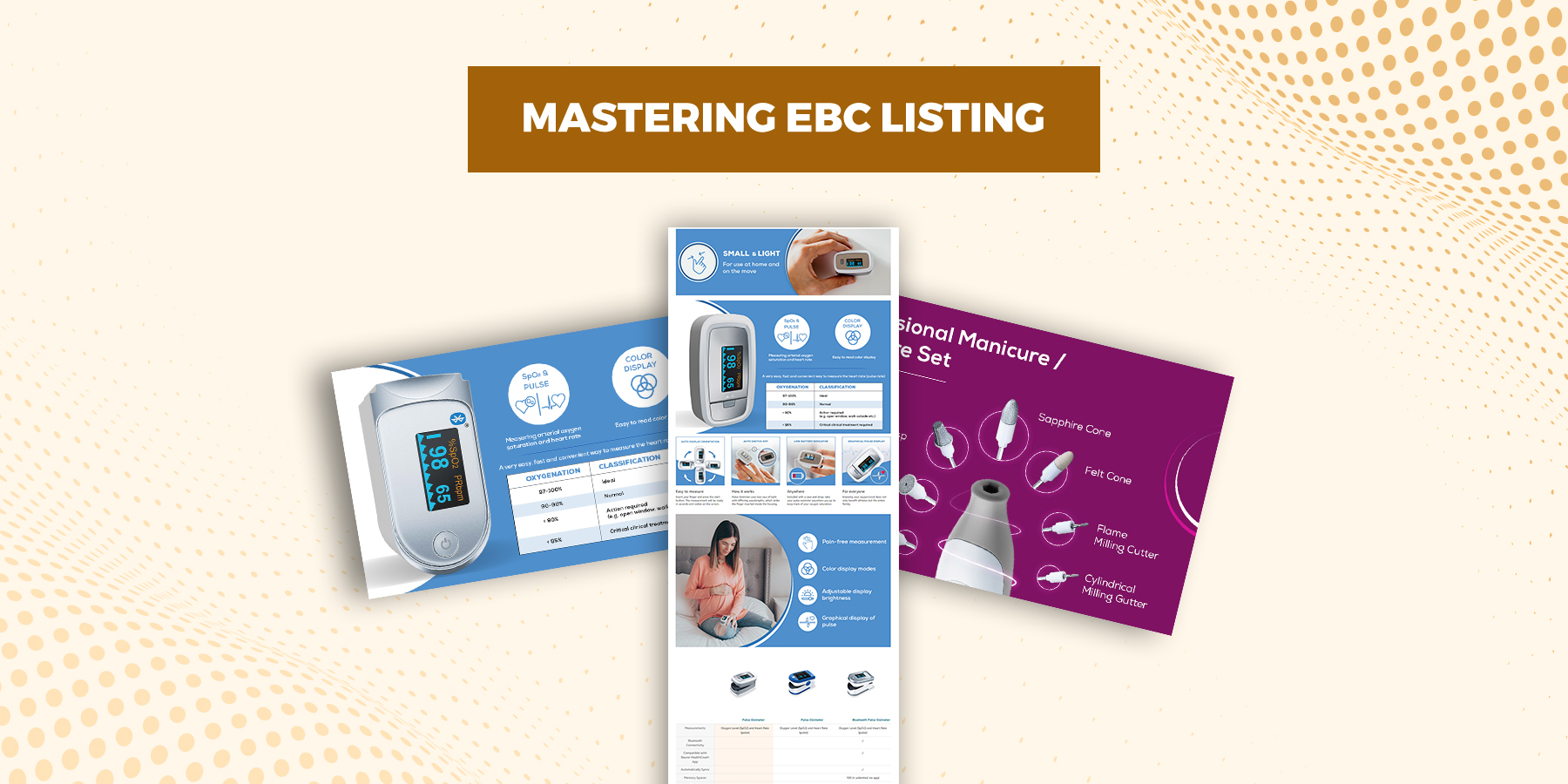
  • The Critical Detail: Follow Amazon's image standards precisely (pure white background for the primary image), but use the rest of your image slots for professional lifestyle shots, detailed infographics, and clear scale representations. For registered brands, leverage A+ Content (Enhanced Brand Content) to tell a richer story, compare products, and visually address common customer objections.
  • Why It Matters: High-quality visuals are essential for mobile shoppers, who now account for the majority of Amazon's traffic. Clear images and A+ content reduce customer confusion, which directly lowers your return rate and improves customer satisfaction.

Phase 3: Operational Excellence (Tips 5-7)

5. Improve Inventory Management: The Profit Protector

Poor inventory management is arguably the fastest way to kill an Amazon business, causing both lost sales and unnecessary fees.

  • The Critical Detail: The goal is to avoid the "twin disasters" of stockouts (which severely damage your search ranking and sales velocity) and overstocks (which trigger costly aged inventory surcharges). Use sophisticated tracking tools to maintain organized inventory systems and calculate precise reorder points based on lead time and sales velocity.
  • Why It Matters: When you run out of stock, Amazon's algorithm lowers your organic ranking as it prioritizes reliable sellers. Recovering that lost ranking can take weeks or months. By maintaining optimal stock levels, you protect your Best Seller Rank (BSR) and avoid being hit with expensive FBA storage fees.

6. Set Up FBA Correctly

For the majority of top sellers, Fulfillment by Amazon (FBA) is the key to scaling, as it unlocks Prime eligibility and hands off the logistics headache.

  • The Critical Detail: A proper Amazon FBA setup requires meticulous attention to product preparation, labeling (FNSKU vs. UPC), and ensuring proper packaging compliance before the products leave your facility. Any mislabeled or improperly packaged unit can result in lengthy delays, unexpected fees, or refusal at the fulfillment center.
  • Why It Matters: FBA ensures fast, reliable delivery, which is a major factor in improving your eligibility for the coveted Buy Box, the element responsible for up to 85% of all Amazon sales.

7. Manage FBA Operations Carefully

The relationship with FBA continues long after the inventory is checked in. Proactive management protects your assets and your profitability.

  • The Critical Detail: Strong Amazon FBA management involves more than just restocking. It means regularly monitoring your Inventory Performance Index (IPI) score, planning for long-term storage fee cutoffs, and diligently auditing for lost or damaged inventory that is eligible for reimbursement.
  • Why It Matters: Your IPI score dictates your storage limits. A low score means you can't send as much inventory, capping your growth potential. Proactive reconciliation and cleanup prevent you from paying high fees for stock that Amazon may have misplaced.

Phase 4: Growth, Data & Strategy (Tips 8-12)

8. Respond Promptly to Customer Messages

Customer communication is a performance metric, not an afterthought.

  • The Critical Detail: Aim to respond to all customer inquiries within 24 hours, even if the response is just acknowledging the message.
  • Why It Matters: Consistent communication directly impacts your Seller Responsiveness Rate and overall seller rating. Failure to meet this requirement can lead to performance penalties and signals to Amazon that you are not providing the high level of service the platform demands.

9. Use Analytics to Make Data-Driven Decisions

Selling without using the data Amazon provides is like driving a car blindfolded.

  • The Critical Detail: Leverage Amazon's detailed Business Reports to analyze key metrics like session percentage (how many people clicked your listing) and unit session percentage (your conversion rate). This data helps sellers understand which keywords are driving traffic and which products are performing best.
  • Why It Matters: Data allows you to identify weak points. If you have a high session rate but a low conversion rate, the problem is your listing copy or pricing. If both are low, the problem is likely your keyword strategy or ad targeting.

10. Track Competitor Pricing and Market Trends

The Buy Box is a constant battle, and winning it requires dynamic strategy.

  • The Critical Detail: Implement tools to monitor competitor pricing, inventory levels, and listing changes in real-time. This allows you to set up automated repricing rules that keep your price competitive enough to win the Buy Box without sinking your profit margins.
  • Why It Matters: Staying competitive isn't just about price; it’s about perceived value. Monitoring market trends also helps you spot new competitor products or feature gaps you can fill with your next product launch.

11. Invest in Sponsored Ads Where Needed

Paid advertising is the ignition for your organic growth engine.

  • The Critical Detail: Sponsored Ads are essential for new product launches to generate initial sales velocity and gather crucial data. They can also be used strategically to defend high-converting keywords against competitors.
  • Why It Matters: The ad spend you invest today can lead to higher organic ranking tomorrow. By driving sales velocity through targeted ads, Amazon's algorithm rewards you with better organic search placement, allowing you to eventually reduce your ad spend reliance.

12. Leverage Professional Support When Necessary

The platform’s complexity makes experts help an investment, not an expense.

  • The Critical Detail: Many scaling sellers choose expert Amazon seller central management to outsource complex, time-consuming tasks like policy appeals, advanced PPC management, or A+ content creation.
  • Why It Matters: Professional partners offer structured workflows, technological insight, and consistent monitoring that far exceed what a single business owner can achieve. This external support allows you to step away from daily operational "firefighting" and focus entirely on expanding product lines, improving branding, and setting long-term growth strategy.

These twelve tips form the foundation of a strong management strategy that supports scaling efforts.

How These Tips Support Business Growth

Each of these actions helps strengthen your presence on Amazon. When your listings are optimized, your inventory is well managed, and your account remains compliant, you reduce operational risks and support continuous growth.

Strong listing optimization boosts visibility. Quality customer service builds trust. Reliable inventory practices reduce delays and cancellations. Together, these elements help create a stable and scalable Amazon brand.

Professional service providers offer structured workflows, technology driven insight, and consistent monitoring, all of which help sellers perform more efficiently. With the right support, business owners can focus on expanding product lines, improving branding, and reaching new markets.

Conclusion

Amazon continues to evolve in 2026, and successful sellers must adapt to new standards and market conditions. By following the twelve Amazon seller account management tips shared in this guide, business owners can streamline their operations, maintain compliance, and unlock new growth opportunities.

Whether you are new to the platform or looking to scale, adopting structured management practices makes it easier to build a strong and profitable Amazon business.

Frequently Asked Questions

1. Why do I need Amazon seller account management?

It helps you stay compliant, improve performance, and increase sales.

2. Can someone help me set up my Amazon account?

Yes. Many professionals assist with complete account setup.

3. Is FBA hard to manage?

It can be complex, but proper tools and expert guidance make it easier.

4. Do optimized listings improve sales?

Yes. Strong listings improve visibility and conversions.

5. Can sellers grow faster with expert support?

Yes. Professional management helps save time and reduce errors.

How to Hire an Expert to Achieve Mastery in Amazon Seller Central Strategies

How To Hire An Expert To Achieve Mastery In Amazon Seller Central Strategies

Nowadays, almost every shopper drifts through the online universe with ease. People buy things while wrapped in blankets, half-asleep, or moving through the quiet rhythms of home life. This shift intensified during the COVID-19 pandemic, when online purchasing became the default pulse of global commerce.

Amazon sits at the center of that pulse. The company rules multiple domains: eCommerce, cloud computing, AI, streaming, and more. Its marketplace has empowered millions to build businesses from scratch. But mastering Amazon Seller Central isn’t simple. From beginners to seasoned sellers, the platform constantly demands attention, skill, and strategy. Running a successful store takes serious effort. Yet many sellers don’t have the hours or mental bandwidth to handle everything alone.

That is where hiring an Amazon expert, an Amazon Seller expert, or even a team of Amazon Seller Central experts becomes a sharp move. These specialists help you grow sales, manage your store, boost visibility, and streamline operations while you focus on manufacturing, brand building, and growth. They turn chaos into structure and complexity into clarity.

This blog explores what Amazon Seller Central really is, why you should consider an Amazon expert for hire, and how to hire Amazon experts who can bring mastery to your business.

Table of Contents

What Is Amazon Seller Central?

Why Should You Hire an Expert in Amazon Seller Central?

How To Hire An Expert in Amazon Seller Central

Your Step-by-Step Guide to Hiring an Amazon Expert

Frequently Asked Questions (FAQ)

Conclusion

Amazon Expt

What Is Amazon Seller Central?

Before searching for an Amazon expert or an Amazon FBA expert, it’s important to fully understand the platform itself. Amazon Seller Central is the gateway for anyone who wants to sell products on Amazon. Through this system, Amazon simplifies the complex world of eCommerce. You don’t have to create your own website, process payments, or manage returns manually. Amazon handles most of the heavy duties.

To start, you simply visit Amazon.com, click the “Sell” button, and register your seller account. Always double-check your details before submitting. If you are selling in a single region, one account is enough regardless of how many brands or products you manage. But if you want to expand into multiple territories, you may need more than one Amazon Seller Central login.

This system holds everything together: your listings, orders, customer messages, payouts, advertising, inventory tracking, and performance metrics. That is why many brands choose to hire an Amazon Seller expert to execute strategies properly.

Why Should You Hire an Expert in Amazon Seller Central?

Bringing an Amazon expert for hire into your business is more of a strategy for growth. These professionals understand the inner mechanics of Amazon. Their skills help you list products correctly, optimize content, manage fulfillment, and comply with Amazon’s rules.
A skilled Amazon selling expert can assist with:

  • Listing optimization
  • Keyword research
  • Competitor analysis
  • Fulfillment setup
  • Amazon advertising
  • Product photography and A+ Content
  • Compliance and policy updates

Many experts even support cost management by predicting Amazon fees and improving listing performance to reduce wasted ad spend.

Seller

How To Hire An Expert in Amazon Seller Central:

Qualities and traits expected of an Amazon expert

Honesty

Honesty is a rare but essential ingredient. A genuine Amazon expert won’t sugarcoat difficult truths. They will tell you if a product idea is weak, if your expectations are unrealistic, or if your listing strategy needs a complete makeover. They value clarity over comfort.

Experienced

Experience is the sharpest teacher. A good Amazon Seller expert understands Amazon’s huge environment. Learning through consulting, writing, selling, or training, their past battles give them foresight. They know what problems are coming long before you see them.

Perceptive

An expert should see what you cannot. Sellers often get emotionally attached to their ideas. Perceptive specialists bring fresh eyes, new angles, and sharper strategies. They break your tunnel vision and reveal hidden opportunities.

Adaptable

Amazon changes day by day. Their rules shift, trends evolve, and algorithms transform. A strong Amazon selling expert adapts quickly. They surf the wave instead of drowning under it.

Empathetic

Empathy may seem unusual in eCommerce, but it is crucial. Your expert should understand your brand, your product vision, and your purpose. When they share your values, they create strategies that truly match your identity.

Empathy

Your Step-by-Step Guide to Hiring an Amazon Expert

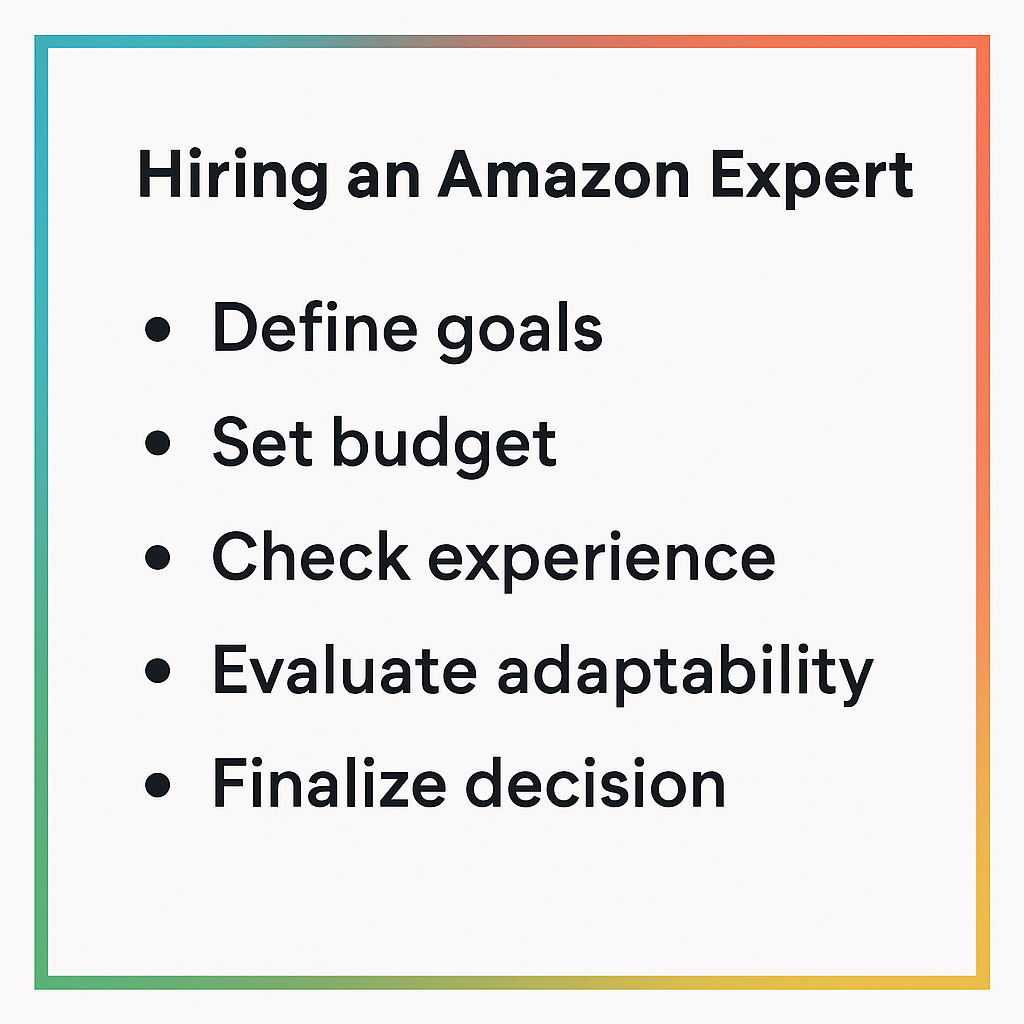
Figuring Out Your Goals

Start with clarity. What do you want to achieve? Do you want more sales, better rankings, higher conversions, or improved operations? Write your goals down and rank them. These goals guide you toward the right Amazon expert for hire.

Setting a Budget

Hiring help costs money. But hiring the wrong person costs more. Consider salary, tools, training, and long-term expenses. Decide your budget early to avoid confusion later.

Getting Help

Professional Amazon service providers such as Vserve can simplify the hiring process. They connect you with trained Amazon Seller Central experts who already understand the ecosystem. You gain expertise without the stress of recruitment.

Get To Know Them

Interview potential experts carefully. Ask about their experiences, strategies, and past results. Pay attention to how they think. Do their answers feel sincere? Do they understand your brand? This step reveals who is truly aligned with your goals.

Finalizing Your Decision

By now, you will have your finalists. Compare skills, communication style, cost, and chemistry. The perfect match feels balanced: knowledgeable, honest, and aligned with your brand. Instinct plays a role too. When everything fits, you’ll know.

Online Shop

Frequently Asked Questions (FAQ)

1. What does an Amazon expert do?

An Amazon expert manages listing optimization, advertising, product visibility, strategy planning, and operational improvements on Amazon.

2. Why should I hire Amazon experts?

Hiring experts saves time, increases sales, reduces mistakes, and ensures your Amazon Seller Central account stays compliant and competitive.

3. What makes a good Amazon Seller expert?

A strong expert is experienced, honest, adaptable, perceptive, and knowledgeable about Amazon’s rules and strategies.

4. Can an Amazon FBA expert help with fulfillment issues?

Yes, they can guide you through FBA setup, inventory management, labeling rules, fee structures, and performance optimization.

5. How long does it take for Amazon Seller Central experts to show results?

Most experts show improvements within a few weeks, but major business growth typically takes 60–120 days depending on strategy.

Conclusion

Amazon selling experts can reshape your business completely. Be it an Amazon expert or a broader team of Amazon Seller expert specialists, they guide strategy, refine your listings, improve advertising, prevent mistakes, and expand your reach. Your chosen expert should understand your brand, respect your goals, and evolve with the changing Amazon landscape.

Finding this person takes patience, thought, and a structured approach. But once you hire the right expert, your Amazon store steps into a new chapter of growth.

With Vserve’s Amazon Listing Services, you gain a partner who understands Amazon deeply. Our strategies, work ethics, and client-focused approach make us the perfect Amazon expert for hire to manage, improve, and scale your store smoothly and affordably.

Suggested Reads

https://www.Amazonlistingservice.com/blog/a-starter-guide-to-Amazon-vendor-central-management/ - Starter guide for understanding Amazon Vendor Central structure.

https://www.Amazonlistingservice.com/blog/top-7-Amazon-store-management-services-for-maximizing-sales-in-2026/ - Breakdown of top store management services for better sales.

https://www.Amazonlistingservice.com/blog/top-9-Amazon-seller-onboarding-mistakes-to-avoid/ - Common onboarding mistakes and how sellers can avoid them.

https://www.Amazonlistingservice.com/blog/top-reporting-tools-for-tracking-seller-onboarding-kpis-2025/ - Tools that help sellers track onboarding KPIs effectively.

A Starter Guide to Amazon Vendor Central Management

A Starter Guide To Amazon Vendor Central Management

Did you know that instead of selling your product directly to customers, you can sell them to Amazon, who will then act as the retailer? This is how Amazon vendor central management works.

You must have heard a lot about Amazon Seller Central, the platform for third-party (3P) sellers. However, there is a lot less conversation about the intricacies of Amazon Vendor Central, the platform for first-party (1P) brands. In this blog, we will take you through the essential guide to Amazon vendor services for today's market, focusing on modern amazon vendor management.

Here’s what you will learn:

  • What is Amazon Vendor Central and how has it changed?
  • How is it different from Seller Central in 2025?
  • What are the core benefits and challenges of the 1P model?
  • What services does effective amazon vendor central management include?

Let’s begin!

Table of Contents

What is Amazon Vendor Central?

Vendor Central vs. Seller Central: The 2025 Landscape

The Advantages of Amazon Vendor Central

Essential Vendor Central Management Services

Frequently Asked Questions

What is Amazon Vendor Central?

Amazon Vendor Central is an invite-only platform where manufacturers and distributors sell their products directly to Amazon in a wholesale capacity. You become the first-party (1P) supplier, and Amazon becomes the retailer.

Here’s how the core process works:

  1. Amazon sends you a Purchase Order (PO) based on its anticipated demand (often using AI-powered forecasting).
  2. You send the products to Amazon’s fulfillment centers.
  3. Amazon sets the retail price, sells the products, handles customer service, shipping, and returns.
  4. Amazon pays you based on the wholesale agreement, irrespective of the final customer sales.

While the model seems lucrative due to its simplicity, the 1P model is currently contracting, leading to an increasing push for brands to adopt a hybrid (1P/3P) or pure 3P strategy. Working with an Amazon vendor central consultant is now vital for navigating these changing terms and maintaining profitability.

Vendor Central vs. Seller Central: The 2025 Landscape

1.Seller Support

With Amazon Vendor Central comes the support of the eCommerce giant itself. Once you become a vendor, Amazon is by your side, and its support can make a huge difference to your business. Be it the catalog updation and management, or customer service, your business leverages more flexibility.

On the other hand, Amazon Seller Central provides minimal support to its sellers. You are on your own when it comes to selling, marketing, and optimizing your products. Amazon offers decent support when it comes to problems related to inventory, payments, and listings. However, one should not expect much.

2.Marketing Support

When you become an Amazon vendor, you get to leverage the Amazon Vendor services. One of them is the advanced marketing support to your brand. Increasing the visibility of your products is easier for vendors than third-party sellers.

Vendor Central partners get access to special marketing features, such as their brand page, A+ content, exclusive promotional programs, vendor coupons, headline ads, and more.

The Seller Central also provides some support to their sellers, such as they can create pricing promotions. However, running those promotions is challenging.

3.Streamlined Business Model

The process of working and conducting the business is a lot simpler for first-party sellers than it is for third-party sellers. Vendors have to focus on filling the orders for Amazon on time and billing it without paying late chargebacks. The platform handles everything else, from selling the products to customer support.

However, a seller has to deal with all the aspects of selling their products, along with handling lost inventory, tax liabilities, and many other costs. Moreover, dealing with competition is a lot more intense for sellers than for vendors. The latter group thrives with the confidence of Amazon.

The Advantages of Amazon Vendor Central

For established, large-scale brands, the 1P model still offers distinct benefits:

1. Consumer Trust and Conversion: The "Sold by Amazon.com" badge instills immense customer trust, often translating to a higher conversion rate compared to third-party listings.

2. Simplified Sales Process: Your primary focus is on timely PO fulfillment. You are relieved of day-to-day administrative burdens like managing customer reviews, handling individual returns, and tax liabilities on sales.

3. Superior Marketing and Content Tools: Vendors receive access to more sophisticated advertising features, including:

  • Premium A+ Content: Enhanced product detail pages with rich media, interactive hotspots, and video modules.
  • Amazon Vine: An exclusive program that offers products to trusted reviewers for honest feedback.
  • Advanced Data: Access to Amazon Retail Analytics (ARA) Premium for deeper insights into sales and inventory forecasting.

Essential Vendor Central Management Services

Given the complexities of chargebacks and Amazon's algorithmic nature, professional amazon vendor amazon vendor central management is critical for protecting profit margins. Services should focus on proactive maintenance and growth:

1. New Item Setup (NIS) and Catalog Optimization: Ensuring new products are set up correctly, with accurate data, optimized listings, and unique A+ Content designed for ranking.

2. Proactive Chargeback and Compliance Management: This is the single biggest threat to 1P profitability. An experienced amazon vendor central consultant will implement strict protocols to avoid common penalties like Late Shipment, ASN Accuracy, and Carton Content Errors, and will manage the tedious process of disputing erroneous claims.

3. Inventory, PO, and Logistics Management: Efficiently tracking inventory, managing PO acceptance/confirmation, and handling all shipping logistics to minimize out-of-stock risks and PO On-Time Accuracy chargebacks. This is core to robust Amazon vendor management.

4. Advanced Advertising and Promotions: Leveraging the full suite of AMS (Amazon Marketing Services) features, including Sponsored Brands and DSP, to drive targeted traffic and maximize return on ad spend (ROAS).

By outsourcing your amazon vendor central management to specialized amazon vendor central consultants, you can focus on brand development while experts ensure compliance and profitability, helping you build a long-lasting and successful relationship with Amazon.

Frequently Asked Questions (FAQ)

1: Is Amazon Vendor Central still invite-only?

Yes, Amazon Vendor Central remains an invite-only platform. Amazon typically extends invitations to large, established brands or successful 3P sellers with high sales volume.

2: What is the biggest financial risk for 1P vendors today?

Chargebacks (also known as deductions or fines). These are penalties Amazon imposes for failure to meet strict operational requirements like late shipments, incorrect labeling, or PO discrepancies, and they can severely erode a brand's profit margins.

3: Can I use both Vendor Central (1P) and Seller Central (3P)?

Yes, this is known as a hybrid model and is increasingly common. Many brands use 1P for their highest-volume, core SKUs where Amazon prefers to buy wholesale, and 3P (Seller Central/FBA) for new product launches, niche items, or products where they need full price control.

4: What is ARA Premium and why is it important for effective amazon vendor management?

ARA Premium (Amazon Retail Analytics Premium) is a vendor-only data reporting tool. It is crucial because it provides deeper insights into consumer search behavior, demand forecasting, and competitor activity, enabling vendors to make data-driven decisions on inventory and advertising.

Top 9 Amazon Seller Onboarding Mistakes to Avoid for a Smooth Product Launch

Amazon Seller Onboarding

Selling on Amazon gives business owners access to one of the largest online marketplaces in the world. However, many sellers underestimate the complexity of the amazon seller onboarding process. A smooth onboarding phase sets the foundation for long term success. Mistakes made early can delay product launches, cause listing issues, or lead to account restrictions.

Whether you are a new brand or an established business entering Amazon for the first time, it is important to understand how the onboarding amazon process works. With proper preparation and the right approach, your launch can move quickly and efficiently. This guide covers the most common mistakes sellers make and how to avoid them.

Table of Contents

Why Smooth Onboarding Matters

Top 9 Amazon Seller Onboarding Mistakes

How Proper Onboarding Helps Business Owners

FAQ

Why Smooth Onboarding Matters

Amazon onboarding is more than filling out forms. It is a structured process that ensures your brand, products, and operations meet Amazon standards. A successful onboarding phase improves compliance, avoids delays, and helps sellers open their listings without unnecessary setbacks.

A clean start also improves customer trust. When your information, product data, and account setup are accurate, customers receive consistent and reliable details. This reduces confusion, enhances the shopping experience, and supports early sales momentum. Many sellers benefit from professional amazon onboarding support to guide them through the process, especially when handling documentation, product setup, and catalog organization.

Top 9 Amazon Seller Onboarding Mistakes

1. Incomplete Business Documentation

Many sellers begin onboarding with missing business licenses or tax documents. This causes account approval delays. Make sure all documents are ready before you begin.

2. Incorrect Brand Registry Information

Submitting wrong brand details can halt progress. Ensure trademarks, brand names, and ownership documents match exactly.

3. Poor Product Data Preparation

Some sellers upload disorganized product information. Amazon requires structured data for titles, attributes, and categories. Good preparation improves listing accuracy and reduces suppressions.

4. Ignoring Amazon Image Requirements

Low quality or non compliant images create delays and listing rejection. Images must follow Amazon guidelines for size, background, and clarity.

5. Lack of Inventory Planning

A product launch fails when inventory is too low or arrives late. Seller onboarding should include inventory forecasting and delivery scheduling.

6. Not Setting Up Fulfillment Correctly

Choosing between FBA and FBM without understanding the requirements leads to fulfillment errors. Ensure your fulfillment setup fits your capacity and goals.

7. Skipping Product Compliance Checks

Some categories require safety certificates, testing reports, or regulatory documents. Missing these can stall listings for weeks.

8. Not Coordinating With the Amazon Onboarding Team

When Amazon provides onboarding support, some sellers ignore guidance or respond slowly. Timely communication keeps the amazon onboarding process moving.

9. Rushing Through Listing Creation

Quick uploads often contain errors. Product descriptions, keywords, and attributes must be accurate to prevent problems during launch.

How Proper Onboarding Helps Business Owners

Proper seller onboarding gives your business a strong foundation. It reduces friction in the early stages of selling and helps you avoid common pitfalls. With clean data and proper compliance, your listings become more stable and less likely to face interruptions.

A smooth onboarding process also builds a professional presence on Amazon. Customers trust brands that present accurate information, organized catalogs, and high quality visuals. With help from an experienced amazon onboarding team, you can save time and focus on strategic decisions instead of technical tasks. Even subtle improvements in onboarding can lead to better rankings, stronger conversions, and fewer product related issues after launch.

FAQ

1. Why does Amazon onboarding take time?

Because Amazon verifies business details, product data, and compliance information.

2. Can someone help me with the onboarding process?

Yes. Many teams offer amazon onboarding support for account setup and product preparation.

3. What causes onboarding delays?

Incomplete documents, incorrect data, and missing product requirements.

4. Is onboarding required before launching products?

Yes. Your account and listings must pass Amazon checks before going live.