
Amazon Listing Optimization Archives - Amazon Listing Service

Category: Amazon Listing Optimization

Step by Step Guide on How to Sell Products on Amazon

Step By Step Guide On How To Sell Products On Amazon

After corporate giants like Apple, Alphabet, and Microsoft, Amazon stands tall as one of the most influential organizations in the world. It is a daily reflex for millions of buyers. For some, it has become a habit. As early as 2008, Amazon recorded around 615 million visitors. Over the years, it invested heavily in campaigns, spending millions to strengthen its bond with shoppers. In mid-2025, amazon.com was receiving roughly 2.7–2.8 billion visits per month, making it one of the most visited e-commerce sites globally.

That number has only grown.

Today, the Amazon marketplace is a massive global stage where established brands and first-time sellers stand side by side. It offers reach, trust, and a selling potential that few platforms can match. If you are wondering how to begin and how to sell smartly, this step by step guide on how to sell products on Amazon will quietly guide you forward.

Before acting on these steps, let us pause and understand why selling on Amazon makes practical sense.

  • Selling on Amazon gives you access to crores of customers worldwide.
  • It comes with a reliable, fast, and mostly stress-free shopping experience.
  • There are no fixed costs. You pay only when your product sells.
  • You also gain access to professional tools and services through Amazon Seller Central that support sellers at every stage.

These reasons alone explain why so many businesses choose Amazon as their first online selling home.

Table of Contents

Advantages of Being an Amazon Seller

A Step-by-Step Guide on How to Sell Products on Amazon

Frequently Asked Questions

Conclusion

Amazon Seller

Advantages of Being an Amazon Seller

There are many advantages to becoming an Amazon seller, and most experienced sellers will nod quietly in agreement.

Amazon attracts millions of daily visitors, making it one of the most trusted platforms for selling online globally. This visibility gives your products a chance to be seen without heavy upfront marketing spend.

Amazon also uses advanced systems and best practices to ensure product visibility. Its algorithms, data structures, and listing rules are designed to surface relevant products at the right time.

The fulfillment options are flexible. You can choose Fulfilled by Amazon (FBA), Fulfilled by Merchant (FBM), or pickup options available in select locations. Each model suits a different business rhythm.

The Amazon seller account dashboard is simple, clean, and surprisingly friendly. You do not need to be a technical wizard to manage inventory, track orders, or review payments.

Fees are clearly mentioned and competitive. You pay when you sell, not before.

Another silent advantage is growth. Selling on Amazon helps businesses expand their online footprint while learning the discipline of structured product data, often guided by a product information management guide approach.

A Step-by-Step Guide on How to Sell Products on Amazon

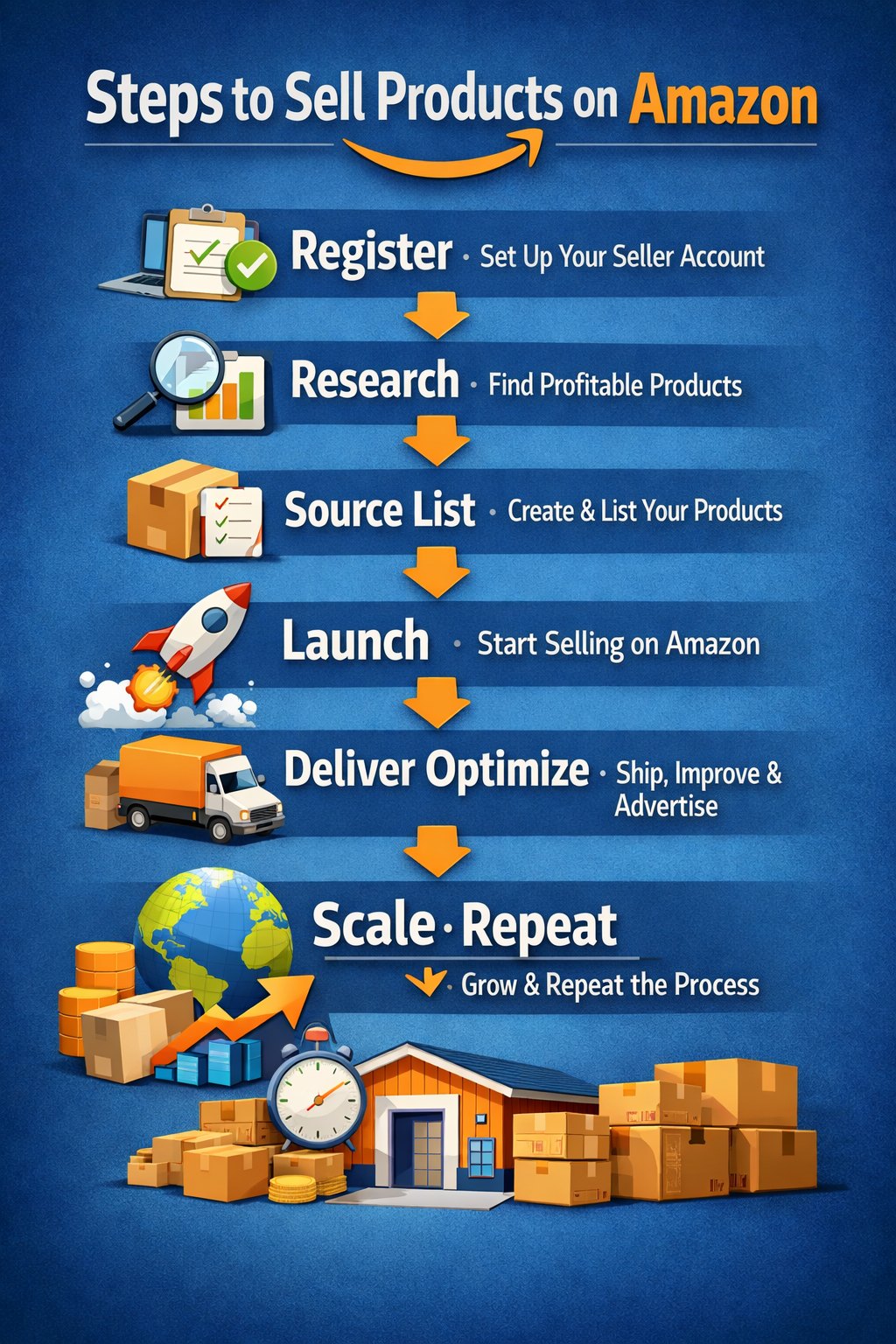
Selling on Amazon is not complicated, but it is methodical. Each step builds the next.

Register as an Amazon Seller

The first step is Amazon seller registration. You need to create your Amazon seller account by submitting the required documents. These include identity proof, bank details, tax information, and business credentials.

Registration happens through Amazon Seller Central, which becomes your control room. From here, you manage listings, pricing, orders, and performance.

Once approved, your seller account becomes active and ready.

Research Products

Before listing anything, study what sells and what sleeps. Amazon provides tools like Best Seller Rank that help sellers understand demand patterns. Products ranked higher generally indicate faster movement, but niche products with lower ranks can also perform well if positioned correctly.

Look at pricing, reviews, competition, and customer questions. Research helps you decide what to sell, what to avoid, and where opportunity hides quietly.

This step becomes easier when you treat product data as an asset, something a product information management guide often emphasizes.

Right Suppliers

Identify and Find the Right Suppliers

Consistency depends on supply.

You need reliable suppliers who can deliver quality products regularly. These could be wholesalers, distributors, local manufacturers, or long-term partners.

If you sell your own brand, ensure that your products meet Amazon’s quality, compliance, and packaging standards. Products that fail these checks may be rejected.

Here are a few ways sellers source products:

  • Buy from wholesalers and sell at labeled prices.
  • Purchase bundles and sell items individually.
  • Form long-term dealer partnerships for better margins.
  • Source unique local or regional products.
  • Create and sell your own innovative products.

Each approach works differently, but all require discipline and trust.

Create a Listing of Your Products Using Amazon Seller Central

Product listing is where visibility begins.

A product listing includes title, description, images, bullet points, backend keywords, and technical attributes. It is content with structure.

If listings feel overwhelming, professional help can simplify the process. Accurate and updated listings help your products rank better and convert faster.

This is also where sellers using Amazon Vendor Central differ from third-party sellers, as vendors follow Amazon’s wholesale-driven model, while sellers control pricing and listings directly through Amazon Seller Central.

Make Sure That Your Amazon Store Is Live on the Amazon Marketplace

Once listings are complete, your store goes live. Customers browse, compare, and purchase. Orders appear in your dashboard. Amazon handles delivery if you choose FBA, or you manage shipping under FBM.

Payments are deposited into your bank account within a set cycle. Fees are deducted only after a sale occurs. From here, selling becomes a rhythm. Adjust pricing, improve listings, and track feedback. This helps you to grow steadily.

Frequently Asked Questions

1. What is the difference between Amazon Seller Central and Amazon Vendor Central?

Amazon Seller Central is for third-party sellers, while Amazon Vendor Central is for brands selling wholesale directly to Amazon.

2. How long does Amazon seller registration take?

Amazon seller registration usually takes a few days if the documents are accurate and verified quickly.

3. Is an Amazon Seller account suitable for small businesses?

Yes, an Amazon Seller account is ideal for small and growing businesses due to low entry barriers.

4. Do I need a product information management guide to sell on Amazon?

While not mandatory, a product information management guide helps maintain accurate and scalable listings.

5. Can I sell internationally on the Amazon marketplace?

Yes, Amazon allows sellers to expand to global marketplaces with proper compliance.

Conclusion

The world of online selling keeps expanding. Buyers multiply, and expectations rise. Platforms evolve.

Amazon remains a powerful place to sell, grow, and learn. When launching your first product or refining an existing store, following the right steps makes the journey smoother.

This step by step guide on how to sell products on Amazon shows that success is structured and intentional.

Ready to simplify selling on Amazon?

Vserve Amazon Listing Services helps you manage product data, optimize listings, and scale with confidence. From product onboarding to listing enhancement, Vserve ALS supports your Amazon journey from start to finish.

Contact Vserve Listing Services today.

Suggested Reads

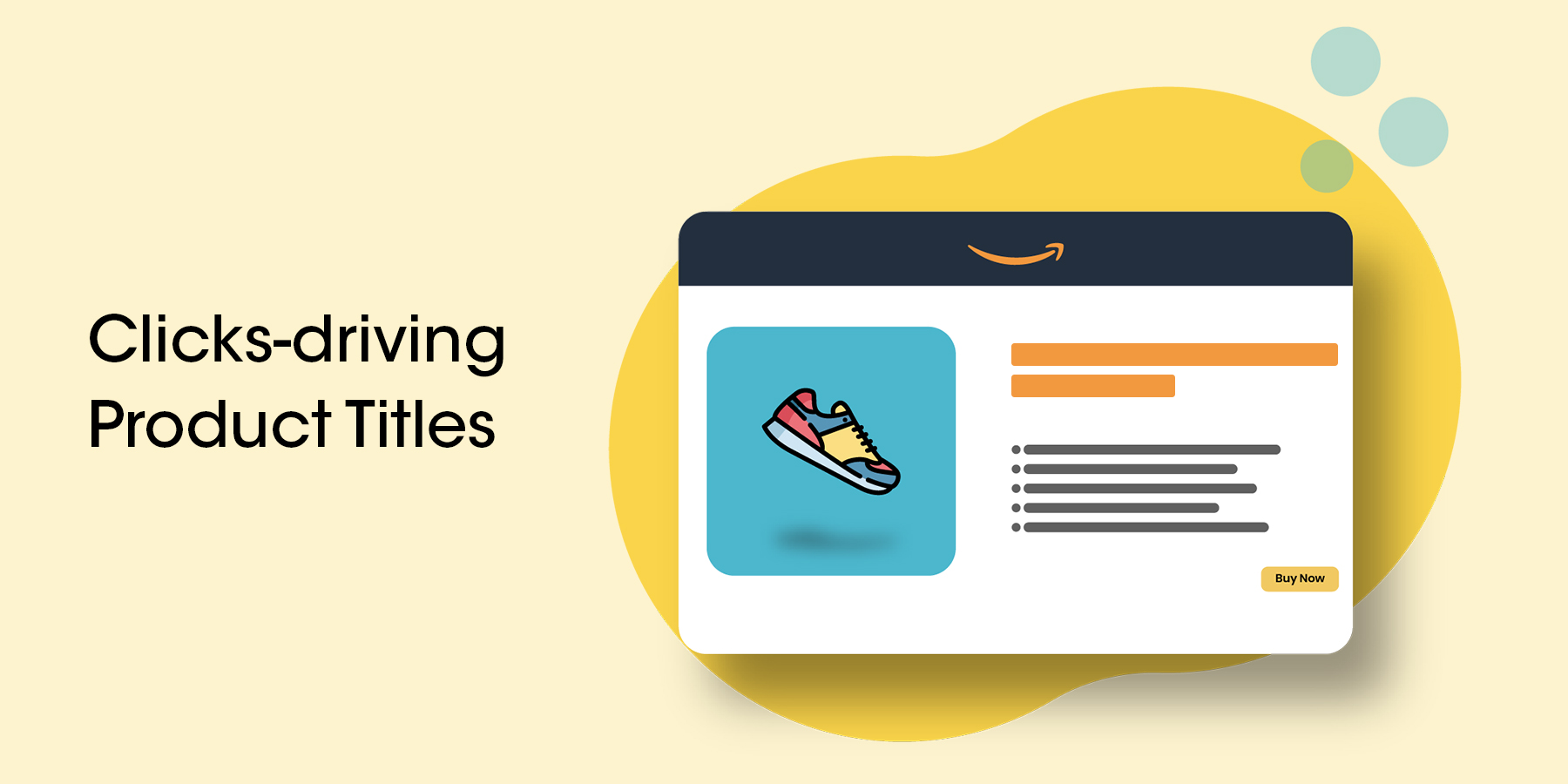
Tips to Write Amazon Product Titles that Drive Clicks

Tips To Write Amazon Product Titles That Drive Clicks

An attractive and practical product title is the single most important element that gravitates your customers towards your products!

In a sea of similar products with similar price ranges, you need to ensure that your Amazon content optimization is at the top of its game. This optimization is what will help your product rank higher in the Amazon search results and, crucially, earn the click. Otherwise, your product will never be seen by your target customers and will fail to sell.

If you are wondering how to proceed, take a look at our top tips for Amazon content creation with specific reference to product titles that drive clicks, now updated for the latest A9 algorithm insights.

Table of Contents

Understanding the Dual Goal of Product Titles

The Golden Rule: Character Limit & Readability

Best Practices for High-Converting Titles

Advanced Keyword Strategy for A9

Understanding Customer Needs and Intent

Critical Elements to Avoid in Your Title

Frequently Asked Questions (FAQs)

Understanding the Dual Goal of Product Titles

A key aspect to remember is that you need to appeal to both your target customers and the search engine (A9). You may have come across many Amazon products with lengthy, keyword-stuffed titles. While these titles may help them rank up in the search engine, they are visually unappealing and hurt readability. Conversely, titles that are creative but lack proper keywords will fail to rank.

Understanding this thin line is essential for you to plan your keyword placement and marketing strategy in a way that considers both Amazon SEO optimization and customer needs.

The Golden Rule: Character Limit & Readability

While writing your product title, ensure that the title is concise and clear.

  • Updated Character Limit: The official Amazon guideline for most categories is a maximum of 200 characters, including spaces. Exceeding this limit can lead to title suppression or poor display on mobile.
  • The Recommended Length: Despite the 200-character cap, the latest authoritative best practices from Amazon recommend using 80 characters or fewer because most mobile screens truncate long titles at around 75-80 characters. This is your golden range that will hook your consumers as well as the A9 algorithm without being cluttered.

Data Insight: According to Amazon Seller Central's official guidelines, keeping titles concise (ideally 80 characters or fewer) is crucial because mobile screens often truncate longer titles, which can hide essential information.

Best Practices for High-Converting Titles

Following best practices ensures your titles contain the necessary details for quick product understanding, which is a major factor in improving Click-Through Rate (CTR)—a key signal for the A9 algorithm.

Essential Details to Include

The recommended structure for an Amazon product title is:

1. Brand Name (Start with this for brand recognition and trust)

2. Product/Model Name (The core product type)

3. Key Feature/Material (Unique Selling Proposition)

4. Size/Color/Quantity (Crucial purchase-driving details)

Title Formatting Checklist

In terms of writing optimized content for your title, you should:

  • Capitalize the first letter of each word, except for prepositions (like in, on, over), conjunctions (like and, or, for), and articles (like the, a, an).
  • Use numerals ("2" instead of "two").
  • Spell out units of measure ("inch," "ounce"), or use standard abbreviations ("cm," "oz").
  • Use the word "and" instead of the ampersand symbol (&) unless the ampersand is part of the brand name.

Advanced Keyword Strategy for A9

Keyword research is imperative for Amazon SEO optimization. Since Amazon has its search engine known as A9, the focus area is on maximizing conversion and sales.

  • A9's Focus: The A9 algorithm prioritizes a product's Performance Factors (like Click-Through Rate, Sales Velocity, and Conversion Rate) alongside Relevance Factors (keyword match). The algorithm is fundamentally designed to show the most relevant product that is most likely to sell.
  • Primary Keyword Placement: Current A9 strategy suggests placing your main, high-volume keyword phrase within the first 80 characters of the title. This gives it maximum indexing weight and ensures it is visible on mobile devices.
  • Avoiding Repetition: A key update from Amazon's latest guidelines is that titles must not contain the same word more than twice, excluding prepositions, articles, and conjunctions. This prevents keyword stuffing and forces sellers to be more strategic with their limited space.

Leveraging Amazon's Search Bar

  • Pro Tip: You can use Amazon's search bar to round up some keywords for your product title. For example, if you want to sell “coffee mug,” type that into the Amazon search bar and see the automated suggestions (e.g., “coffee mug warmer,” “coffee mug with lid,” “coffee mug set of 6”). These are high-volume, relevant customer search terms that should be incorporated into your title or backend search terms.

Understanding Customer Needs and Intent

Nowadays, consumers like to make their decisions quickly. They will click on the most relevant title that clearly addresses their need.

Your product title must be informative and appeal to the customer's intent. You can enhance the title by:

  • Adding an emotional adjective: “Facial Cleansing Brush for Beautiful Skin”
  • Adding a practical adjective: “Powerful Emergency Light for Camping Needs”

Such descriptive words instantly connect with the relevant customers and peak their interest. While sticking to a word limit is complex, remember that one word can completely change your title's tonality and connection with the customer.

Critical Elements to Avoid in Your Title

The following are strictly prohibited by Amazon and will cause listing suppression or lower ranking:

  • Price: Amazon already displays this information.
  • Promotional Offers: Avoid terms like "Free Shipping," "Best Seller," or "Limited Time Offer."
  • Special Characters: New policy updates from Amazon strictly disallow characters like !, $, ?, _, { , }, ^, ¬, and | unless they are part of the brand name. Use standard punctuation only.
  • Subjective Commentary: Phrases like "Highest Quality" or "Hot Item" are considered subjective and are not allowed.
  • Words in ALL CAPS: This is visually unappealing and will result in listing suppression (you should only capitalize the first letter of each major word).

Frequently Asked Questions (FAQs)

1. Why is my Amazon product title so important?

It's the first thing customers see, and a good title makes people click on your product instead of a competitor's. It also helps Amazon's search engine (A9) find and show your product to the right shoppers.

2. How long should my product title be?

The best length is 80 characters or less. While Amazon allows up to 200, shorter titles are fully visible on phones and tend to get more clicks.

3. What are the most important things to put in my title?

Always start with your Brand Name. Then include the Product Name, a Key Feature (like the material), and important details like Size or Color.

4. Where should I put my main keywords?

Your most important keyword or phrase should be in the first 80 characters of the title. This ensures it's visible on mobile and helps Amazon understand what your product is.

5. Can Vserve help me write better Amazon titles?

Yes! Vserve specializes in Amazon content optimization. We can help you create titles that use the best keywords, follow all of Amazon's rules, and are designed to drive more clicks and sales.

6. Does Vserve ensure my titles follow Amazon's rules?

Absolutely. We stay updated on the latest Amazon policies (like avoiding ALL CAPS, price, or too many special characters) to make sure your listing doesn't get suppressed and ranks properly.

Understanding Amazon Listing Optimization for a Successful Product Launch

Understanding Amazon Listing Optimization For A Successful Product Launch In 2021

It's both exhilarating and difficult to launch a new product.

There's nothing more exciting than seeing your product on the market. It can, however, feel like you're in a mad scientist's laboratory. You can see that it is complete with science equipment, levers, and flashing buttons you can’t wait to touch. However, there are no clear directions on what to do.

What most people don't realize is that a successful product launch on Amazon involves extensive research, time, and effort.

Table of Contents

Product Launch Page Optimization Strategy

Keyword Research and Optimization

Product Page Structure and Style Guide

Product Images

A+ Content

Post Launch Strategy

Boosting New Product Visibility with Amazon Sponsored Ads

Restock Inventory

Build a Solid Content Strategy

Bottom-line

FAQ

It's not only an issue of putting your product on the market or having a great product. Rushing into it may turn a sure-fire triumph into a costly and disappointing start.

An excellent product will fail in the market because of a poorly-planned product launch on Amazon.

For your product launch on Amazon to be successful, you'll need a well-thought-out core strategy. According to Jungle Scout, 58% of Amazon sellers achieve profitability within their first year of launching. Additionally, 19% of small business sellers reach average monthly sales exceeding $10,000.

You’ll have to make use of various methods such as Amazon A+ content. It’s also important to understand Amazon Sponsored Ads and everything related to that.

You will need to take several steps to create a successful product launch on Amazon. Figuring out what tools you'll need to use is key to making sure your product launch goes well.

Understanding Amazon Listing Optimization For A Successful Product Launch

Product Launch Page Optimization Strategy

Product Page Content

Only 2.42% of site visits result in a purchase on average. This is bad news for online sellers. The most common cause of this is due to poorly designed pages. You will lose prospective consumers if you have a non-refurbished product page.

On their pages, the majority of successful online firms employ a CRO strategy. You can use customer testimonials, reviews, or product suggestions.

The most successful of the pack employs a combination of CRO methods, as well as a few extras, to boost the effectiveness of the strategies.

By optimizing your pages, you may convert those who only visit them into sure consumers.

Another tool that can help you with this is Amazon A+ Content, which you will learn about in a few more topics.

Keyword Research and Optimization

A keyword is a word or a combination of words that someone types into a search engine or search bar on the internet.

To maintain an online presence, you must conduct keyword research.

Keyword research may provide you significant insight into the Google searches that your target market is searching for.

The knowledge you may get from this study can assist you in developing a well-thought-out keyword approach.

Your keywords can help your pages get to the top of search results.

With Amazon listing optimization, you may improve your search visibility, click-through rate (CTR), and conversion rate (CR), resulting in more sales.

You may target these keywords in your headlines, bullet points, and description. Amazon SEO and customers’ demands are your main goals when thinking and considering keywords.

Product Page Structure and Style Guide

Customers will remember your brand if you maintain consistency throughout all of your material.

This is why maintaining a consistent brand image is so important.

Having consistency on all of your product detail pages is an excellent method. This way, your brand, and products are easily identifiable throughout the world.

There are distinct sets of “style rules” that you must follow while creating content. The rules usually differ according to each country.

Amazon's standards ban the use of words such as "high-quality" and "best on the market” on listings. You must consider the varying market-based needs while developing content.

Product Images

This details another importance of Amazon listing optimization. You need to have your product page optimized. This is because product images are the first thing customers see.

When a picture contains text in a certain language, it's important to maintain that the text is consistent with the product description. Keeping the photos in the same sequence as on other sites or pages is also essential.

After seeing the initial product image, buyers should have all the information they need to make a purchasing choice. This is especially significant because people regularly multitask while shopping on their phones.

A+ Content

Images, text, and other visual cues are vital parts of Amazon A+ content. There are a lot of templates to choose from. With A+ content, you'll not only increase sales but also establish a high-quality brand presence on Amazon.

According to Amazon, A+ content may assist a product's overall sales to improve by up to 10% on average. It serves as an Amazon listing services enhancement tool that creates visually appealing web content for your items. It aims to grab the attention of your customers.

Post Launch Strategy

Drive Traffic to your Site

After your product has launched, there are quite a few tasks to undertake. You'll need to make sure that your website's online traffic keeps growing. Amazon listing enhancement is necessary for a solid and continuous flow of online traffic.

There are several strategies to improve traffic to your website. Things like reviews, customer recommendations, and Amazon Sponsored Ads can pull customers toward your product.

You should concentrate on the outcomes rather than the details. It's also critical that you emphasize how your product benefits customers rather than concentrating just on how great you and your organization are.

Get Reviews and Create Social Proof

Any online seller who wants to have a consistent and strong presence on Amazon needs to pay attention to reviews. Customers believe in product reviews because they are expected to be genuine.

Amazon and its policies regulate product reviews and seller feedback. It's best to start being familiar with them.

Product reviews are also necessary for your product to rise to the top of the ranking system. PPC campaigns are impossible to run without them. You must put in as much effort as possible to receive positive reviews.

Boosting New Product Visibility with Amazon Sponsored Ads

The use of Amazon Sponsored Advertisements for new products is a very powerful way of increasing visibility fast and driving traffic on one of the largest internet platforms. Companies can target specific audiences through Amazon Sponsored Ads by selecting keywords, concentrating on locations, and applying demographic criteria to ensure that their advertisements are exposed to high-potential clients. This focused strategy is very important for building awareness, boosting early sales, and collecting vital information on consumer behavior and preferences for new products. With Amazon Sponsored Ads, you get to place your product front and center in search results and on product pages, thus putting it ahead of competitors and removing the delay linked with organic rankings.

Clear objectives must be set, and Amazon Sponsored Ads performance must be closely monitored to gain the best possible outcome. Click-through rates, conversion rates, and cost per acquisition would help in evaluating ad performance by allowing adjusting of ads to optimize results. With A/B testing in Amazon Sponsored Ads, you can test the different ad versions and find the best message and creative components of the ad. Retargeting techniques are also applied by Amazon Sponsored Ads to attract users again who were initially interested but did not convert. In this way, Amazon Sponsored Ads increase first-party sales and provide information for streamlining general marketing strategies, providing good support for a product's achievement.

Restock Inventory

One of the most critical skills you'll need is effective inventory management.

You must prepare for the possibility that your sales may grow, and you must resupply your goods ahead of time. There is a risk of running out of supplies before they arrive if you restock at the last minute. This may have an impact on the amount of activity on your product page.

When you run out of goods, your page's activity will reduce until it comes to a standstill. This is the last thing you want to happen.

Build a Solid Content Strategy

It's impossible to make a sale if your buyer has no idea what your product is or how it will benefit them.

Customer retention, or recall, is the objective of every successful marketing strategy. Your product must be the first thing that springs to mind for your consumers when they think of anything similar.

With this in mind, having a great marketing team behind your product is critical.

Focusing on the advantages of your product and how it is vital for your clients' needs and wants is one of the finest methods to ensure this happens.

Knowing your target audience through conducting online research, particularly on social media, to learn about their opinions and needs for your product.

Bottom-line

Launching a product can be as terrifying as admitting your feelings, but you must plan ahead of time to ensure its success.

Now that you understand how things like Amazon A+ Content work, you should take advantage of Vserve’s Amazon Listing Services.

You can count on us to provide distinct, comprehensive, and appropriately classified listings.

To make it more enticing to clients, prices are created to be competitive.

It is there to help you every step of the way because we at Vservice understand how overwhelming this is for you.

We guarantee that all that mumbo jumbo about Amazon listing enhancement and Amazon Sponsored Ads are not that hard to understand. We'll be there to help you every step of the way.

FAQ

1. How does Amazon A+ Content help my product launch?

A+ Content uses images and better text layouts to make your product page more visually appealing. On average, Amazon reports that using these tools can increase a product’s overall sales by up to 10% by grabbing customer attention and building brand trust.

2. What happens if I run out of stock shortly after launching?

Running out of inventory is a major risk. If your stock hits zero, the activity on your product page will drop or come to a standstill. This can damage your search rankings, so it is critical to plan ahead and restock before you completely run out.

3. Why are product reviews so important for my new listing?

Reviews provide "social proof" that customers trust. Without positive reviews, it is nearly impossible to rank high in search results or successfully run Amazon Sponsored Ads (PPC) campaigns, as shoppers use reviews to decide if a product is genuine.

4. How do Amazon Sponsored Ads help a product that has no organic ranking yet?

Amazon Sponsored Ads place your new product front and center in search results and on competitor pages immediately. This removes the delay of waiting for organic rankings to grow, helping you build early awareness, drive initial sales, and gather vital data on customer behavior from day one.

Top 6 Benefits of Outsourcing Amazon Listing Services

Top 6 Benefits Of Outsourcing Amazon Listing Services

A persuasive product listing is the secret doorway to profit and visibility on Amazon. The sooner your Amazon product listing goes live, the faster you start getting returns on your sales. Yet the real question is, do you have the time, energy, and patience to handle it? You have to take care of bulk uploads, detailed product descriptions, keyword optimization, compliance checks, and more.

If the answer is no, then the solution is simple. It is time to outsource Amazon listing services. Why struggle with repetition when you can delegate to experts in Amazon outsourcing services who turn product chaos into polished listings? By doing so, you unlock focus for your business while specialists handle the mechanics.

Table Of Contents

Amazon Is Changing The eCommerce Game
Outsourcing Amazon Listing Services Is The Right Choice For Small Businesses
Time To Focus On Revenue Earning Opportunities
Expert Support
Boost Page Ranking
Increase Conversion
Cost Benefits
Scalability
FAQs About Outsourcing Amazon Listing Services
Final Thoughts

Amazon Is Changing The eCommerce Game

Amazon is no longer just a platform—it’s a world of its own. Did you know that more than 60% of all Amazon sales come from third-party (3P) sellers, and that 58% of sellers are profitable within a year of launching their business on Amazon? In 2019, third-party sellers were the ones that drove half of Amazon’s global sales. Thus, both small businesses and global brands are attracted to this platform like a magnet. Amazon is reshaping how commerce works.

But don’t be fooled. Success on Amazon is not simply about creating an account and throwing products online. It requires a sharp Amazon outsourcing strategy, precise listings, optimized content, and flawless execution. The right listing differentiates your brand, even in a marketplace crowded with nearly identical products.

Top 6 Benefits Of Outsourcing Amazon Listing Services

Outsourcing Amazon Listing Services Is The Right Choice For Small Businesses

Managing Amazon listings isn’t rocket science, but it is a discipline best left to professionals. eCommerce product listing outsourcing frees businesses from monotonous work while leveraging the power of seasoned experts. Be it Amazon FBA outsourcing or Seller Central, outsourcing ensures compliance, accuracy, and efficiency.

In a world where every second counts, an expert partner allows you to focus on your vision instead of the mechanical labor of uploading and optimizing.

Time To Focus On Revenue Earning Opportunities

Top 6 Benefits Of Outsourcing Amazon Listing Services

Updating PPC campaigns, monitoring competitor moves, uploading new SKUs—it all consumes endless hours. Add in writing polished descriptions and optimizing keywords, and you’ll find yourself drowning.

Through outsourcing Amazon listing management, experts take over these repetitive but critical tasks. That means more of your time goes into scaling, brand promotion, and customer retention. An outsourcing partner ensures listings remain updated, accurate, and conversion-ready—so you regain both hours and energy to build growth.

Expert Support

Amazon operates inside a sealed ecosystem, with rules only experts truly understand. While you might scratch the surface of listing basics, outsource Amazon optimization services offer far deeper expertise. They refine every product title, bullet, image, and keyword to align with Amazon’s ever-changing algorithms.

Outsourcing partners can even support Seller Central and Vendor Central accounts, offering end-to-end coverage. In short, Amazon outsourcing services let you harness years of professional knowledge without having to build it in-house.

Boost Page Ranking

A listing that looks attractive but ignores keyword strategy is a wasted opportunity. To climb both Amazon and Google search ladders, optimization is essential. Outsource Amazon listing service providers, and your listings will shine.

They weave product keywords, secondary variations, and natural readability into each listing. This not only improves ranking but also strengthens discoverability. With the right Amazon outsourcing strategy, your product won’t just sit in the catalog; it will rise above the noise.

Increase Conversion

Shoppers crave details. They want words that mirror the experience of holding a product in a physical store. For a handful of items, you may manage that. For hundreds or thousands, it becomes unbearable.

This is why the solution to outsource Amazon listing services exists. Professional teams craft compelling content, curate flawless images, and ensure transparency. They know how to highlight features, benefits, and differentiators in ways that nudge browsers into buyers. Conversion rises because listings tell stories that customers want to believe.

Top 6 Benefits Of Outsourcing Amazon Listing Services

Cost Benefits

Hiring full-time employees for listing tasks means ongoing salaries, training, and overhead. By contrast, Amazon outsourcing services are more flexible. You pay per project or hourly, reducing long-term costs.

With ecommerce product listing outsourcing, you receive the advantage of a full professional team—often at nearly half the cost of internal staffing. Savings here can be redirected into advertising, product development, or customer service.

Scalability

Business is not static. During seasonal booms, you’ll face massive SKU growth. Without a scalable solution, you risk late uploads, missing updates, and lost sales. Outsourcing solves this.

With Amazon FBA outsourcing and listing management experts, you can scale upward when volumes spike and scale back when the rush ends—without the pain of hiring or layoffs. This flexibility is a hidden yet powerful benefit of outsourcing.

FAQs About Outsourcing Amazon Listing Services

1. What is eCommerce product listing outsourcing?

It’s the process of hiring experts to manage Amazon product uploads, optimization, and updates.

2. How does outsourcing Amazon listing management save time?

It frees sellers from repetitive listing work, letting them focus on growth.

3. Outsourcing Amazon listing service: is it cost-effective?

Yes. It reduces staffing and infrastructure expenses while delivering expert quality.

4. Can Amazon FBA outsourcing improve store performance?

Absolutely. Experts ensure listings are optimized for conversions and compliance.

5. What should I look for in Amazon outsourcing services?

Experience, scalability, and a proven Amazon outsourcing strategy tailored to your business needs.

Final Thoughts

Outsourcing Amazon listing services is about saving time and amplifying growth at the same time. The right partner helps you gain expertise, scalability, cost savings, and conversion-ready listings that fuel your Amazon presence.

When you choose to outsource Amazon listing services, you’re not just delegating tasks—you’re building a smarter, more sustainable business model.

We’d love to hear your thoughts—share your experiences and perspectives in the comments below to keep the conversation alive.

Want more insights on Amazon listing optimization and the latest trends? Follow Vserve on Facebook, Instagram, and LinkedIn. Stay connected with us as we explore and navigate the fast-shifting world of eCommerce together.

Transform Your Store With Vserve Amazon Listing Services

Vserve is your trusted partner for outsourcing Amazon listing management. From keyword-rich product descriptions to professional images, we handle everything. With our Amazon outsourcing services, you can choose to outsource Amazon optimization services, or you could select Amazon FBA outsourcing and full ecommerce product listing outsourcing solutions.

Explore Vserve Amazon Listing Services

Suggested Reads:

Increase Traffic to Your Amazon Listing Product

Increase Traffic To Your Amazon Listing Product

The Amazon Marketplace is similar to other marketplaces in terms of being lucrative and crowded. To gain maximum profits as a seller, you have to be the most unique among the other two million sellers on the platform. But if you are successful in grabbing your buyer's attention, the sale is bound to happen. The average rate of conversion in Amazon is 15%, which means it is three times higher than a regular e-commerce website. Therefore, the key to driving your buyer's attention towards your brand is maximizing your Amazon product listing. There are thousands of products on the marketplace, making it difficult for buyers to notice everyone. Hence, make it convenient for your buyers to find you by working on your Amazon listing optimization and understanding how to drive traffic to Amazon listing effectively.

Table of Contents

Why driving traffic to your Amazon product listing is important?

Prepare Your Listing for Maximum Impact

How to derive traffic on your Amazon product listing?

Advanced Strategies to Maximize Amazon Listing

Common Mistakes to Avoid

Why Outsource to Amazon Listing Experts?

Frequently Asked Questions (FAQs)

Start Now!

Why driving traffic to your Amazon product listing is important?

As the sponsored advertisement costs and Amazon seller competition is increasing day by day, you need to get one step ahead by looking for additional ways to drive organic traffic to your Amazon product listing. Although Amazon already offers incredible internal advertising solutions to sellers, it is still necessary to derive external traffic on your Amazon listing products to increase product visibility on Amazon and improve Amazon visibility.

Before you begin with the process of how to increase traffic to your Amazon store, you should make sure that your Amazon listing optimization is accurate, with a decent conversion rate. A robust Amazon listing optimization includes the following:

  • SEO-friendly content
  • High-quality images
  • Thorough product information
  • 25-35 reviews with at least a rating of 4 stars.

The primary benefit of optimizing your Amazon product listing is that you can grow Amazon listing performance and derive external traffic directly at your Amazon storefront without competition or ads. Did you know, according to Salesduo, Amazon conversion rates are notably high, typically ranging between 10–15% for well-optimized listings, compared to the average of 1–2% in general e-commerce?

Did you know, according to Salesduo, Amazon conversion rates are notably high, typically ranging between 10–15% for well-optimized listings, compared to the average of 1–2% in general e-commerce.

Increase Traffic To Your Amazon Listing Product

Prepare Your Listing for Maximum Impact

Driving external traffic won’t help if your listing isn’t fully optimized. To maximize Amazon listing results:

  • Ensure product titles and descriptions are keyword-rich yet natural.
  • Add high-resolution product images with lifestyle shots.
  • Maintain up-to-date inventory to avoid “out of stock” penalties.
  • Gather authentic reviews and maintain a 4+ star rating to increase trust.

By preparing your listing thoroughly, you create a strong foundation to get traffic to Amazon listing and convert visitors into buyers.

How to derive traffic on your Amazon product listing?

To increase traffic to Amazon listing and boost your product visibility, we have highlighted a few essential techniques. These strategies will help you lead buyers right to your Amazon store and make their way down your sales funnel to become loyal customers. These steps are also effective when learning how to get traffic to your Amazon listing.

Amazon listing optimization with SEO.

Search engine optimization is key to how to drive traffic to Amazon listing. Both shoppers who already exist on Amazon and external buyers who use other sites will find your Amazon listing products if you use appropriate keywords. In addition, other websites along with Amazon determine that your Amazon product listing is authentic and relevant, thus ranking it higher on the search engine.

  • Google Keyword Planner: This tool is free, indicating the search volume of keywords on the Google search engine, month-wise. Since Amazon product listing has high ranks on Google, this tool might prove extremely useful.
  • Scope: This is a keyword tool that is specially created for Amazon listing optimization. It offers tracking of keywords' monthly volume, estimated sales, ranking position, and much more.

Placing these keywords strategically throughout your Amazon product listing helps you increase product visibility on Amazon.

Buying sponsored products ads.

Even by doing the best of search engine optimization, there is no guarantee that your Amazon product listing will rank higher on the Amazon search results. The marketplace considers some additional ranking factors like price, selling history, reviews, etc. Therefore, if you want to gain more control over the visibility of your Amazon product listing, you can pay for your ads to get sponsored to place them in higher search results. Moreover, you only need to pay when a buyer clicks on your sponsored ad, making your Amazon promotion a guaranteed payoff. This is another approach to consider when planning how to increase page views on Amazon.

Sharing your Amazon product listing on social media.

The average person spends almost three to four hours on social media daily. Considering this popularity, promoting your Amazon product listing on social media is a great way to increase traffic and get your products in front of thousands of potential buyers. Here are a few ideas on how you can subtly share your Amazon product listing on social media:

Share content linking your Amazon product listing: Post helpful and informative blogs and articles, including a link to your Amazon listing products. You can even create how-to-do videos for the same purpose.

Make promo codes: As a professional seller, you can create promotional links and share them on your social media business account to offer deals and discounts to your customers. Unlike traditional ads, sharing promo codes increases user value, as they can save money when buying from your Amazon product listing.

Running Competitor Analysis.

To make your Amazon product listing internally visible, it needs to stay one step ahead of your competitors' Amazon listing products. If you fail to monitor how your competitors engage their shoppers, your product listing will always fall behind in getting higher search rankings and gaining buyers' attention.

To keep your Amazon product listing always on top in the search engine, you must monitor the following few factors:

Price: Every buyer is attracted to an online store when it offers its products at a lower price than others. Therefore, try to price your goods in the Amazon product listing lower or the same as your competitor's product rates.

Product images: Visuals are a significant factor in encouraging online sales. While shopping online, buyers are not only attracted to an excellent selling price but also to high-quality and clear product photos. Therefore, make sure that your Amazon product listing has more high-quality images than your competitors.

Product descriptions: Be sure to add relevant information about your products or services on your Amazon product listing. If your listing is not getting a good rank in the search engine, there might be some issue with your keyword choice. Therefore, choose your keywords wisely.

Partnering with a few influencers.

Just like any other e-commerce store, your Amazon product listing can get organic traffic simply by influencer marketing. Have some prominent influencers promote your services on their social media through pictures and videos linking your Amazon listing products. This would convey a message to your buyers that your Amazon product listing is worth checking out!

For your Amazon listing optimization through influencer marketing, be sure that you make a list of those influencers with a strong community with a considerable base of social media followers. It is also important to look for influencers relevant to the kind of Amazon product listing you own.

Maintaining a robust product rating.

For a marketplace as vast and competitive as Amazon, you need to make your first impression, a great one. Since Amazon is a huge name, your buyers would not settle for a product on your Amazon product listing with zero or average reviews. Therefore, maintaining high-star ratings is essential to make your first impression a positive one. These ratings will be visible to your buyers if they go through your products on your Amazon product listing.

Here are a few easy ways to maintain high-star ratings on your products.

Clear and straightforward product description: Describe your product exactly how it is. Do not add more or less information that might hurt your buyer's expectations after the product is delivered.

Excellent customer support: Buyers are most likely to return and become loyal customers if they get their queries and issues solved instantly by the seller. Therefore, offering excellent customer service to your buyers is the most significant way of maintaining high stars on your Amazon product listing.

Reach out to negative reviewers: If your buyers leave a poor rating on your amazon product listing, reach out to them to see if their query or issue can be solved. This way, you would make your buyers feel valuable, and they might edit their reviews to a positive one in the future.

Affiliate blogging.

While you would not completely control this unless you own your own blogging site, affiliate blogging is a great way to drive external traffic to your Amazon product listing. There are hundreds of blogging websites run by content creators associated with The Amazon associate Program. We will tell you how it works. Whenever you ask a blogger to write a blog related to your product, they would add an affiliate link to your Amazon product listing. This is a common practice known as Amazon affiliate blogging. That way, your hired blogger would also benefit by earning some commission each time a visitor clicks on your Amazon product listing link from their blog.

Advanced Strategies to Maximize Amazon Listing

As competition on Amazon grows fiercer each day, sellers must go beyond basic optimization to stay ahead. Leveraging advanced tools and marketing methods can help you maximize your Amazon listing and ensure long-term growth. These strategies not only improve your visibility but also enhance your ability to attract high-quality traffic that converts.

One of the most effective ways to strengthen your listing is by using Amazon Brand Analytics. This tool provides valuable insights into how shoppers find and interact with your products. By analyzing keyword performance and customer behavior, you can refine your titles, bullet points, and backend keywords to target the right audience.

Another powerful feature to utilize is A+ Content. Enhanced content transforms your product page into a visually engaging and informative experience. It allows you to include detailed images, comparison charts, and storytelling elements that build trust and encourage customers to buy. Listings with A+ Content often see higher conversion rates and fewer returns.

To further boost your visibility, consider driving external traffic through channels beyond Amazon. Some key methods include:

  • Google Ads: Target customers searching for similar products outside of Amazon to funnel them directly to your listing.
  • Email Campaigns: Re-engage past buyers or potential leads with exclusive deals, updates, and product launches.
  • Partnerships and Affiliates: Collaborate with niche bloggers, influencers, or content creators who can promote your product to new audiences.

By combining data-driven insights, enhanced content, and external marketing efforts, you can significantly increase traffic to your Amazon listing, improve your rankings, and ensure sustained success in the competitive marketplace.

Common Mistakes to Avoid

Many sellers make critical errors when trying to boost their Amazon visibility, which can limit their success and waste valuable resources. Understanding these pitfalls is essential to creating a sustainable strategy that delivers results over time.

One of the biggest mistakes is ignoring listing optimization before running ads. Driving traffic to a poorly optimized listing often results in low conversions, wasted ad spend, and poor performance metrics. Your product title, images, bullet points, and reviews must be strong enough to convert visitors before you invest in paid campaigns.

Another common issue is over-reliance on paid traffic without building Amazon organic traffic. While paid ads can deliver quick visibility, they are costly and unsustainable in the long term if not paired with solid SEO practices. Developing Amazon organic traffic through keyword optimization, quality content, and excellent customer experiences ensures steady sales even when ad spend fluctuates.

Finally, many sellers neglect competitor analysis and ongoing monitoring. Amazon’s marketplace evolves rapidly, competitors change prices, update content, and adapt to trends. Without regular monitoring, you risk falling behind. Consistently reviewing analytics, keyword performance, and competitor strategies keeps you competitive and ensures your approach remains effective.

By avoiding these mistakes, you set a strong foundation for long-term growth and improved Amazon visibility.

Why Outsource to Amazon Listing Experts?

Managing an Amazon store requires continuous effort, from optimizing listings to monitoring performance and driving consistent traffic. For many sellers, balancing these tasks while running a business can be overwhelming. This is where outsourcing to Amazon listing experts becomes a valuable solution.

The primary benefit of working with professionals is access to comprehensive listing optimization and traffic-building services. Experts ensure that every part of your listing, titles, descriptions, images, keywords, and backend data, is fully optimized to meet Amazon’s evolving standards. They also implement strategies to generate Amazon organic traffic, reduce ad dependency, and improve overall visibility.

Agencies like Vserve Amazon Listing Services specialize in helping sellers promote Amazon listings effectively and sustain long-term growth. By combining in-depth keyword research, competitor analysis, creative content development, and data-driven traffic campaigns, they provide end-to-end support designed to maximize sales potential. With expert management, you gain peace of mind knowing that your listings are always updated, competitive, and primed for success.

Frequently Asked Questions (FAQs)

1. How to get traffic to Amazon listing without spending on ads?

You can get traffic to your Amazon listing organically by focusing on Amazon listing optimization, which includes keyword-rich titles, compelling product descriptions, high-quality images, and backend keywords. Additionally, leveraging Amazon organic traffic through SEO strategies, affiliate blogging, and influencer partnerships ensures consistent visibility without relying solely on paid ads.

2. What is the most effective strategy to increase traffic to Amazon listing?

A combination of internal optimization and external promotion works best. Internally, ensure your product listing is fully optimized for Amazon SEO. Externally, promote Amazon listing through social media campaigns, influencer collaborations, and affiliate marketing. This multi-channel approach helps increase product visibility on Amazon and sustain long-term growth.

3. How to increase traffic to your Amazon store if you’re a new seller?

For new sellers, start with Amazon listing optimization to build a strong foundation. Use keyword research tools like Google Keyword Planner and Amazon Brand Analytics to find relevant search terms. Then, implement strategies like sharing content on social media, offering launch promotions, and collaborating with niche influencers to grow Amazon listing exposure quickly.

Start Now!

We hope that this article has helped you understand how you can derive internal and external traffic to your Amazon product listing. By following the above-mentioned tips and techniques, you would not only get more and more conversions, but it will also assist you in gaining some valuable insights to understand your buyers on Amazon, which your competitors would not be able to do.

Hence, if you plan to outsource your Amazon listing optimization work, then Vserve Amazon Listing Service will be the best option for you. We function as the one-stop solution for all your Amazon listing optimization needs, giving you the best possible results in no time.

For further assistance, you can reach us at info@amazonlistingservice.com. We will be more than happy to help you at any time.

Want to Increase Traffic to Your Amazon Store?

Our experts help you boost Amazon organic traffic, improve rankings, and maximize sales.

Get a Free Amazon Traffic Audit

Suggested Reads: