



Last updated on August 31st, 2026
A comprehensive strategic blueprint for enterprise leaders seeking operational excellence, brand protection, and accelerated revenue expansion on the world's primary marketplace platform.
Scaling a modern Amazon enterprise is no longer an execution challenge; it is an architectural, capital allocation, and risk management discipline that requires deep operational specialization.
Executing a successful enterprise strategy requires navigating complex logistics, shifting algorithm dynamics, and stringent brand protection policies. Independent marketplace research demonstrates that Amazon captures roughly 37.6% of all U.S. retail e-commerce spending, making direct channel execution a mission-critical priority for high-volume brand leaders. Amazon store management services provide the institutional framework, specialized operational capabilities, and technological architecture required to transform fragmented listing maintenance into a reliable, high-margin revenue engine.
High-volume brand operators facing margin compression, inventory inaccuracies, or stagnant customer acquisition often realize that internal resources are stretched too thin. Operating an enterprise marketplace ecosystem requires active coordination across supply chain integration, continuous listing optimization, catalog structure, and programmatic advertising. Utilizing Amazon store management equips executive teams with dedicated category expertise, enabling rapid scaling without the capital expenditures or hiring delays tied to expanding internal headcount.
In immediate operational terms, Amazon store management services consolidate day-to-day administrative tasks, strategic channel positioning, and technical compliance management under a unified service level framework. These services eliminate operational friction by addressing listing suppressions, automating catalog synchronization, streamlining fulfillment logistics, and optimizing media yield. For enterprise brands, outsourcing marketplace management shifts internal focus toward core manufacturing, product design, and broad corporate expansion.
Table of Contents
How Amazon Store Management Services Work
Benefits of Amazon Store Management Services
How Amazon Store Management Services Work
Structured marketplace management follows a rigorous, data-driven framework designed to diagnose inefficiencies, align channel objectives, and execute continuous performance improvements. Enterprise accounts require systematically planned operational cycles to maintain peak visibility and protect operating margins.
Manage your Amazon Store with expert management services
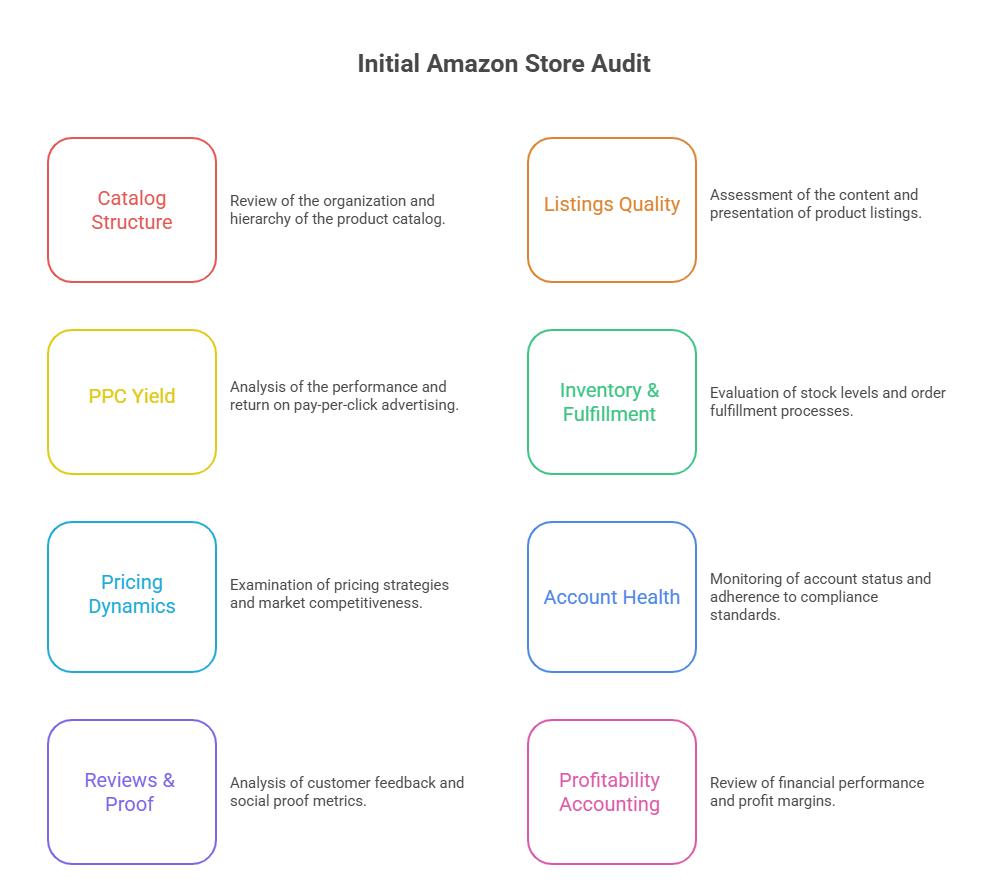
Initial Amazon Store Audit
Every engagement begins with a comprehensive technical, financial, and operational diagnostic of your current Amazon store setup. This audit establishes performance baselines and isolates hidden revenue leaks across every operational vector.
- Catalog Structure: Identifying duplicate listings, variant parentage errors, suppressions, and title indexing gaps.
- Listings Quality: Evaluating conversion copy depth, A+ Content quality, lifestyle imagery, and keyword indexation.
- PPC Yield: Reviewing historical ad spend efficiency, match-type distribution, waste search terms, and total advertising cost of sales (TACoS).
- Inventory & Fulfillment: Inspecting stock velocity, regional distribution metrics, FBA storage fee structures, and excess holding charges.
- Pricing Dynamics: Assessing buy box ownership rates, minimum advertised price (MAP) compliance, and automated repricing rule performance.
- Account Health & Compliance: Reviewing policy compliance flags, order defect rates (ODR), late shipment metrics, and voice of the customer (VOC) scores.
- Reviews & Social Proof: Analyzing review velocity, star-rating trends, negative feedback resolution, and customer sentiment.
- Profitability Accounting: Calculating net landed margins after subtracting referral fees, fulfillment charges, ad spend, and return overhead.
Strategy & Goal Setting
Once audit data is compiled, cross-functional teams build a tailored marketplace roadmap aligned directly with your corporate financial goals. This strategy outlines realistic growth targets, capital deployment plans for media spend, and operational timelines for catalog remediation.
Clear key performance indicators (KPIs) are established around gross sales volume, net operating margins, inventory turn rates, and target conversion metrics. Establishing explicit expectations upfront ensures complete strategic alignment between executive stakeholders and your operating partners.
Implementation
The execution stage translates diagnostic findings into immediate operational updates across your entire product footprint. Specialist teams rebuild suppressed listings, resolve stranded inventory, restructure ad accounts, and correct brand registry errors.
Operational integration also includes connecting your enterprise resource planning (ERP) systems, warehouse inventory feeds, and pricing engines directly with Seller Central or Vendor Central portals. This foundational cleanup stabilizes account health metrics and creates a scalable foundation for marketing acceleration.
Ongoing Monitoring
Marketplace conditions change constantly due to competitor pricing shifts, algorithm updates, policy changes, and hijacking attempts. Continuous real-time oversight guarantees immediate intervention whenever anomalies or compliance threats arise.
Automated alerting systems combined with manual operational audits protect buy box position, maintain MAP enforcement, and ensure uninterrupted listing availability. Proactive oversight prevents minor administrative discrepancies from snowballing into severe listing suspensions or inventory holds.
Monthly Reporting & Optimization
Strategic account management relies on structured reporting loops that look past surface vanity metrics to focus on bottom-line contribution margin. Monthly performance reviews dissect organic traffic acquisition, paid media return on investment, inventory turns, and unit economics.
Optimization teams use these analytical reviews to refine ad bidding models, iterate listing design assets, adjust reorder points, and eliminate non-performing keywords. Continuous iterative testing ensures your catalog maintains high conversion efficiency amid shifting consumer demand patterns.
Benefits of Amazon Store Management Services
Partnering with an experienced Amazon store management agency offers distinct business outcomes for enterprise brands looking to dominate their category:
- Save Time and Internal Resources: Reallocate executive bandwidth and internal team focus toward long-term product innovation, broader distribution network strategy, and core manufacturing efficiencies rather than day-to-day listing updates.
- Improve Product Visibility: Expand organic search indexation and capture market share through advanced search engine optimization, precise backend keyword structures, and targeted paid search campaigns.
- Increase Conversion Rates: Convert passive catalog traffic into verified sales by implementing high-converting A+ Content, mobile-optimized listing graphics, clear benefit messaging, and structured variant relationships.
- Reduce Stockouts and Overstock: Maintain optimal inventory equilibrium by leveraging predictive demand modeling, structured reorder schedules, and proactive FBA inventory level management.
- Improve Advertising Efficiency: Lower total advertising cost of sales (TACoS) by deploying programmatic bidding strategies, negative keyword harvesting, and advanced sponsored brand placement models.
- Protect Account Health: Prevent costly listing suppressions, policy violations, and account suspensions through continuous compliance auditing and rapid resolution protocols.
- Improve Profitability: Expand net operating margins by identifying hidden Amazon fee errors, curbing wasteful ad spend, enforcing minimum advertised pricing, and reducing logistics overhead.
- Scale Without Building a Large Internal Team: Eliminate the overhead, ongoing training costs, and operational friction tied to recruiting, onboarding, and retaining an in-house team of channel specialists.
How to Choose an Amazon Store Management Service Provider
Selecting the right operating partner is a critical strategic decision that directly impacts brand equity, supply chain flow, and overall corporate profitability.
Check Their Amazon Expertise
Assess the provider's experience across complex catalog management, brand registry tools, and advanced vendor options. An effective partner must demonstrate deep expertise navigating both Seller Central and Vendor Central environments for enterprise operations.
Review Their Service Scope
Verify that the agency provides true end-to-end management rather than basic task execution or fragmented PPC management. A full-service partner should handle listing creation, visual asset production, advertising, inventory forecasting, account compliance, and customer support coordination under one umbrella.
Ask Who Will Manage Your Account
Ensure your account will be overseen by senior marketplace strategists rather than outsourced junior staff. Understanding team structures, account-to-manager ratios, and direct access models guarantees your business receives dedicated strategic guidance.
Understand Their Reporting Process
Require complete clarity on how channel data, financial metrics, and campaign results are communicated to your executive leadership team. Premium service partners provide custom executive dashboards, clear financial reporting, and actionable monthly strategy calls rather than raw automated reporting exports.
Ask Which KPIs They Track
Verify that the provider's primary metrics align directly with enterprise financial health rather than superficial traffic statistics. Ideal partners prioritize total revenue growth, net contribution margin, TACoS, inventory turnover velocity, and conversion rate optimization.
Check Their Approach to Account Health
Examine the provider's internal protocols for handling intellectual property claims, listing suppressions, negative feedback spikes, and policy warnings. Rapid, systematic account defense capabilities are required to keep enterprise revenue streams running smoothly.
Understand Pricing and Contract Terms
Review service agreements carefully to understand fee structures, whether based on flat monthly retainers, performance incentives, or hybrid models. Avoid providers that lock your business into long-term restrictive commitments without clear performance milestones or transparent termination rights.
Ask About Communication and Escalation
Confirm established response SLAs, communication channels, and clear managerial escalation pathways for urgent account issues. When critical operational blocks occur, your team needs direct access to problem solvers who can fix issues fast.
Request Relevant Case Studies
Ask for verified case studies and reference accounts within your broader industry sector or catalog complexity level. Proven records of scaling top-line revenue while protecting operating margins offer concrete proof of an agency's execution capabilities.
Provider Evaluation Checklist
|
Evaluation Area |
Key Criteria |
| Category Experience | Proven record managing complex catalogs in your specific vertical |
| Operational Scope | Comprehensive support including PPC, SEO, inventory, and account health |
| Team Seniority | Senior account strategists assigned directly to your business account |
| Reporting Capabilities | Customized executive dashboards detailing net profit contribution |
| Contract Transparency | Clear performance milestones without hidden performance fees |
Frequently Asked Questions
1. What are Amazon store management services?
Amazon store management services are full-service solutions provided by specialized marketplace partners to oversee, optimize, and scale an enterprise brand's Amazon channel operations. These comprehensive services cover product catalog structure, search engine optimization, paid media advertising, supply chain inventory forecasting, brand protection, and ongoing policy compliance monitoring.
2. What does an Amazon store management company do?
An Amazon store management company handles the end-to-end administration and strategic scaling of a client's Amazon account. They build listing graphics, execute conversion rate optimization, manage programmatic advertising campaigns, monitor account health indicators, handle seller support tickets, and implement long-term marketplace expansion strategies.
3. How much do Amazon store management services cost?
Pricing models vary widely based on catalog scope, annual revenue tier, and service complexity. Most elite management agencies operate on flat monthly retainers, percentage-of-revenue models, or hybrid structures designed to align agency compensation directly with performance and top-line growth.
4. Is Amazon store management worth it?
Engaging specialized channel management delivers strong ROI for brands seeking higher conversion rates, optimized ad spend, and reduced administrative burden. By leveraging dedicated category specialists, brands typically recapture lost margin, improve product visibility, and scale significantly faster than through internal efforts alone.
5. Can I outsource Amazon store management?
Yes, outsourcing store management to a trusted external team is standard practice for high-growth enterprise brands, manufacturers, and industrial distributors. Professional outsourcing delivers high-level expertise and flexible execution without requiring internal hiring or dedicated infrastructure investments.
6. What is the difference between an Amazon VA and an Amazon management agency?
A virtual assistant (VA) performs basic task-based requests like manual data entry, simple customer service replies, or minor copy updates. In contrast, a full-service Amazon store management company provides high-level strategic direction, multi-channel logistics alignment, advanced media management, brand defense, and dedicated executive accountability.
7. How do I choose an Amazon store management company?
Evaluate prospective agencies based on category experience, reporting transparency, team structure, fee alignment, and proven client growth results. Prioritize partners offering full operational management, custom executive dashboards, and rapid escalation protocols for account health issues.
8. How often should Amazon listings be optimized?
Listing optimization is an ongoing, iterative process driven by search trends, competitive shifts, and algorithm adjustments. Core keywords, advertising match types, visual assets, and pricing strategy should be audited monthly, with continuous conversion rate testing applied across key catalog drivers.
9. What KPIs should an Amazon store manager track?
A skilled management team tracks operational metrics including gross sales volume, net profit margin, total advertising cost of sales (TACoS), conversion rate, Buy Box win percentage, organic search ranking trends, and inventory turn velocity.
10. Can an Amazon management company handle PPC and inventory?
Yes, a full-service Amazon store management company manages both advertising acceleration and inventory demand forecasting. Aligning ad strategies directly with inventory stock levels ensures the media budget is allocated efficiently toward high-margin items with strong stock runway.
Conclusion
Navigating the complexities of modern marketplace expansion requires a balanced combination of strategic vision, operational discipline, and agile execution. Retaining an experienced Amazon store management company gives enterprise decision-makers, operations leaders, and corporate owners the specialized capabilities needed to expand market share while protecting operating margins.
Whether your strategic priority is improving conversion rates, protecting brand equity against grey-market sellers, or optimizing logistics efficiency, selecting an established service provider provides the platform needed for sustainable, long-term channel leadership. Elevating your management framework from passive account maintenance to proactive execution ensures your corporate portfolio captures its full growth potential.