


Last updated on September 18th, 2026
Growth on Amazon can quickly turn from an opportunity into an operational burden. As product catalogs expand and fulfillment spans multiple regions, catalog variations, compliance checks, daily account health monitoring, and inventory forecasting can consume valuable executive time. Instead of allowing routine marketplace tasks to pull leadership away from strategic priorities, businesses can delegate these responsibilities to a dedicated Amazon virtual assistant agency or specialized contractor, keeping day-to-day operations organized while leadership stays focused on growth, profitability, and long-term strategy.
According to verified industry research published by VA Masters, approximately 72% of established e-commerce brands and Amazon sellers now deploy specialized virtual assistant talent to manage operational workflows. Enterprise leaders utilize these remote professionals to safeguard contribution margins while driving sustainable operational velocity. When executive teams choose to hire Amazon virtual assistant specialists, they establish scalable operational frameworks without expanding domestic overhead.
A skilled virtual assistant removes repetitive, time-intensive execution tasks from the seller's workload to optimize core logistics. By offloading catalog maintenance, routine buyer communications, inbound shipment creation, and advertising campaign monitoring, operations leaders prevent severe bottlenecks. This guide provides a practical hiring framework designed for enterprise executives evaluating virtual staffing structures, specialized agencies, and strict compliance boundaries.
Table of Contents
When Should You Hire an Amazon Virtual Assistant?
What Can an Amazon Virtual Assistant Do?
How Much Does an Amazon Virtual Assistant Cost?
Where Can You Hire an Amazon Virtual Assistant?
When Should You Hire an Amazon Virtual Assistant?
Determining the precise timing to introduce remote operational support requires a cold analysis of administrative friction versus executive time valuation. Organizations must evaluate whether internal talent is burdened with lower-tier tasks that impede critical corporate expansion goals.
Scale Your Amazon Operations With Expert VA Support
Signs you've outgrown DIY Amazon management
Executive teams frequently spend excessive hours handling tactical catalog updates, customer messages, and shipment creation. Suppressed listings, stockouts, unaddressed stranded inventory, and account health warnings signal that your operations require dedicated support. Continuing to handle these tasks internally slows company growth and distracts leadership from strategic oversight.
How many hours of work should you delegate?
Most enterprise brands begin by delegating 15 to 20 hours per week of structured administrative and operational tasks. As standard operating procedures normalize, this engagement often evolves into full-time operational support across product catalog lines. Identifying routine workflows allows leadership to establish predictable daily delegation schedules.
When hiring a VA makes financial sense
Delegating tactical execution makes financial sense when high-paid internal leadership spends valuable hours on manual Seller Central tasks. If an executive earning $75 per hour handles data entry that a specialized assistant could manage for $10 per hour, resource allocation is failing. Reallocating lower-tier administrative workload immediately protects profit margins and frees up leadership talent.
When you should NOT hire a VA yet
Organizations should hold off on hiring remote operational staff if core product supply chains remain unstable or standard workflows are completely undefined. Virtual assistants execute established systems effectively, but they cannot fix flawed business fundamentals or broken operational processes. Enterprise leaders must stabilize product sourcing and define clear operational guidelines before adding team members.
What Can an Amazon Virtual Assistant Do?
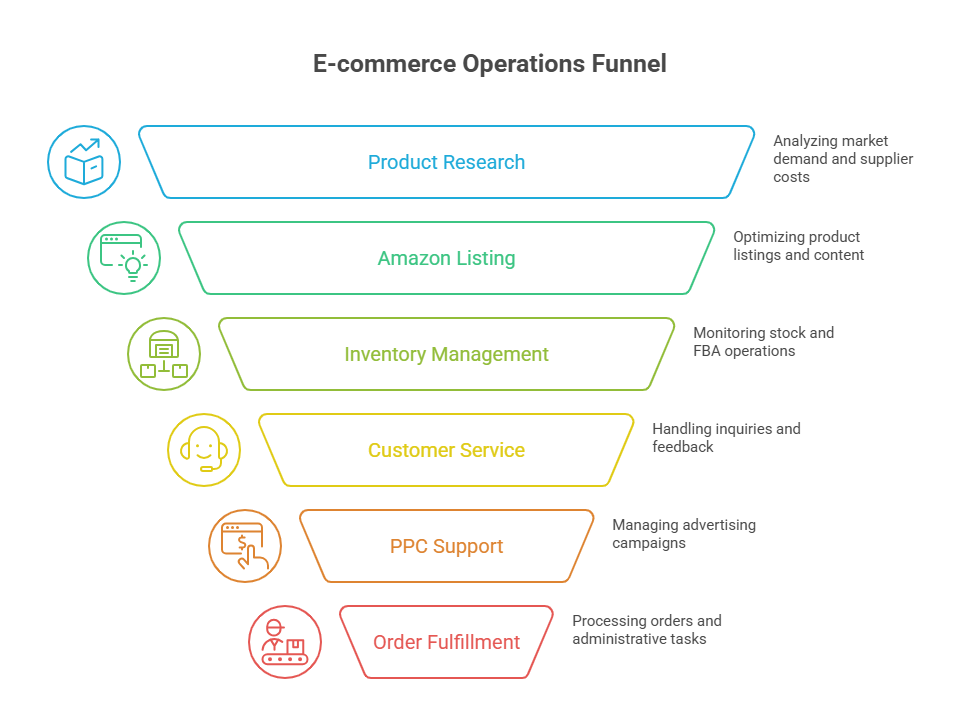
An experienced specialist integrates directly into existing enterprise workflows to streamline day-to-day Seller Central management.
- Product research and sourcing: Experienced assistants analyze market demand, review supplier pricing structures, track competitor catalog movements, and calculate landed product costs to support purchasing choices.
- Amazon listing management: Specialized contractors update parent-child variation listings, optimize backend search terms, format policy-compliant product copy, and upload brand assets seamlessly.
- Inventory and FBA operations: Remote staff monitor stock velocity, create inbound FBA shipping plans, manage removal orders, and address stranded inventory to protect account metrics.
- Customer service: Dedicated support talent manages buyer inquiries, logs return processing requests, handles negative feedback removal appeals, and maintains strict customer service response benchmarks.
- PPC and advertising support: Advertising assistants track keyword bidding efficiency, harvest high-performing search terms, update negative keyword lists, and draft performance summaries for campaign managers.
- Order and administrative tasks: Specialists review merchant-fulfilled order queues, log inbound freight documentation, track vendor invoices, and manage routine administrative tasks without operational friction.
- Reporting and analytics: Dedicated team members compile daily sales summaries, track contribution margins across individual SKUs, monitor account health scores, and deliver structured dashboard reports.
- Account and catalog management: Specialists open policy support cases, monitor detail page changes, address listing suppression notices, and safeguard brand assets across active marketplaces.
How Much Does an Amazon Virtual Assistant Cost?
Evaluating compensation structures requires understanding geographic talent pools, technical expertise, and agency pricing models. General administrative assistants based in offshore hubs like the Philippines or India typically command between $5 and $10 per hour. Specialized operational talent skilled in FBA logistics management, listing creation, or PPC optimization ranges from $8 to $15 per hour.
US-based or nearshore specialized talent with deep enterprise expertise generally charges between $25 and $50 per hour. When enterprise decision-makers work with a dedicated Amazon virtual assistant agency, pricing models often shift to fixed monthly retainers. Retainers typically range from $1,200 to $3,500 per month depending on dedicated hours, technical scope, and tier of management oversight.
Where Can You Hire an Amazon Virtual Assistant?
Sourcing qualified operational talent requires choosing the right recruitment channel based on your required oversight level and risk tolerance.
Freelance marketplaces
Platforms like Upwork or Fiverr offer direct access to global remote contractors across various skill levels and pay scales. However, using these channels requires internal managers to spend significant time screening resumes, testing technical skills, and verifying track records.
Amazon-focused VA agencies
Partnering with a specialized Amazon virtual assistant agency grants immediate access to pre-vetted, highly trained operational specialists. If you want to hire Amazon virtual assistant talent without dealing with tedious recruitment cycles, agencies streamline onboarding by delivering managed support structures and replacement guarantees.
Amazon seller communities
Industry forums, specialized masterminds, and corporate seller networks serve as strong referral channels for proven remote talent. Sourcing through peer networks often connects businesses with experienced professionals who understand complex enterprise marketplace workflows.
Referrals
Requesting warm introductions from non-competing e-commerce executives remains one of the safest ways to secure top-tier operational talent. Referred specialists bring proven track records, established professional standards, and verified performance capabilities.
Direct hiring
Publishing specialized job postings on platforms like LinkedIn or specialized job boards allows corporate talent acquisition teams to run custom recruitment drives. While direct recruitment demands internal HR bandwidth, it gives leadership total control over final candidate selection.
Common Mistakes When Hiring an Amazon VA
However, finding the right Amazon VA involves more than evaluating hourly rates or basic marketplace experience. Businesses must also assess platform knowledge, communication skills, data security practices, reliability, and familiarity with the specific tasks being delegated. A poorly matched VA can create listing errors, inventory issues, compliance problems, and unnecessary oversight, ultimately costing more time than the role was intended to save.
- Hiring solely based on price: Selecting candidates exclusively on low hourly rates often leads to costly listing errors, mismanaged inventory shipments, and account policy violations.
- Hiring without a clear role: Bringing on remote support without defined operational responsibilities creates confusion and yields poor performance results across the account.
- Skipping skills tests: Failing to evaluate candidates with real-world Seller Central tasks risks hiring individuals who lack true platform expertise.
- Giving excessive account access: Granting full administrative access instead of restricted user permissions exposes sensitive corporate financial data and primary account controls to unnecessary risk.
- Not creating SOPs: Expecting remote staff to execute complex procedures without clear standard operating procedures guarantees inconsistent output and operational errors.
- Failing to establish KPIs: Managing team members without clear performance metrics makes it impossible to measure ROI or evaluate account efficiency accurately.
- Expecting a VA to make strategic decisions without guidance: Treating operational assistants like senior brand directors leads to misaligned corporate initiatives and poor resource allocation.
FAQs
How much does an Amazon virtual assistant cost?
Rates range from $5 to $15 per hour for offshore specialists, while US-based experts command $25 to $50 per hour. Dedicated agency retainer models typically range from $1,200 to $3,500 monthly based on scope and managed service levels.
Where can I hire an Amazon VA?
Sourcing options include freelance networks, specialized Amazon seller communities, direct referral channels, or dedicated service agencies. Working with a specialized Amazon VA agency remains the most efficient route for accessing pre-vetted talent.
What tasks can an Amazon VA handle?
Virtual assistants manage catalog updates, buyer messaging, FBA inventory planning, ad campaign tracking, stranded inventory resolution, and regular performance reporting. They handle time-consuming operational tasks so internal management can stay focused on core growth.
Should I hire a general VA or Amazon specialist?
Enterprise brands should hire specialized talent trained directly on Seller Central protocols and platform nuances. General virtual assistants lack the platform-specific expertise needed to resolve listing suppressions, manage FBA inventory, or file policy appeals.
Should my Amazon VA work full-time or part-time?
Part-time engagements work well for focused, tactical responsibilities like basic buyer communications or simple catalog updates. High-volume brands with extensive product lines require full-time assistance to maintain consistent listing coverage and operational speed.
How do I test an Amazon VA before hiring?
Assign candidates a paid, time-bound trial task that mirrors real operational demands, such as drafting an optimized product listing or fixing sample inventory file errors. Evaluating their work speed, problem-solving skills, and adherence to instructions reveals true platform competency.
Can an Amazon VA manage my entire store?
A single virtual assistant can manage routine store operations, but they should not operate without executive leadership oversight. Strategic decisions around pricing policy, brand expansion, capital allocation, and supplier negotiation must remain under internal corporate control.
How do I safely give a VA access to Amazon Seller Central?
Grant restricted user permissions within Seller Central by sending an invitation to the virtual assistant's corporate email address. Never share primary account login details, and strictly limit access to only the specific tools needed for their role.
What tools does an Amazon VA need?
Depending on their specific role, assistants need access to tools like Helium 10, Jungle Scout, Sellerboard, or Keepa for research and operational tracking. Internal communication and task tracking require enterprise software such as Slack, Asana, or ClickUp.
How long does it take to train an Amazon VA?
Experienced Amazon specialists usually complete onboarding within one to two weeks if robust standard operating procedures are ready. Training general virtual assistants on complex platform mechanics takes four to eight weeks of active internal coaching.
Conclusion
Deciding to hire Amazon virtual assistant specialists provides enterprise brands, industrial distributors, and manufacturers with a flexible, scalable operational framework. Outsourcing repetitive platform management tasks allows executive teams to eliminate logistics bottlenecks, maintain catalog health, and safeguard contribution margins. Operational support allows enterprise leaders to keep internal staff focused on high-level strategy, product development, and multi-channel expansion.
Building a sustainable marketplace presence requires pairing skilled execution with structured managerial oversight. Sourcing talent through a dedicated Amazon virtual assistant agency or establishing clear internal operating procedures ensures your store scales efficiently while mitigating policy risks. Enterprise e-commerce success relies on turning everyday marketplace operations into a streamlined, high-efficiency system.