


Last updated on September 24th, 2026
According to Amazon’s latest seller data, independent sellers account for more than 60% of sales in Amazon’s store, with most of these businesses classified as small and medium-sized enterprises. However, establishing a sustainable commercial presence requires far more than completing a basic sign-up form.
Comprehensive Amazon seller onboarding is an end-to-end process that involves validating business models, preparing compliance documentation, configuring seller accounts, developing launch-ready product data, and establishing operational logistics. Engaging professional Amazon seller onboarding services can help enterprise leaders navigate Amazon’s platform requirements while allowing internal executives to retain strategic control over unit margins, inventory allocation, and brand assets.
Executing a rushed onboarding process frequently leads to account suspension warnings, suppressed detail pages, and severe inventory bottlenecks. When organizations skip systematic product-market validation or submit inconsistent documentation, they expose their operations to extended verification delays. A structured onboarding framework ensures that banking setups, tax protocols, and user permissions are properly established from day one.
A successful onboarding initiative transitions an organization from initial entity registration to a predictable, profitable sales engine within 30 to 90 days. This comprehensive guide details the precise strategies required to prepare corporate documents, configure Seller Central, avoid common registration traps, and execute post-launch operational workflows.
Table of Contents
Build Your Amazon Seller Onboarding Strategy Before Registering
Prepare Your Amazon Seller Onboarding Documents
Set Up Your Amazon Seller Account Correctly
Your First 30 Days After Amazon Seller Onboarding
Common Amazon Seller Onboarding Mistakes to Avoid
Build Your Amazon Seller Onboarding Strategy Before Registering
Before submitting operational credentials to Amazon Seller, enterprise leaders must structure their commercial framework. Establishing clear business positioning and verifying margin structures prevents expensive operational restarts later.
Define your Amazon business model
Selecting the correct operating model dictates your supply chain structure, capital requirements, and platform governance. Organizations must align internal capabilities with one of the following marketplace frameworks:
- Reseller: Purchasing existing commercial brand inventory from authorized distributors to sell against established detail pages.
- Private label: Manufacturing custom-branded consumer products through contract partners to build proprietary brand equity.
- Manufacturer: Direct-to-consumer distribution of internally manufactured goods to eliminate intermediary distributor markups.
- Wholesale: Purchasing bulk product allocations directly from brand owners to supply business buyers and retail consumers.
- Brand owner: Enrolling registered trademarks into Amazon Brand Registry to control detail page content and authorized distribution.
Validate product-market fit
Launching products without rigorous market validation leads to excess inventory holding costs and weak conversion rates. Executive teams must evaluate historical search volume, examine competitor review velocity, analyze primary keyword density, and assess price point elasticity. Establishing a clear product differentiation strategy ensures that your catalog stands out against established category incumbents.
Calculate unit economics before committing inventory
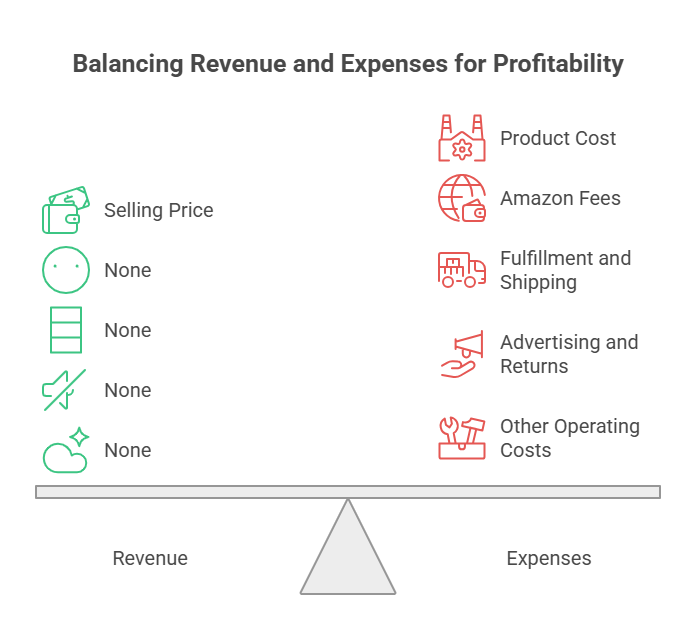
Maintaining positive contribution margins requires accounting for all platform commissions, logistics fees, and advertising overhead. Organizations should analyze individual SKU profitability before issuing manufacturing purchase orders. Use the following baseline profit calculation:
Check category, brand, and product restrictions
Certain product categories, gated sub-categories, and hazardous materials require specialized approval workflows before listings can go live. Operations managers must verify whether target SKUs demand safety data sheets, compliance certifications, or ungating documentation. Identifying restriction boundaries early prevents inventory from becoming stuck in transit or rejected during warehouse intake.
Choose your fulfillment model
Selecting the right logistics engine directly impacts unit margins, customer experience, and Prime badge eligibility. Decision-makers must choose between Fulfillment by Amazon (FBA), Fulfillment by Merchant (FBM), or a hybrid distribution approach based on package dimensions and inventory velocity.
Execute a structured Amazon seller onboarding strategy
Prepare Your Amazon Seller Onboarding Documents
Gathering compliant corporate documentation before initiating account creation is critical for passing Amazon's automated identity verification systems.
- Business information: Legal business name, state registration documents, operating agreements, and federal Tax Identification Numbers matching official government registries.
- Seller identity information: Government-issued passports or driver's licenses for primary account owners and legal business representatives.
- Banking and payment information: Internationally chargeable credit cards and corporate bank account statements formatted with identical legal business names.
- Tax information: Completed W-9 or W-8BEN tax classification forms and state sales tax permit registration numbers.
- Proof of address and identity: Utility bills, bank statements, or pipeline gas statements generated within the last 90 days displaying matching physical addresses.
- Product and brand documentation: Trademark registration certificates, safety compliance testing reports, manufacturer authorization letters, and commercial invoices.
- Create a controlled document repository: Maintain an internal digital drive containing high-resolution PDF scans of all verification materials to streamline future compliance requests.
Set Up Your Amazon Seller Account Correctly
Executing a compliant account setup requires selecting the correct business classification and entering corporate registration data with absolute precision. Enterprise managers must select the appropriate entity type, such as a Corporation or LLC, ensuring that the legal business name matches IRS tax records exactly. During the initial sign-up flow, supply primary corporate contact details, establish preferred billing methods, and link a verified corporate bank account for bi-weekly disbursements.
Security protocols must be established immediately during registration to prevent unauthorized access and secure brand data. Enable two-factor authentication across all primary login credentials using dedicated enterprise authenticator applications rather than personal mobile numbers. Furthermore, establish formal account recovery procedures, document backup security codes, and configure emergency contact details within Amazon Seller settings.
Managing operational access requires implementing strict user permission hierarchies instead of sharing root credentials with internal staff or external partners. Grant individual secondary user access to specific operational modules, such as inventory management or advertising reporting, using corporate email addresses. To prevent account flags or verification failures, organizations must avoid critical mistakes like entering inconsistent addresses, using shared login details, selecting incorrect entity types, leaving identity verification steps incomplete, or granting third-party agencies full administrative control over primary account settings.
Your First 30 Days After Amazon Seller Onboarding
The initial 30-day post-registration window dictates your long-term account momentum, indexing speed, and inventory performance metrics.
Days 1-7: Validate account and listing readiness
Verify that account health metrics display good standing and confirm that user permission tiers are properly configured. Audit active product listings to ensure bullet points, backend search terms, high-resolution media, and variation structures are indexed correctly.
Days 8-14: Monitor traffic, conversion, and inventory
Initiate targeted pay-per-click advertising campaigns to drive relevant initial shopper sessions to your detail pages. Track daily unit session percentages and conversion rates to confirm that price points and media assets resonate with marketplace shoppers.
Days 15-21: Identify listing and customer issues
Review customer feedback, buyer messaging logs, and return reason codes to identify potential product packaging or copy misunderstandings. Resolve stranded inventory warnings promptly and file support cases for any unexpected detail page suppressions or buy box losses.
Days 22-30: Optimize and document
Refine advertising campaign keyword bidding based on real conversion data to optimize total advertising cost of sales. Codify successful daily workflows into standard operating procedures and assign operational ownership across internal teams.
Metrics to monitor
Tracking operational performance requires consistent dashboard evaluation across these key metrics:
- Sessions: The volume of unique customer visits to your product detail pages within a given timeframe.
- Conversion rate: The percentage of detail page sessions that result in completed customer purchases.
- Sales: Total gross product revenue generated across active catalog SKUs.
- TACoS/ACoS: Total Advertising Cost of Sales and Advertising Cost of Sales, measuring marketing efficiency.
- Organic keyword visibility: Search engine rank positioning for primary index keywords across your category.
- Inventory days: Projected days of available stock remaining based on recent sales velocity.
- Return rate: The percentage of delivered units returned by buyers due to defects or dissatisfaction.
- Customer issues: Account health metrics tracking buyer messages, order defect rates, and policy notices.
- Contribution margin: Net profitability remaining after deducting product costs, Amazon fees, and logistics overhead.
Common Amazon Seller Onboarding Mistakes to Avoid
Avoiding operational missteps during initial account deployment protects capital and prevents unnecessary verification account holds.
- Registering before validating the product: Committing corporate capital to account registration without verifying category demand, pricing dynamics, or competitor strength.
- Submitting inconsistent documents: Uploading verification files where business names, addresses, or tax identification numbers fail to match official records exactly.
- Ignoring gated categories: Shipping inventory before securing explicit approval for restricted categories, sub-categories, or restricted brand gating requirements.
- Giving away primary account control: Granting external service providers root login credentials instead of managing user permissions through secondary access settings.
- Launching without unit economics: Deploying products without accounting for dimensional fulfillment fees, storage surcharges, return reserves, and ad spend.
- Sending inventory before quality checks: Dispatching uninspected goods directly to FBA warehouses, leading to customer returns, bad reviews, and inventory rejections.
FAQs About Amazon Seller Onboarding
What is Amazon seller onboarding?
Amazon seller onboarding is the structured process of preparing business documentation, setting up a compliant Seller Central account, building launch-ready product listings, configuring logistics workflows, and managing early operational velocity.
How long does Amazon seller onboarding take?
Document preparation and account submission usually take 1 to 2 weeks, while Amazon's identity verification process takes anywhere from 24 hours to several business days. Completing listing creation, FBA inbound shipping, and initial launch optimization generally requires 30 to 45 total days.
What documents are needed to become an Amazon seller?
Sellers need a government-issued photo ID, official business registration documents, a corporate tax ID, a recent utility bill or bank statement matching the business address, an internationally chargeable credit card, and a verified bank account for disbursements.
How do I prepare for Amazon seller verification?
Ensure that the legal business name, address, and entity details across your bank statements, utility bills, and tax forms match your Seller Central inputs exactly. Provide clear, unedited, high-resolution PDF or color scans of all requested identity and business documents.
What should I do before creating an Amazon seller account?
Validate product-market fit, calculate unit economics including all platform fees, verify category and brand approval requirements, decide on a fulfillment strategy (FBA vs. FBM), and organize all required verification documents in a central drive.
How do I avoid Amazon seller verification delays?
Submit official, uncropped documents generated within the last 90 days, avoid submitting expired identification, ensure all text is legible, and confirm that every character in your submitted address matches your utility bills and bank statements.
Should I prepare my product listing before account approval?
Yes, you should draft optimized copy, gather compliant product images, select relevant backend keywords, and organize brand assets in advance so you can create listings immediately once account verification is granted.
Should a VA manage my Amazon seller account?
A virtual assistant can handle tactical execution like creating listings, handling buyer messages, and monitoring inventory levels. However, internal executive leadership must maintain control over primary account credentials, strategy, capital allocation, and user permissions.
What should I do in the first 30 days after onboarding?
Verify listing indexing, drive targeted traffic using PPC campaigns, monitor daily session conversion rates, resolve inventory or customer service issues quickly, optimize campaign bidding, and document daily operating procedures.
Conclusion
Executing a structured Amazon seller onboarding process provides enterprise brands, manufacturers, and industrial distributors with a strong foundation for long-term marketplace expansion. Organizations that invest time in rigorous document preparation, account configuration, unit economics analysis, and listing optimization minimize operational friction and avoid policy enforcement delays. By establishing proper security controls and clear user permissions, executive teams ensure their platform operations scale safely.
Achieving sustained success on Amazon requires moving beyond simple account creation to build a disciplined operational engine. Utilizing professional Amazon seller onboarding services or establishing comprehensive internal standard operating procedures helps businesses manage compliance requirements and maintain healthy contribution margins. Transforming your initial marketplace setup into an organized, high-performing sales channel positions your entire product catalog for sustainable profitability.