
Amazon Product Listing Archives - Page 7 of 10 - Amazon Listing Service

Category: Amazon Product Listing

Amazon Store Management Explained for Brand Growth in 2026

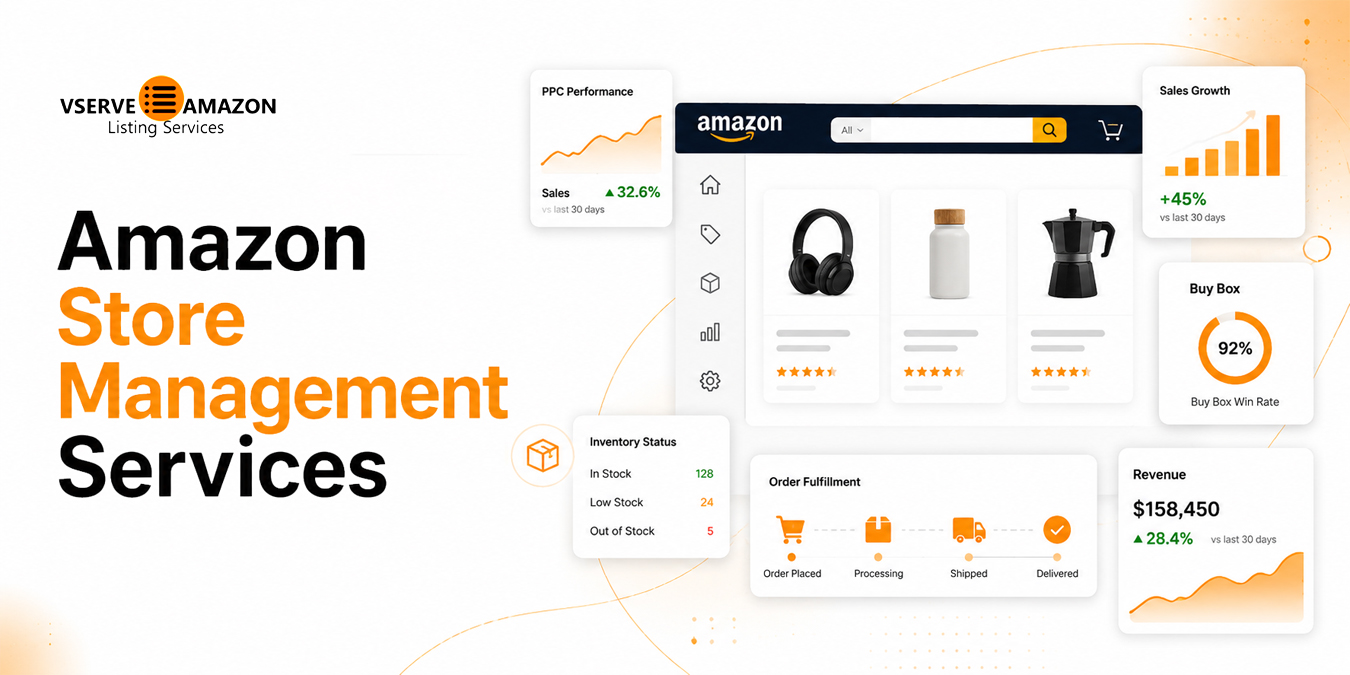
Amazon Store Management Services

Selling on Amazon used to be simple. Upload products, run ads, and wait for orders. In 2026, that approach no longer works.

Today, Amazon is one of the most competitive ecommerce ecosystems in the world. Brands are competing on pricing, visibility, fulfillment speed, customer experience, advertising efficiency, and account compliance simultaneously. One operational mistake can reduce rankings, suppress listings, or trigger account health warnings that impact revenue overnight.

According to Amazon’s 2025 Small Business Empowerment Report, independent sellers now account for more than 60% of sales in Amazon’s store, and more than 75,000 independent sellers generated over $1 million in annual sales in 2024 alone. The scale of marketplace competition continues growing every year, making operational efficiency a major differentiator for brands.

That is why more brands are investing in Amazon store management services to improve operational consistency, marketplace visibility, and long-term profitability.

From listing optimization and PPC management to inventory coordination and analytics, modern Amazon management requires a structured strategy that combines SEO, advertising, operations, and customer experience.

This guide explains how Amazon store management works, what services are included, when businesses should outsource, and how to choose the right partner for sustainable marketplace growth in 2026.

If your business needs scalable marketplace account management support for Amazon operations, inventory coordination, and performance optimization, talk to the team at Amazon Listing Services.

What Is Amazon Store Management?

Amazon store management is the ongoing process of operating, optimizing, and scaling a brand's presence on Amazon Marketplace.

It combines multiple operational and marketing functions, including:

  • Product listing management
  • Marketplace SEO
  • PPC advertising
  • Inventory coordination
  • Fulfillment monitoring
  • Customer support
  • Account health management
  • Reporting and analytics
The goal of Amazon store management services is not simply maintaining a seller account. The real objective is maximizing product visibility, improving conversions, maintaining compliance, and increasing profitability across the marketplace.

As Amazon's algorithm and competitive landscape continue evolving, sellers now require structured ecommerce marketplace management services to stay competitive at scale.

What Is Included in Amazon Store Management Services?

Modern Amazon listing services and marketplace management programs typically cover five core operational areas.

Listing Optimization and Catalog Management

Your product listing directly impacts discoverability and conversion rates.

Amazon SEO optimization includes:

  • Keyword research
  • Product title optimization
  • Bullet point enhancement
  • Backend search term management
  • A+ content optimization
  • Product image coordination
  • Variation management
  • Catalog structure cleanup

Strong listing optimization helps products rank for high-intent customer searches while improving conversion once users land on the page.

For example, a supplement brand may improve conversions significantly simply by restructuring product titles, improving image sequencing, and optimizing mobile readability across listings.

Catalog consistency also becomes critical for large inventories. Poor parent-child relationships, duplicate ASINs, and inconsistent attributes often create indexing and visibility issues.

Amazon PPC Management and Growth Support

Advertising now plays a major role in Amazon marketplace growth.

Effective PPC management includes:

  • Sponsored Products campaigns
  • Sponsored Brands campaigns
  • Sponsored Display advertising
  • Keyword bid optimization
  • Search term analysis
  • Negative keyword management
  • Budget allocation
  • ROAS optimization

Without proper campaign management, brands often overspend on broad traffic while failing to convert high-intent searches.

A structured PPC strategy aligns advertising with:

  • Inventory availability
  • Seasonal demand
  • Keyword intent
  • Product lifecycle stage
  • Profit margin targets

This is why many growing brands combine Amazon listing services with advertising optimization under one management structure.

Inventory and FBA Management

Inventory issues directly impact rankings and customer experience.

Amazon store management teams typically support:

  • Inventory forecasting
  • FBA replenishment planning
  • Stock monitoring
  • Sell-through optimization
  • Overstock reduction
  • Return management coordination
  • Fulfillment performance tracking

Running out of stock can destroy ranking momentum built over months of advertising and SEO investment.

At the same time, excessive inventory creates storage fee pressure and operational inefficiencies.

Strong inventory management balances:

  • Demand forecasting
  • Ad spend
  • Seasonal trends
  • Warehouse limitations
  • Fulfillment timing

This operational layer is especially important for brands managing large SKU counts across multiple marketplaces.

Account Health, Compliance, and Customer Experience

Amazon prioritizes seller performance metrics heavily.

Store management teams monitor:

  • Order defect rate
  • Late shipment rate
  • Customer complaints
  • Policy violations
  • Intellectual property claims
  • Listing suppressions
  • Account health warnings

Even profitable stores can face operational disruption if compliance issues are ignored.

Customer experience management also includes:

  • Review monitoring
  • Buyer communication workflows
  • Return resolution support
  • Feedback management

This operational discipline helps brands protect long-term marketplace stability while maintaining seller reputation.

Reporting and Performance Analytics

Data analysis drives marketplace optimization.

Professional marketplace account management programs often include reporting on:

  • Conversion rates
  • Traffic sources
  • Advertising efficiency
  • Keyword rankings
  • Inventory turnover
  • Buy Box performance
  • Profitability trends
  • Category benchmarks

Analytics help brands identify:

  • Underperforming listings
  • Wasted ad spend
  • Seasonal opportunities
  • Margin leakage
  • High-converting keywords

Without centralized reporting, most sellers operate reactively instead of strategically.

When Should Businesses Outsource Amazon Store Management?

Not every seller needs external support immediately. However, certain operational signals indicate it may be time to outsource.

High Competition Is Reducing Visibility

If competitors consistently outrank your products despite similar pricing and reviews, your listings and advertising strategy likely require optimization.

This usually indicates weaknesses in:

  • Keyword targeting
  • Listing structure
  • Ad management
  • Catalog quality
  • Conversion optimization

Your Product Line Is Growing Rapidly

Managing 20 products is very different from managing 2,000 SKUs.

As catalogs grow, operational complexity increases dramatically.

  • Inventory synchronization
  • Variation relationships
  • Pricing management
  • Compliance monitoring
  • PPC coordination

At this stage, many businesses adopt structured ecommerce marketplace management services to maintain operational consistency.

Sales Performance Has Plateaued

Plateauing sales often indicate operational inefficiencies rather than product issues.

For example:

  • Listings may not target emerging keywords
  • Advertising may be wasting budget
  • Conversion rates may decline due to outdated content
  • Inventory gaps may suppress rankings

A marketplace management partner can identify and resolve these growth bottlenecks systematically.

Internal Teams Are Overloaded

Many ecommerce teams eventually reach operational limits. Marketing teams handle campaigns. Operations teams manage fulfillment. Customer support handles reviews and returns. Without centralized marketplace coordination, performance gaps appear quickly.

Outsourcing creates operational scalability without immediately expanding internal headcount.

Agency vs Freelancer vs In-House Management

Businesses evaluating Amazon management support typically compare three operational models.

Model

Advantages

Limitations

Freelancer Lower cost, flexible support Limited scalability, narrow expertise
In-house team Full operational control Higher hiring and training costs
Agency partner Multi-specialist expertise, scalable support Requires onboarding alignment

Freelancers may work well for:

  • Small catalogs
  • Short-term listing optimization
  • Isolated PPC projects

In-house teams are effective when:

  • Amazon is the company's primary revenue channel
  • Operational scale justifies dedicated staffing
  • Internal expertise already exists

Agency partnerships often provide the best balance for mid-sized and enterprise sellers requiring:

  • Operational scalability
  • Cross-functional expertise
  • Reporting consistency
  • Inventory coordination
  • Advertising management
  • Catalog optimization

Benefits of Outsourcing Amazon Marketplace Operations

Improved Operational Efficiency

Outsourced teams follow structured workflows that reduce delays, inconsistencies, and operational bottlenecks.

This creates faster execution across:

  • Listings
  • Campaigns
  • Inventory planning
  • Issue resolution

Better Marketplace Visibility

Experienced Amazon specialists understand:

  • Ranking factors
  • Keyword behavior
  • Conversion optimization
  • Advertising structure

This improves discoverability and listing performance over time.

Faster Scalability

As product catalogs expand, outsourced support provides operational flexibility without requiring major internal restructuring.

This is especially valuable during:

  • Seasonal demand spikes
  • Marketplace expansion
  • New product launches

Stronger Compliance Management

Amazon policies evolve constantly.

Dedicated management teams help reduce risks associated with:

  • Account suspensions
  • Listing violations
  • Restricted products
  • Policy changes

Centralized Marketplace Reporting

Consolidated reporting improves strategic decision-making while helping leadership teams track operational performance more accurately.

A good marketplace strategy directly impacts brand growth. In 2019, Nike adjusted its direct selling relationship with Amazon after facing challenges related to marketplace control, counterfeit products, and customer experience consistency. The move highlighted how critical structured marketplace operations and brand governance have become within large ecommerce ecosystems.

How to Choose the Right Amazon Store Management Partner

Not all providers offer the same level of operational capability.

Here are the most important evaluation criteria.

Marketplace Experience

Look for providers with proven experience managing:

  • Large catalogs
  • Multi-category stores
  • Amazon advertising
  • Inventory operations
  • Compliance management

Experience matters because Amazon operations connect closely with one another.

Reporting Transparency

A strong management partner should provide the following:

  • Clear KPIs
  • Campaign visibility
  • Operational reporting
  • Growth insights
  • Performance recommendations

Lack of transparency often creates operational blind spots.

Scalability and Process Structure

Ask how the provider handles:

  • Workflow management
  • Catalog scaling
  • Communication
  • Issue escalation
  • Account monitoring

Structured operational processes become critical as marketplace complexity increases.

Alignment With Business Goals

The right partner should align operations with:

  • Profitability goals
  • Inventory strategy
  • Growth objectives
  • Customer experience priorities

Marketplace management is not just about maintaining listings. It should directly support business growth.

Common Mistakes Brands Make on Amazon

Many marketplace performance issues stem from operational mistakes rather than product quality.

Common problems include:

  • Keyword stuffing in listings
  • Poor inventory forecasting
  • Duplicate product listings
  • Inconsistent catalog attributes
  • Weak mobile optimization
  • Unmanaged PPC campaigns
  • Ignoring account health warnings
  • Fragmented operational ownership

These problems compound over time and reduce overall marketplace efficiency.

Structured Amazon store management services help eliminate these operational gaps systematically.

Future Trends in Amazon Marketplace Management for 2026

Amazon operations are becoming increasingly data-driven and AI-assisted.

Here are the trends shaping marketplace management in 2026.

AI-Driven Listing Optimization

AI tools now help brands optimize:

  • Titles
  • Bullet Points
  • Search Terms
  • Product Descriptions
  • Image Sequencing

This improves keyword targeting and conversion efficiency at scale.

Predictive Inventory Forecasting

Machine learning models increasingly support:

  • Demand Prediction
  • Replenishment Timing
  • Seasonal Planning
  • Storage Optimization

This reduces both stockouts and overstock costs.

Automation in Marketplace Operations

Automation workflows now handle:

  • Pricing Adjustments
  • Campaign Bidding
  • Review Monitoring
  • Inventory Alerts
  • Compliance Tracking

This improves operational responsiveness while reducing manual workload.

Personalized Marketplace Experiences

Amazon's recommendation systems continue evolving toward more personalized customer journeys.

Brands with optimized catalog structures and strong behavioral data will gain competitive visibility advantages.

Conclusion

Amazon marketplace growth now depends on much more than product quality alone.

Success requires coordinated management across:

  • Listings
  • Advertising
  • Fulfillment
  • Inventory
  • Compliance
  • Analytics
  • Customer Experience

As operational complexity increases, more businesses are adopting professional Amazon store management services to improve scalability, protect account health, and maximize long-term marketplace performance.

Whether you are managing a growing catalog or trying to improve marketplace efficiency, structured operational support can significantly improve visibility, conversions, and profitability.

If your business needs scalable marketplace account management and operational support, connect with the team at Amazon Listing Services.

FAQs About Amazon Store Management Services

1. How long does it take to see results from Amazon store optimization?

Most sellers begin seeing measurable improvements within 60 to 90 days. Results depend on listing quality, competition, advertising strategy, inventory availability, and account history. Competitive categories often require longer optimization periods to improve rankings consistently.

2. Can Amazon store management help with international marketplace expansion?

Yes. Marketplace management teams often support expansion into global Amazon regions by handling localization, catalog setup, compliance requirements, inventory coordination, and operational workflows across multiple regional marketplaces simultaneously.

3. Do Amazon management services support seasonal sales planning?

Yes. Many providers help brands prepare for seasonal demand spikes through inventory forecasting, promotional planning, advertising adjustments, and fulfillment coordination to reduce stock risks and maximize peak-period sales opportunities.

4. What industries benefit most from Amazon marketplace management?

Industries with large product catalogs, high competition, and operational complexity benefit most. This includes electronics, beauty, supplements, apparel, home goods, automotive products, industrial supplies, and consumer packaged goods.

5. Can marketplace management improve Buy Box performance?

Yes. Consistent pricing, inventory availability, fulfillment efficiency, account health, and customer satisfaction all influence Buy Box eligibility. Structured operational management helps improve these performance signals over time.


Top 12 Amazon Product Page Strategies for Furniture Sellers

Amazon Product Page Strategies

Online furniture sales continue to rise year over year. According to the US Census Bureau, furniture and home furnishing eCommerce sales exceeded 95 billion dollars annually, reflecting a major shift in how buyers research and purchase large household items.

For furniture sellers, this growth represents opportunity and pressure. Buyers cannot touch or test furniture online, which means the Amazon product page must do all the heavy lifting. A well structured page builds trust, answers objections, and encourages confident purchasing decisions.

Table of Contents

Why Furniture Sellers Must Get the Amazon Product Page Right

Strategy 1 Build Keyword Focused Product Titles

Strategy 2 Use Professional Furniture Photography

Strategy 3 Show Scale and Room Placement

Strategy 4 Write Bullet Points That Answer Buyer Questions

Strategy 5 Create Detailed Product Descriptions

Strategy 6 Highlight Materials and Build Quality

Strategy 7 Use A Plus Content to Reduce Doubt

Strategy 8 Optimize for Mobile Shoppers

Strategy 9 Strengthen Backend Keyword Strategy

Strategy 10 Use Competitive and Logical Pricing

Strategy 11 Support Listings With Reviews and Q and A

Strategy 12 Maintain Ongoing Page Optimization

Conclusion

Frequently Asked Questions

amazon product page

Why Furniture Sellers Must Get the Amazon Product Page Right

Furniture buyers behave differently than buyers of small consumer goods. They compare dimensions, materials, style, and durability before committing. If your product page is unclear or incomplete, customers move on quickly.

A strong product page helps:

  • Improve search visibility
  • Reduce product returns
  • Increase conversion rates
  • Support long term brand credibility

This is why many brands rely on structured Amazon small business services or guided onboarding systems when launching or expanding listings.

Strategy 1 Build Keyword Focused Product Titles

Your title is one of the strongest ranking factors on Amazon.

Effective furniture titles should:

  • Lead with the main furniture type
  • Include size, material, and style
  • Stay readable and buyer friendly
  • Avoid keyword stuffing

Clear titles help shoppers instantly understand whether the product fits their needs.

Strategy 2 Use Professional Furniture Photography

Furniture is a visual product. Poor images immediately reduce trust.

Best practices include:

  • High resolution images on a white background
  • Multiple angles
  • Close ups of textures and finishes
  • Lifestyle images showing real room placement

Images influence purchase decisions more than long descriptions.

Strategy 3 Show Scale and Room Placement

One of the biggest causes of furniture returns is incorrect size expectations.

Use images that:

  • Show furniture next to sofas, beds, or people
  • Include dimension callouts
  • Display the product in real rooms

This helps customers visualize fit before buying.

Strategy 4 Write Bullet Points That Answer Buyer Questions

Bullet points are scanned more than paragraphs.

Strong bullet points explain:

  • Who the furniture is for
  • What problem it solves
  • Key dimensions and materials
  • Assembly requirements
  • Care instructions

Think of bullets as quick decision makers.

Strategy 5 Create Detailed Product Descriptions

Descriptions should expand on benefits, not repeat bullets.

A strong description:

  • Explains how the furniture fits into daily life
  • Highlights comfort, durability, or design value
  • Uses simple and professional language

This is where your brand voice quietly builds trust.

Strategy 6 Highlight Materials and Build Quality

Furniture buyers care deeply about materials.

Clearly state:

  • Wood type or metal grade
  • Upholstery fabric and care
  • Weight limits
  • Manufacturing standards

Transparency reduces hesitation and negative reviews.

Strategy 7 Use A Plus Content to Reduce Doubt

A Plus Content allows enhanced visuals and layout.

Use it to:

  • Tell your brand story
  • Compare product models
  • Show construction details
  • Educate buyers visually

This is especially helpful during the Amazon vendor onboarding process.

Strategy 8 Optimize for Mobile Shoppers

A large portion of Amazon traffic is mobile.

Ensure:

  • Images are readable on small screens
  • Bullet points are short and clear
  • Descriptions are not overly dense

Mobile friendly pages convert better.

Strategy 9 Strengthen Backend Keyword Strategy

Backend keywords support discoverability without cluttering the page.

Include:

  • Synonyms
  • Alternate spellings
  • Regional terms
  • Common search phrases

This step is often overlooked during initial seller onboarding services.

Strategy 10 Use Competitive and Logical Pricing

Pricing impacts both ranking and trust.

Consider:

  • Market averages
  • Material quality
  • Shipping costs
  • Promotions for visibility boosts

Avoid racing to the bottom on price.

Strategy 11 Support Listings With Reviews and Q and A

Social proof matters.

Encourage:

  • Honest customer reviews
  • Prompt responses to buyer questions
  • Clear follow up communication

Active listings build confidence faster.

Strategy 12 Maintain Ongoing Page Optimization

Amazon rewards consistency and improvement.

Regularly review:

  • Keyword performance
  • Image effectiveness
  • Conversion metrics
  • Customer feedback

Ongoing updates are essential, especially for brands using amazon virtual onboarding process or amazon remote onboarding support.

Conclusion

A high performing Amazon product page is not accidental. It is the result of structure, clarity, and continuous refinement. Furniture sellers who invest in strong visuals, clear information, and buyer focused messaging create listings that work as full time sales tools.

As competition grows, sellers who approach Amazon strategically and leverage professional systems when needed gain a measurable advantage. Strong product pages do not just sell furniture, they build lasting brand trust.

Frequently Asked Questions

1. Why is furniture harder to sell on Amazon?

Buyers cannot physically inspect furniture, so listings must clearly explain size, materials, and quality.

2. How many images should a furniture listing have?

At least six high quality images showing angles, scale, and room placement.

3. Are backend keywords important?

Yes. They help improve search visibility without affecting the front end layout.

4. Does A Plus Content really improve conversions?

Yes. It helps buyers understand products faster and reduces uncertainty.

5. Should new sellers use onboarding services?

Yes. Structured onboarding helps avoid listing errors and speeds up marketplace readiness.

How eCommerce Product Listing Services Can Help You Grow Your Amazon Store

How Can Ecommerce Product Listing Services Help You Grow Your Amazon Store

Have you ever wondered why your Amazon product listing is getting low traffic? Why do your competitors’ listings always have a higher rank in Amazon searches?

With increasing competition for every product, it is becoming difficult for Amazon sellers to stay ahead. With a complex ranking algorithm in place, it can be hard to understand how your product can climb up in search ranking. As an Amazon seller, you need to understand that to gain more clicks and improve your conversion rate, you need to focus on keeping your product listing stand out from the crowd. Hence, outsourcing eCommerce product listing services to an experienced Amazon listing services provider can be the best option to improve your sales on Amazon.

Let's look at how outsourcing eCommerce listing services can help your Amazon store grow. But first, we should understand what an Amazon listing is and how optimizing it can help you grow your store.

Table of Contents

What is Amazon Product Listing?

Why Optimize Your Product Listing?

What Do eCommerce Listing Services Include?

How Can an Amazon Listing Services Provider Help Boost Your Sales?

Conclusion

FAQs

What is Amazon Product Listing?

An Amazon product listing is a product page created on the Amazon marketplace. It exhibits the features and characteristics of the product that a brand wants to sell. Your Amazon listing may include product images, videos, and infographics showcasing the product details in a visually appealing way. Sellers can add images, product descriptions, and attractive product titles with relevant keywords to boost the product ranking. A product listing with relevant and positive customer reviews and ratings can complement the listing. It can be a deciding factor for your potential customers.

A product listing is the face of your product on the eCommerce marketplace. Sellers can showcase their offerings, present them to potential customers, and drive their attention, encouraging more sales through product listing. The better you prospect your potential customers, the higher the chance of sales.

Why Optimize Your Product Listing?

Amazon listing optimization is the process of optimizing your product listing to increase traffic and sales. Optimizing your listing is the most important way to improve the ranking of your product. To successfully optimize your product listing on Amazon search pages, you need to consider all areas. This includes product title, product description, images, keywords, and reviews.

Optimizing your listing is the key to creating a personalized experience for your audience. According to Statista (2025), over 350 million products are sold on Amazon, meaning competition is endless. Hence, even if you have a great product, selling it can be difficult if your customers can’t find it.

An optimized product listing will comprise:

  • Compelling product title enriched with high-volume keywords
  • Engaging and detailed product description with relevant keywords
  • Visually appealing highly-optimized images, videos, and other media
  • Customer reviews and ratings

Listing optimization can be a complex, time-consuming process. For best results, consider outsourcing your eCommerce product listing services to professional Amazon listing service providers.

What Do eCommerce Listing Services Include?

eCommerce product listing is far more than mere data entry; it is a blend of specialized SEO, persuasive copywriting, and operational precision. Businesses that choose to engage in eCommerce product listing outsourcing are not just offloading administrative tasks, they are plugging into a professional system designed to accelerate sales velocity and minimize costly errors.

Top-tier ecommerce listing services provide a full-spectrum arsenal of solutions, ensuring every product is positioned for dominance. Let's break down the essential components that make a specialized product listing services partner invaluable:

1. Product Uploading: Establishing Flawless Digital Integrity

This is the bedrock of your online catalog. A professional eCommerce listing service ensures meticulous data input that safeguards against search suppression and catalog errors.

  • The Critical Detail: This process goes far beyond simple fields. Specialists meticulously input every essential attribute, like SKU, Product ID (UPC/EAN), correct product categories, and technical specifications. This precision ensures variations (size, color, pack count) are correctly grouped under a 'Parent-Child' relationship, creating a seamless browsing experience.
  • The Strategic Value: Accurate categorization and technical data prevent products from becoming undiscoverable in search results or, worse, being suppressed by the marketplace’s quality control filters. Flawless data guarantees your ecommerce product listing is indexed correctly from day one.

2. Listing Optimization: The Art of Algorithmic Persuasion

This is the commercial heartbeat of every item you sell. The optimization service transforms raw product facts into highly persuasive copy that simultaneously appeals to search algorithms and human buyers.

  • The Core Process: Optimization begins with intensive, specialized keyword research, identifying the high-volume search terms your target customers are actually using. These keywords are then seamlessly infused into the product title (the digital headline), the benefit-driven bullet points (the key selling points), and the rich, engaging product description (the narrative).
  • The Strategic Value: A listing that is both keyword-rich and compelling drastically improves two key metrics: Search Ranking (by convincing the algorithm of relevancy) and Conversion Rate (by eliminating shopper doubt and driving the final click). This is the key difference offered by dedicated eCommerce product listing services.

3. Product Image Editing: Visual Compliance and Trust Building

Since online buyers can't touch the product, the images must do all the heavy lifting. This service transforms mere photos into powerful, conversion-driving visual assets while ensuring compliance.

  • The Compliance Hurdle: Professional editing ensures all marketplace guidelines are met (e.g., specific file sizes, required white backgrounds for main images).
  • The Engagement Driver: Beyond compliance, designers create high-impact secondary visuals, including detailed infographics that convey specifications clearly and lifestyle shots that help the buyer visualize product ownership.
  • The Strategic Value: High-quality visuals build immediate credibility and significantly reduce the likelihood of returns. By presenting a professional, visually consistent brand story, these services enhance the entire eCommerce product listing experience.

4. Inventory Management: The Guardrail of Growth

Unreliable stock levels are a direct threat to search ranking and revenue. Product listing services often integrate inventory oversight to provide operational stability.

  • The Critical Function: The service monitors your stock levels in real-time, establishing dynamic reorder points based on current sales velocity and supplier lead times. This proactive tracking is designed specifically to prevent the operational catastrophe of out-of-stock (OOS) situations.
  • The Strategic Value: Avoiding OOS is vital, as it causes a sharp drop in sales ranking that takes weeks to recover. Proactive inventory management ensures continuous fulfillment, protecting your sales velocity and, ultimately, the performance of your entire eCommerce product listing.

Inventory management services track your stocks to prevent out-of-stock situations and ensure timely restocking.

How can Amazon listing service providers help boost your Amazon store sales?

Since Amazon sellers have to focus on different aspects of their business, handling product listing and optimization processes can be pretty tiring and time-confusing. Instead of putting all your focus on optimization, you can outsource Amazon product listing services to a professional service provider. The listing service provider agency can handle all the aspects of product listing and optimization and reduce your workload. The listing services provider will put their skills and expertise to help you increase traffic and sales on your Amazon store.

Still unsure about outsourcing your eCommerce listing services to an expert agency? Here are a few ways how amazon product listing services can boost the ROI of your Amazon store:

Boosts Selling Ability

Amazon listing services providers have creative content writers who can create enticing product titles and informative descriptions that appeal to your audience. Graphic designers can help you enhance the quality of product images and make them more appealing. This will enhance product visibility, click-through rate, and sales. As the listing services provider has years of expertise in managing eCommerce marketplaces for their customers, they are well-versed with Amazon’s algorithm to help your product rank higher in the search results and gain more sales.

Saves Money and Time

When you outsource your product listing task to an Amazon listing services provider, you can have peace of mind that your listing and optimization process will be in the expert’s hands. Outsourcing the process will save you time to handle business processes and develop new business strategies to grow your business. While outsourcing will cost you money, it will be relatively less than hiring an in-house team of experts to handle a specific task. Hence, outsourcing your product listing process can help you save time and money for your business.

Better Customer Support and Availability

Outsourcing your eCommerce product listing services can help you expand the business hours. You get customer support 24x7, especially when you assign the task to an agency from a different time zone. With increasing sales, you may have to keep a check on your inventory and provide 24-hour support services to your customer. This can be possible when you outsource the process to an agency that offers around-the-clock service.

Access to Professional Services

For a successful product listing and optimization, you need various skills. Some of these include creative content writing, keyword research, SEO, competition research, and graphic designing. The Amazon listing services provider will have a team of experts. Experts have the right skills and experience to efficiently handle all your listing needs. Your outsourcing partner ensures that each element of your product listing is fully-optimized for best results. This includes finding relevant, high-volume keywords, providing customer support, and creating engaging product titles to make the product images visually appealing.

Product Listing Optimization

Placing your product in the correct category and subcategory in the marketplace is vital for listing optimization. eCommerce product listing service providers ensure that your product is placed in the appropriate category and subcategory to enable maximum visibility to your audience. Moreover, the outsourcing partners also do keyword research to find the most relevant and high-volume keywords for your product to ensure better reach.

Manage Sales Orders and Inventory

Listing service providers can also keep track of your inventory, sales orders, and shipments. They monitor your stock and inform you in advance about any product getting out of stock. Moreover, they can also help provide customer support to your customers and provide them with shipping status and estimated delivery time.

Conclusion

To become a successful seller, you need eCommerce product listing services. Optimizing your product listing is not just about changing a few parameters but improving its overall appearance and efficiency to ensure that your product appears higher in the search results.

Hence, hiring a professional Amazon listing services provider for optimizing your product listing makes sense. This will give a significant boost to the visibility of your product and the ROI of your Amazon store.

Are you looking to launch your product to Amazon or want to boost sales of your existing Amazon store? Amazon product listing services by Vserve can help you fulfil all your Amazon listing needs to make sure that your product listing motivates your buyers to purchase from you. Our team of product listing experts is well-versed with Amazon product upload guidelines and can help you create a product listing that attracts your potential customers.

FAQs

1. What is an Amazon product listing?

It is a product page on Amazon that includes title, description, images, videos, and reviews to showcase the product.

2. Why should I optimize my product listing?

Optimization increases visibility, traffic, and sales by improving search ranking and appeal to buyers.

3. What services do eCommerce listing providers offer?

They offer product uploading, listing optimization, image editing, inventory management, and customer support.

4. Is outsourcing listing services cost-effective?

Yes, it saves time, reduces costs, and provides expert handling compared to an in-house team.

5. Can outsourcing help improve my Amazon sales?

Yes, professional providers optimize listings, boost rankings, improve product visibility, and increase conversions.

Top 8 Amazon Product Listing Services for Unlocking Data Standardization and Catalog Accuracy

Amazon Listing Services

Selling on Amazon is highly competitive and success depends heavily on how accurately your products are listed. Business owners often underestimate how important data standardization is, especially when managing large catalogs. This is where reliable amazon listing services become essential. These services help you maintain catalog accuracy, improve product visibility, and reduce listing errors that can damage customer trust.

The shift toward structured product data has made it necessary for brands to invest in consistent titles, bullet points, attributes, and images. A well organized catalog leads to better search performance and fewer customer complaints. If you want to scale on Amazon, you need professional support that understands Amazon rules, formatting requirements, and data quality standards.

Table of Contents

Why Data Standardization Matters

Top 8 Amazon Product Listing Services

How These Services Help Business Owners

FAQ

Why Data Standardization Matters

Data standardization is the cornerstone of effective catalog management. A consistent listing format helps Amazon understand your products better and place them in the right categories. Clear product data reduces listing suppressions and increases conversion rates.

For business owners, this means fewer customer inquiries, fewer returns, and better visibility in search results. Clean and accurate data also ensures smooth integration with inventory systems, marketing platforms, and analytics tools. When your catalog is standardized, every sales channel benefits from the improvement.

Top 8 Amazon Product Listing Services

Below are the eight most impactful services that help ensure catalog accuracy and data consistency.

1. Product Title Optimization

This involves creating clear and accurate titles that follow Amazon rules. Optimized titles help customers find your products faster and improve relevance in search results.

2. Bullet Point and Description Creation

Professional amazon listing service providers create structured bullet points that highlight features and benefits. Clear descriptions reduce customer confusion and increase conversions.

3. Product Attribute Standardization

This service ensures all required attributes are filled with accurate product information. Standardized attributes help Amazon classify your products correctly.

4. Keyword Integration and SEO Enhancement

Amazon SEO experts apply the right keywords in titles, descriptions, and backend fields. This increases reach without keyword stuffing.

5. Image Upload and Compliance Checks

Product images must follow Amazon guidelines. Teams ensure your visuals meet size, background, and clarity requirements.

6. Variation Listing Setup

Variation listings combine different sizes, colors, or styles into one parent listing. This improves customer experience and keeps your catalog organized.

7. Catalog Cleanup and Error Resolution

This service fixes suppressed listings, removes duplicate entries, and resolves incorrect category placements.

8. Product Data Migration and Bulk Upload

If you manage thousands of SKUs, bulk uploads save time. Professionals handle the entire process to ensure accuracy during large scale migrations.

How These Services Help Business Owners

Using amazon product listing services allows business owners to focus on strategic decisions instead of technical listing tasks. Professional support prevents listing errors that can cause revenue loss. With accurate data, your catalog becomes easier to manage, and customers get a reliable shopping experience.

A well maintained catalog also improves brand credibility. When your listings look polished and consistent, potential buyers feel confident about purchasing your products. These services do not just improve listings. They support your entire e-commerce growth strategy by ensuring your product data remains clean and organized.

FAQ

1. Why do I need help with Amazon listings?

Because listing accuracy affects visibility, sales, and customer trust.

2. Can someone manage my Amazon product data for me?

Yes. Many providers offer product listing services to handle all details.

3. Will optimized listings help me sell more?

Yes. Better content and clean data improve conversion and ranking.

4. What if my listings keep getting suppressed?

A professional amazon service provider can fix data issues that cause suppression.

What are the Essential Pillars of Amazon Product Optimization?

Product Optimization Pillars

If you desire to begin your e-commerce journey but aren’t sure where to place your first stone, Amazon should unquestionably be the starting point. More than 300 million active shoppers hover around this colossal marketplace. It has become one of the most trusted platforms to showcase and sell products across every imaginable category. Research after research shows a simple fact—the better your product detail page optimization is, the higher the probability of visibility and conversion. Visibility, after all, is the gatekeeper of sales.

Now, you may be sitting with the obvious question: What approaches actually work to boost Amazon sales and revenue? Breathe easy. This is precisely where Amazon product optimization steps into the picture. Consider it the foundation stone, the compass, and the key that unlocks growth. Below, we unfold the essential pillars of this practice—pillars that can diversify your e-commerce presence and give you a stronger digital shelf space for your brand.

Table of Contents

What is Amazon Product Optimization?

The Role of Keywords and Ranking in Amazon Product Optimization

What All to Include in Amazon Product Optimization?

Why is Product Listing Optimization Important?

Frequently Asked Questions (FAQs)

Conclusion

What Are The Essential Pillars Of Amazon Product Optimization

What is Amazon Product Optimization?

Just as Google or Yahoo operate through algorithms, Amazon too has its inner engine, affectionately called ‘A9.’ This logical mechanism decides which products rise and which fade in search results. Every time you type wireless headphones or yoga mat in that little search bar, you are shaking hands with A9.

It appears simple for customers—type, click, and see relevant results. But behind that curtain, A9 evaluates the fine fabric of Amazon SEO listing for product pages. It analyzes your content, reviews, performance, and especially keywords, then assigns a rank. This rank decides whether you live on Page One or disappear in the oblivion of Page Ten.

That is why Amazon vendors spend tireless energy ensuring that their product titles, descriptions, and bullet points are harmonious with A9’s preferences. This act of refining is what we call Amazon product optimization.

The Role of Keywords and Ranking in Amazon Product Optimization

Amazon’s search function relies heavily on keywords to match customers with the right product. If your content is aligned with the exact language your buyers type, your chances of ranking skyrocket. That’s where Amazon product title optimization and Amazon product description optimization play starring roles.

What Are The Essential Pillars Of Amazon Product Optimization

But how does one unearth the right keywords? Here are two tested avenues:

1. Competitor Analysis

Turn detective. Peek into the titles, product descriptions, bullet points, and even multimedia of top-sellers in your category. Ask: What keywords are they repeating? How are they framing their titles? Where do I lag behind? This exercise reveals the gaps you can fill.

Competitor Analysis: A Game Changer

According to Ad Badger, brands that research and track at least 150 top-performing competitor keywords see a 6× return on ad spend (ROAS). This demonstrates how targeting proven keywords can dramatically boost performance.

2. Amazon Auto-Completes

Begin typing your product name into the Amazon search bar. Watch the auto-suggestions cascade below. Each phrase represents what thousands of buyers are already searching for. If you sell books, and Amazon suggests books for kids or books for beginners, those are golden keyword trails waiting to be followed.

Keywords are not just ornaments. They are structural beams. Without them, your Amazon product listing optimization collapses before it begins.

What Are The Essential Pillars Of Amazon Product Optimization

What All to Include in Amazon Product Optimization?

Now comes the tangible part—what exactly must you weave into your listing to welcome both A9 and human buyers?

1. Keyword-Rich Amazon Title Optimization

Your title is the billboard of your listing. A9 scans it first. This is where Amazon title optimization shows its importance. Amazon product title optimization helps you craft titles with primary keywords upfront but do not overload them. A stuffed title screams desperation, while a balanced one after Amazon product title optimization signals authority.

Example:

Bad: Shoes, Sneakers, Trainers, Walking Shoes for Men Cheap Best

Better: Men’s Running Sneakers – Lightweight Walking Shoes for Everyday Comfort

2. Informative Bullet Points

Amazon bullet points are like mini sales pitches. Use them to explain benefits, features, and emotional hooks. Incorporate secondary keywords here without breaking the flow. Remember, bullet points are not mere decorations—they influence both SEO and buyer psychology.

3. Product Descriptions

This is where Amazon product description optimization shines. Go beyond dry technical details. Paint pictures. Tell stories. Add subtle keywords while narrating why your product solves problems. With Amazon product detail page optimization, you can persuade the undecided buyer standing at the edge.

4. Visual Assets: Images and Videos

Words may win the algorithm, but images win the human. High-resolution pictures, lifestyle photos, infographics, and even short videos are critical. They elevate the Amazon product detail page optimization by showing, not just telling.

5. Backend Keywords

Often overlooked, backend keywords are invisible but mighty. Insert misspellings, synonyms, and alternate terms here. They feed A9 without cluttering the public-facing content.

6. Continuous Testing

Optimization is not a one-step ritual. Amazon loves active sellers who test, refine, and re-optimize. Adjust titles, bullet points, and descriptions based on performance metrics. Treat it as an ongoing process rather than a one-time project.

What Are The Essential Pillars Of Amazon Product Optimization

Why is Product Listing Optimization Important?

You may ask: Why all this fuss? The answer is simple but profound. Without Amazon product detail page optimization and Amazon SEO listing for product optimization, even the best product can remain invisible. On Amazon, visibility is everything. When you appear on Page One, your probability of sales multiplies. When you’re lost in the depths, you may as well not exist.

In other words, Amazon product description optimization is not optional—it’s survival. It boosts ranking, enhances conversion, reduces bounce rates, and ultimately fuels revenue. For sellers dreaming of scaling, Amazon SEO listing for products is the most crucial pillar of success.

Frequently Asked Questions (FAQs)

1. Why is product listing optimization important on Amazon?

Because it improves your product’s visibility in Amazon search results, drives more traffic, and increases conversions, ultimately boosting sales.

2. What does Amazon product title optimization include?

It involves adding relevant keywords naturally into the title while keeping it clear, descriptive, and appealing to both Amazon’s A9 algorithm and customers.

3. How does Amazon product detail page optimization help sellers?

It ensures your listing has keyword-rich titles, compelling descriptions, engaging bullet points, and strong visuals, which improve both ranking and buyer trust.

Conclusion

Amazon is a vast ocean, but Amazon SEO listing for product visibility acts like a lighthouse guiding customers toward your shore. Titles, keywords, bullet points, descriptions, and images all converge to craft an optimized listing. Whether done in-house or outsourced, this practice ensures that your products don’t just exist but thrive.

If you have an in-house team, make sure they perform every layer of optimization diligently, from Amazon title optimization to Amazon product description optimization. But if resources are limited or expertise is lacking, the smart choice is to collaborate with professionals who breathe Amazon every day.

At Vserve Amazon Listing Services, we specialize in Amazon product title optimization, product description optimization, and product detail page optimization. Our experts ensure your listings are tuned perfectly for A9, designed to capture attention, and built to convert.

Ready to Optimize?

Don’t let your product drown in obscurity. Partner with Vserve Amazon Listing Services today and elevate your Amazon store with precision-driven optimization.

Book your consultation now

Suggested Reads: