

Amazon Catalog Management Archives - Amazon Listing Service

Category: Amazon Catalog Management

What are Amazon Catalog Management Services? 5 Reasons You Should Hire Amazon Catalog Management Services

What Are Amazon Catalog Management Services 5 Reasons You Should Hire Amazon Catalog Management Services

Globally, Amazon is regarded as one of the most powerful eCommerce platforms ever built. From a simple online bookstore to a digital marketplace that touches nearly every category imaginable, Amazon has grown steadily and relentlessly. Today, it accounts for nearly 41% of the U.S. eCommerce market, making it one of the most lucrative destinations for online sellers worldwide.

But success on Amazon is not automatic. It has to be fought for.

Amazon has also evolved into a crowded battleground where sellers compete for visibility, clicks, trust, and conversions. Every product listed is standing shoulder to shoulder with thousands of similar options. In this environment, the product catalog becomes more than data. It becomes a strategy. This is where Amazon catalog management services step in as a quiet yet powerful differentiator.

A product catalog is as important to an eCommerce business as the product itself. If the catalog is weak, outdated, or confusing, sales stumble. If it is sharp, structured, and optimized, growth follows. Properly optimized product catalogs, with complete and accurate listings, can increase conversion rates by up to 23% compared to generic or incomplete product data.

Table of Contents

Amazon Also Doubles Up as a Battleground for Sellers

What Is Product Catalog Management?

Top 5 Reasons Why eCommerce Business Owners Must Hire Amazon Catalog

Amazon Product Catalog Management Services

Frequently Asked Questions (FAQ)

Conclusion

Catalog Management

Amazon Also Doubles Up as a Battleground for Sellers

The massive growth of Amazon has made it irresistible for sellers. At the same time, it has made competition unforgiving.

Thousands of new sellers join the platform every day. Many sell identical or near-identical products. Standing out becomes difficult, even for good brands.

This is where Amazon catalog management becomes a survival tool. Sellers use structured catalogs, optimized listings, and refined content to differentiate their brand from the rest. The catalog is what persuades the customer to buy.

Without a strong catalog, even the best products struggle to surface.

What Is Product Catalog Management?

A product catalog is the digital version of a traditional print catalog, but far more powerful. It defines each product, its attributes, variations, pricing, images, and descriptions. On Amazon, this catalog becomes the backbone of your eStore.

Product catalog management service involves creating, organizing, updating, and optimizing this data so that it works for both customers and Amazon’s algorithm.

In simple words, eCommerce catalogue management services help sellers sell smarter. They enable better search visibility, smoother navigation, and opportunities for upselling and cross-selling. Amazon provides vast product data, but it takes an experienced Amazon catalog manager to turn that data into results.

Amazon Catalog Management Services

Top 5 Reasons Why eCommerce Business Owners Must Hire Amazon Catalog Management Services

There is no rule that forces sellers to hire professionals. Yet, businesses that do often move faster, rank higher, and convert better. Below are the top five reasons why Amazon catalog management services matter.

1. Improves the Visibility of the Various Products That Are Sold

Visibility is everything on Amazon. A product that does not appear on the first page might as well not exist. New sellers often assume traffic will find them naturally. Reality is harsher.

A well-managed catalog improves discoverability. Keyword-rich titles, structured bullet points, clean backend search terms, and optimized descriptions all work together. Catalog management services ensure your products speak Amazon’s language fluently.

When done right, visibility improves. Traffic increases, and the chances of conversion rise.

2. Makes Sure That Products Are Listed in the Respective Categories Accurately

Incorrect categorization is one of the most common seller mistakes. Some sellers list products in unrelated categories, hoping to reach more users. Instead, it confuses buyers and damages rankings.

Accurate categorization improves search relevance and customer experience. When products sit where customers expect them, trust builds faster. eCommerce catalog management services prevent misplacement and ensure each product appears in the right aisle of the marketplace.

Better placement leads to better discovery. And discovery leads to sales.

3. Can Increase Sales

Every business wants sales. Amazon is no exception. A strong catalog communicates value clearly. Outsourcing product catalog management services gives sellers access to teams that focus only on optimization. From persuasive descriptions to SEO-friendly content and high-quality images, every element is refined.

On Amazon, your catalog is often the only interaction customers have with your brand. If it convinces, sales follow. If it confuses, customers leave.

4. Enhances Customer Experience

Customer experience decides loyalty. Over 45% of customers expect brands to deliver smooth and helpful interactions.

Imagine a buyer landing on your product page but finding missing details, unclear images, or confusing specifications. The buyer leaves, probably forever.

A properly maintained catalog answers questions before they are asked. It talks about sizes, colors, materials, and delivery. Everything flows. eCommerce catalogue management services focus on clarity, not clutter, and clarity converts.

5. Strengthens Brand Image

Brand image is shaped silently through titles, images, and consistency.

A professional Amazon catalog manager ensures that every product page reflects the same voice, quality, and intent. With enhanced content and A+ modules, brands can deliver premium experiences even in competitive categories.

Strong catalogs build strong brands. And strong brands survive price wars.

Amazon Catalog Management Services

Amazon Product Catalog Management Services

Amazon catalog management services include a wide range of ongoing tasks designed to keep listings accurate, competitive, and visible.

Product Listing and Update

Listings are the first point of judgment. Titles, descriptions, prices, images, and reviews must stay updated. Catalog management services ensure listings evolve with market trends and policy changes.

Competitor Price Monitoring

Pricing is dynamic on Amazon. An experienced Amazon catalog manager monitors competitor pricing and helps sellers remain competitive without sacrificing margins.

Product Description Writing

Only a fraction of shoppers go beyond the first page of results. SEO-rich, persuasive descriptions help products rank and convert. This is a key part of product catalog management service.

Product Image Editing

Images sell silently. Clear, high-resolution, and compliant visuals improve trust and click-through rates. Visual optimization is central to eCommerce catalog management services.

Inventory Management

Stock availability impacts rankings. Managing inventory ensures products stay live, visible, and ready to ship. This operational layer supports catalog performance directly.

Amazon Catalog Management Services

Frequently Asked Questions (FAQ)

1. What is Amazon catalog management in simple terms?

It is the process of creating, organizing, and optimizing product listings on Amazon.

2. Why are Amazon catalog management services important in 2026?

Competition is higher than ever, and optimized catalogs help sellers stay visible and relevant.

3. Can a small seller benefit from catalog management services?

Yes, small sellers often benefit the most by avoiding costly listing mistakes.

4. What does an Amazon catalog manager do daily?

They update listings, monitor performance, fix errors, and improve content continuously.

5. Are ecommerce catalogue management services only for Amazon?

No, but Amazon-specific services focus on marketplace rules and algorithms.

Conclusion

According to estimates, millions of active sellers operate on Amazon, with thousands joining daily. Competition is intense, attention is limited, and customers are impatient. In this environment, an optimized product catalog becomes a silent salesperson working round the clock.

By outsourcing Amazon catalog management services, sellers can improve rankings, enhance customer experience, and increase conversions. It allows business owners to focus on growth while experts handle complexity.

Make your Amazon journey smoother, smarter, and more profitable with Vserve Amazon Listing Services. Let our experts manage, optimize, and scale your product catalog while you focus on growing your business.

Call our experts today.

Suggested Reads

https://www.Amazonlistingservice.com/blog/updated-Amazon-product-catalog-upload-process-things-you-need-to-know/ - Step-by-step guide to updated catalog upload processes on Amazon.

https://www.Amazonlistingservice.com/blog/ai-marketplace-management-tools/ - How AI tools are reshaping modern marketplace management strategies.

https://www.Amazonlistingservice.com/blog/Amazon-catalog-processing-service/ - Deep dive into catalog processing services and operational benefits.

https://www.Amazonlistingservice.com/blog/5-reasons-you-should-hire-Amazon-catalog-management-services/ - Why professional catalog services matter for growing sellers.

Best eCommerce Marketplace Management AI-Powered Tools for Catalog & Pricing Optimization

Ecom Marketplace

Running an eCommerce business in 2025 isn’t just about listing products online, it’s about staying competitive in crowded marketplaces like Amazon, Walmart, and Shopify. Catalog accuracy and dynamic pricing are now critical to success. A weak catalog or static pricing strategy can lead to lost sales, even if your traffic is strong.

At Amazon Listing Service, we specialize in delivering eCommerce marketplace management services designed to solve these challenges. From bulk catalog uploads and listing optimization to AI-powered pricing strategies, our Amazon management services help sellers save time, win the Buy Box, and grow consistently across multiple marketplaces.

Amazon Marketplace Management Services 2025

Specifics

Details

Key Services

Catalog setup, bulk uploads, listing optimization, A+ content design, AI-driven pricing management

Specialized Support

Human-led, AI-enabled marketplace management services to improve accuracy, boost visibility, and increase conversions

Industries Served

eCommerce, Retail, Consumer Goods, Amazon & multichannel marketplace sellers (Walmart, Shopify, eBay)

Client Types

Small businesses, mid-market retailers, and enterprise brands managing thousands of SKUs

Contact Details

USA: 99 Wall Street #625, New York, NY – 10005

INDIA: 2nd & 3rd Floor, Vijay Towers, Father Randy Street, RS Puram, Coimbatore – 641002

PHILIPPINES: VEB Solutions, 19F Marco Polo Ortigas, Sapphire Rd, Ortigas Center, Pasig – 1600

At Amazon Listing Service, our role as a trusted Amazon marketplace manager is to provide end-to-end catalog and pricing support. By combining AI-powered tools with hands-on expertise, we ensure sellers maximize visibility, optimize pricing, and achieve sustainable growth across marketplaces.

Table of Contents

Why Catalog & Pricing Optimization Matters in eCommerce Marketplace Management

AI-Powered Tools for Catalog Optimization

AI-Powered Tools for Pricing Optimization

Case Study: AI-Powered Pricing Boost for an Amazon Seller

How AI Fits into eCommerce Marketplace Management Services

Frequently`Asked Questions (FAQs)

Conclusion

Why Catalog & Pricing Optimization Matters in eCommerce Marketplace Management

In my experience, catalog and pricing are the backbone of marketplace management services. If your catalog isn’t accurate, customers lose trust. If your pricing isn’t competitive, they leave for another seller. That’s why I believe optimization in these areas is not a “nice to have” but a must-have.

Catalog optimization ensures:

  • Titles, bullet points, and descriptions are keyword-rich and customer-focused.
  • Images and A+ content highlight product features clearly.
  • Product variations are structured properly to avoid duplicates or errors.

Pricing optimization focuses on:

1. Staying competitive without always racing to the bottom.

2. Automating price changes in real time.

3. Linking pricing strategies with promotions and seasonal campaigns.

According to a McKinsey report, businesses that adopt advanced analytics in pricing achieve profit margin improvements of 2–7%. That’s a huge edge in competitive markets like Amazon and Walmart.

Best Ecommerce Marketplace Management Ai Powered Tools For Catalog Amp Pricing Optimization

AI-Powered Tools for Catalog Optimization

When it comes to catalog optimization, AI has changed the game. I’ve seen tools analyze customer behavior, competitor listings, and even search patterns to suggest better product titles, keywords, and descriptions.

Some of the most effective features AI catalog tools offer include:

  • Automated keyword insertion: Identifying high-ranking terms for SEO.
  • Dynamic content generation: Writing customer-friendly bullet points.
  • Image recognition: Checking compliance with Amazon’s listing rules.

Take Helium 10, for example. It helps sellers uncover hidden keywords, track ranking performance, and optimize product listings with AI-backed insights. I’ve used similar approaches with clients where poorly optimized titles were dragging down visibility. After applying AI-driven catalog fixes, their listings saw traffic grow by over 30% in just 60 days.

At Amazon Listing Service, we provide eCommerce marketplace management services that include catalog audits, keyword analysis, and listing redesign. While AI tools are powerful, our team blends human expertise with these tools to ensure every catalog not only ranks but also converts.

AI-Powered Tools for Pricing Optimization

In my opinion, pricing optimization is where AI makes the biggest difference. Manual price changes just can’t keep up with competitive marketplaces. AI tools monitor competitors, detect demand patterns, and adjust prices in real time.

Key capabilities I’ve seen in AI pricing tools:

  • Dynamic repricing: Adjusting prices automatically based on competitor behavior.
  • Demand forecasting: Predicting seasonal trends.
  • Profit guardrails: Ensuring margins aren’t sacrificed.

For example, RepricerExpress and Informed.co are widely used in Amazon market services. These tools allow sellers to react instantly to competitor price drops or stockouts. One client I worked with struggled with pricing wars, constantly undercutting competitors. By introducing AI-driven repricing with rules, they maintained healthy margins while still winning the Buy Box.

Our Amazon marketplace manager team applies similar strategies, combining AI insights with manual monitoring. This hybrid model ensures clients never lose profitability while still staying competitive.

Case Study: AI-Powered Pricing Boost for an Amazon Seller

One of our clients, a mid-sized electronics retailer, faced constant pricing challenges. They sold across Amazon, Walmart, and Shopify but had no unified way to manage prices. Using AI-powered repricing software alongside our marketplace management services, we implemented:

  • Rule-based repricing strategies to balance competitiveness and profitability.
  • Catalog optimization to improve product visibility.
  • Real-time sync across multiple marketplaces.

Results within 90 days:

  • Buy Box win rate increased by 22%.
  • Overall revenue rose by 18%.
  • Time spent on manual pricing dropped by 70%.

This case is a strong example of how eCommerce marketplace management services like ours, powered by AI tools, can transform catalog and pricing strategies.

How AI Fits into eCommerce Marketplace Management Services

I always remind sellers: AI is not here to replace marketplace managers, but to make them smarter. AI provides the data and automation, while human experts provide the strategy and creativity.

Here’s how I see AI fitting in:

  • Catalog management: AI suggests keywords; humans refine messaging for emotional impact.
  • Pricing management: AI automates competitive repricing; managers set profit safeguards.
  • Marketplace reporting: AI creates dashboards; experts interpret insights into strategies.

At Amazon Listing Service, we don’t just use AI tools, we design complete Amazon management services to ensure sellers thrive across marketplaces.

Best Ecommerce Marketplace Management Ai Powered Tools For Catalog Amp Pricing Optimization

Frequently`Asked Questions (FAQs)

1. Do small businesses really need AI-powered tools for catalog and pricing optimization?

Yes. Even small sellers compete with large retailers. AI tools level the playing field by automating repetitive tasks and providing insights that would take hours manually.

2. Are AI repricing tools safe to use on Amazon?

Yes, when set up correctly. They must follow Amazon’s pricing rules and include profit guardrails. That’s why combining them with expert management is best.

3. Can AI tools work across multiple marketplaces, not just Amazon?

Absolutely. Many AI tools integrate with Walmart, eBay, and Shopify, making them ideal for businesses selling across multiple platforms.

Conclusion

From what I’ve seen, the future of eCommerce marketplace management is inseparable from AI-powered catalog and pricing tools. They save time, increase accuracy, and drive real results, but only when used alongside a smart strategy.

At Amazon Listing Service, we bring together the best of both worlds: AI-driven technology and human expertise. Whether it’s catalog optimization, pricing automation, or end-to-end Amazon market services, we help brands grow with confidence.

Ready to Optimize Your Amazon Catalog and Pricing?

Work with a trusted Amazon marketplace manager to handle catalog audits, bulk uploads, and real-time pricing strategies. From AI-powered repricing to full marketplace management, our services are designed to save you time and maximize conversions.

Get Your Free Consultation Today

Suggested Reads:

Why Amazon Catalog Processing Service Is Important for E-commerce?

Why Amazon Catalog Processing Service Is Important For E Commerce Copy
  • ebook1
  • ebook4
  • ebook7

eCommerce is a growing domain, and for a business to be successful, it is essential to have a systematic catalog management service. The same holds good for Amazon store owners. Catalog processing service is essential for eCommerce businesses as it contributes to its success. A catalog is a window to a website. Thus, it is essential to organize all the catalog aspects to complement the eCommerce website.

Since Amazon came into being, the eCommerce platform has grown by leaps and bounds. Store owners will agree that an Amazon product catalog is one of the most critical aspects of the business. This blog discusses what is Amazon catalog processing and its importance for the eCommerce business. Before we dive into other aspects, let us understand what is Amazon catalog processing.

What Are Amazon Catalog Processing Services?

Amazon catalog processing service is a procedure of grouping all the products and their respective brands, prices, offers, etc., for an eCommerce website. Catalog processing includes various activities. It ensures product data quality and configures the buyer's required format. Catalog management and processing have become the most crucial elements of the thriving eCommerce industry because a successful eCommerce business always needs a well-managed and updated Amazon product catalog. Businesses look for online catalog builders to help them with this aspect.

Why Are Catalog Services Important for an Ecommerce Store?

Amazon store owners will agree that managing and maintaining an eCommerce catalog is more challenging than it sounds. Catalog services include maintaining an organized, up-to-date, and informative Amazon product catalog, creating SEO-friendly, informative, and engaging content, delivering a seamless shopping experience with a well-managed checkout process, and more. Catalog management services are important as they can make or break the business. We have listed the importance of an eCatalog for the company and how online catalog builders can help the company.

A Large Section of a Target Audience Can Be Reached

A research study points out that many online consumers browse through the product catalog before purchasing a product or service. Thus, as an eCommerce Amazon store owner, it is necessary to have an Amazon product catalog. Some customers tend to share the catalog. Store owners can reach out to a larger target audience through a catalog. Users tend to lose interest in an Amazon store that does not have a catalog. Thus, a store needs to have a catalog.

A Reliable Source of Information

A catalog is a source of information. Before purchasing a product, shoppers check multiple sources of information. An Amazon product catalog also doubles up as an authentic source of information. Shoppers will trust the information shared about the company, its brand, and its products. It can help influence the customers to purchase the product. Thus, the Amazon eStore owner must update the eCatalog regularly.

Helps in Spreading Brand Awareness

An eCatalog contains information about the product or service. It also includes product descriptions, key features, and product advantages. All these factors that give information about the product go a long way in strengthening brand image. Even though a customer purchases the product, the eCatalog will help make the consumer aware of the brand and strengthen the brand image.

As an Amazon store owner, you can work on the following aspects when working on Amazon product catalog management:

Adjusting the Product Prices Depending on the Competitors

The Amazon marketplace is dynamic, and you must align with it as an Amazon eStore owner. You must monitor the market 24*7, besides collecting and analyzing your competitor data. It will provide you with how you need to work on pricing, product availability, and performance. And, with profitable pricing strategies and Amazon product catalog management, your business will gain a competitive edge in the marketplace.

Ensure That the Product Descriptions Are SEO Friendly

While working on product descriptions, you must ensure that the product descriptions align with the Search Engine Optimization. After identifying the primary keyword, care must be taken to ensure that the primary keyword is placed along with the content naturally. It will improve the chances of your Amazon product catalog and your product appearing on higher ranks on the search engine result pages.

Care Must Be Taken to Upload the Latest Product Images

Various research studies show that 75% of customers are influenced by product images when deciding to purchase a product. Such is the importance of product images. Thus, as an Amazon store owner, you must ensure that you upload the latest product images on your eCatalog. Additionally, while you check on the content, you must update the latest product images.

Update Your Product Catalog with the Latest Status of Stock Available in Your Estore

Regularly, you must update the stock availability status of each item available at your store in your Amazon product catalog. Information like product availability and quantity, along with all the information needed to refill the inventory as and when required, can be furnished. You can also use the help of an online catalog builder.

In our blog's next section, we discussed how you could handle Amazon product catalog updates and maintenance.

Amazon product catalog maintenance includes:-

Adjusting Product Pricing Depending on the Competitors

The Amazon marketplace is a changing landscape. Thus, as an Amazon eStore owner, you must keep track of your competitors’ strategies and plan your move accordingly. It involves monitoring the market 24*7, collecting and analyzing rivals' data, and finally deciding what price band will work best for you.

Updating Information about Products

Creating and optimizing Amazon product catalog listings is time-consuming. From writing appealing product descriptions and creating attractive images to optimizing your product listing, you need to add a professional touch to it as it will reflect in your Amazon catalog. When you update your Amazon product catalog, it must be updated with the industry's best practices and timelines.

Search-Engine Friendly Product Description

Amazon store owners yearn to rank high on search engine result pages. The product description must be written to appear in the top position of the search engine result page. In other words, the product description content must be SEO-friendly.

Adding and Refining Images

Stats prove that more than 75% of customers consider product images an influencing factor in their buying decisions.

A proven way to drive more sales to your Amazon store is to have high-quality product photos on your product pages. The images that support the product description must be:-

  • High-quality product images without any visible flaw
  • Transparent backgrounds with no distortion
  • Realistic and unique images
  • Consistent quality and a cohesive style in alignment with Amazon guidelines.
  • Keeping track of inventory and checking the status of sold items

As a part of Amazon product catalog management, having an eye on the list and checking the status of sold items give Amazon store owners better stock management control. It also signals to the store owner when the stock and inventory must be filled.

Wrapping Up

Amazon Catalog Processing Services are crucial for the success of an e-commerce business. A well-organized and informative Amazon product catalog can attract more customers and help spread brand awareness. Catalog management includes updating product information, adjusting pricing strategies, ensuring SEO-friendly product descriptions, and uploading the latest product images. They can take the help of online catalog builders to do this.

Regular catalog maintenance is also essential to ensure the Amazon product catalog is up-to-date and relevant. By following these practices, Amazon store owners can gain a competitive edge in the marketplace and boost their sales.

Many online shoppers would check out different online stores before settling for one where they will make their purchase. Your main goal is to have pages that will keep your consumers engaged. You want to make sure that they will stay with your competitors. At Vserve Amazon Listing Services, we ensure your Amazon product catalog is updated and maintained with precision.

Get in touch with us for a quote for your Amazon product catalog. Our team of experts will be glad to help with your online catalog builder needs.

Resolve Common Ecommerce Catalog Management Challenges with the Help of Experts: Here Is How!

Resolve Common Ecommerce Catalog Management Challenges With The Help Of Experts
  • ebook1
  • ebook4
  • ebook7

Table of Contents

Amazon Product Catalog Management - What Is It?

Understanding eCommerce Product Data

What is the Importance of Product Catalog Management in Amazon?

What Are the Challenges of Product Catalog Management (and their Solutions)

1. Product Pricing

Problem: Setting up Prices That Fit the Market Can Be Challenging

Solution: Set up Dynamic Pricing

2. Launching a Product

Problem: Setting up the Launch of a Product

Problem: Setting up the Launch of a Product

3. Tracking your Inventory

Problem: Manual Tracking Is Too Time-Consuming

Solution: Integrate Your Platform with an ERP

4. Not Using Metadata Properly

Problem: Improper Use of Metadata Leads to Poor SEO

Solution: Using the Right Tool for the Job

5. Labeling and Tagging your Products

Problem: Mislabeling Products Leads to Issues

Solution: Using a Tool to Automate the Labeling Process

Conclusion

Amazon has experienced rapid expansion in recent years, much of which has been driven by its core commerce sector. They accounted for an estimated 44% of eCommerce sales in 2017 and approximately 4% of total retail sales in the United States.

While this growth provides terrific opportunities for those of us in the eCommerce industry, it also poses issues for Amazon merchants.

So, you have an Amazon store with a growing catalog, but you need help managing it. You are not the only one in this situation. eCommerce Amazon catalog management is a challenging task. It might have been simple to keep up with your products when you only had a handful, but a growing business will have too many for a person to track and manage effectively.

Customers today are attentive and careful when purchasing at a store. Before buying anything, they want to examine the prices and features of several brands and models. As a result, the accuracy of product data is critical throughout the buyer's journey. That's why you need to be on point with your product catalog.

Resolve Common Ecommerce Catalog Management Challenges With The Help Of Experts Here Is How

Amazon Product Catalog Management - What Is It?

A digital product catalog is comparable to a traditional print catalog. Amazon uses this format to define a product or collection of commodities and their attributes. A digital record may contain multiple items that share particular characteristics.

eCommerce organizations like Amazon use strategic product catalog management to facilitate upselling and cross-selling by organizing product data in their eCommerce catalogs.

Even if your product data is stored internally or by a third party, you must implement catalog management solutions for your eCommerce website.

Understanding eCommerce Product Data

Product data quality is a critical determinant of your Amazon store performance. Accurate and up-to-date information improves your product's Google ranking, increases consumer purchasing choices, and allows you to manage your inventory and operations better.

Product data must be optimized for SEO, ease of site search and navigation, tailored product suggestions, warehousing and inventory management, and delivery operations for B2C and B2B eCommerce to prosper.

Here are a few examples of the types of product catalog changes you need to be mindful of:

  • For a product: no duplication, updated pricing, proper product type, color, HTML tags, product description information that matches product photos, and so on.
  • For SEO: Keywords used in page titles, page URLs, picture titles, image alt tags, headers, navigation, internal links, meta title, and meta description

What is the Importance of Product Catalog Management in Amazon?

87% of online shoppers say detailed product content is extremely important when deciding to buy online. Your product catalog drives your Amazon store's sales strategies, marketing activities, and more.

If your product catalog is accurate and up to date, it can positively affect your customers' online shopping experience and, as a result, your sales. An Amazon catalog management that will cut ice is accurate, up-to-date, and supported by seamless product catalog administration.

Product catalog management serves diverse functions for different industries. Still, the fundamental message stays the same - giving precise information about your items to boost sales and improve the entire client experience.

It's not about a single product, brand, or sector; instead, it's about building a vibrant ecosystem where everyone can readily access what they need. Product catalogs deliver consistent user experiences across a heterogeneous eCommerce ecosystem.

It is critical to have well-designed digital catalogs to connect with customers while increasing brand stickiness. Catalogs can be delivered through a reliable eCommerce platform like Amazon that can adapt to shifting contexts and geographies. The one that can provide real-time visibility into inventories, detect the pulse of your consumers, and provide you with relevant data.

We feel that eCommerce firms must now use product catalogs for:

  • Making the purchasing experience more personal
  • They are seeking ways to increase consumer loyalty.
  • Obtaining greater access to client data
  • Going omnichannel and investigating upsell and cross-sell opportunities
  • Using a competitive eCommerce platform, you may save money.

With the right eCommerce platform and a solid catalog management approach, you can quickly improve your game in the eCommerce market.

What Are the Challenges of Product Catalog Management (and their Solutions)

Product catalog administration is error-prone and time-consuming.

Here are the top five issues in product Amazon catalog management that eCommerce organizations confront, and solutions to solve them.

1. Product Pricing

Problem: Setting up Prices That Fit the Market Can Be Challenging

You can provide discounts on specific items or recognize and reward your most valuable clients. Furthermore, you must consider rival pricing to ensure that all your items are suitably priced.

Customers have more time to compare your items to those of your competitors when they purchase online, allowing them to choose who has the best offer. Customers are more inclined to choose the company with the lowest pricing. You must make a good decision here.

Solution: Set up Dynamic Pricing

Modern eCommerce systems have pricing automation capabilities that allow you to change prices or adjust them based on market conditions to gain a competitive advantage.

2. Launching a Product

Problem: Setting up the Launch of a Product

Product catalog management takes time, and you must prepare for the launch. This might be due to several factors.

You may have too many goods to offer, insufficient time to update every catalog, or your supplier may have provided you with incomplete or misleading information.

You may also have consumers worldwide and be pressed for time to attend to precise product specifics.

There might be differences in the styles and layouts for your digital catalogs across your site, which could harm your brand identification.

Things might start coming apart quickly after the launch if you need the necessary tools or a strong staff.

Problem: Setting up the Launch of a Product

You may only sometimes require outside assistance. But, when you have a big task, you must do what you must! For example, having an external partner split the job during a sale season or festival is beneficial.

An eCommerce Amazon catalog management services provider can manually or automatically update your product catalog data using catalog management software.

Some SaaS solution providers provide catalog management and automation services to decrease overhead and turnaround time. In addition, you will have a completely personalized, ready-to-sell internet store in 30 days.

It's usually a good idea to verify with your platform provider before looking into individual or third-party service providers since they might not be as safe and dependable as you assume.

3. Tracking your Inventory

Problem: Manual Tracking Is Too Time-Consuming

Keeping track of inventory becomes difficult when you have many SKUs sold across numerous channels - digital, offline, eCommerce marketplaces, and so on. It is also impossible to follow it in real time.

When there is no process to track your inventory regularly, there is typically a gap between demand and availability. This causes many problems, including inefficiencies in the supply chain, bad client purchasing experiences, etc. This is not a good indication.

Solution: Integrate Your Platform with an ERP

The seamless integration of your eCommerce platform and ERP will assist you in keeping track of inventory across numerous locations. This data interchange will occur in real time, and you will always have the most up-to-date inventory information.

4. Not Using Metadata Properly

Problem: Improper Use of Metadata Leads to Poor SEO

Digitization may be complex, and with the assistance of a knowledgeable digital firm, tasks such as metadata development, tagging, and so on may be possible.

Metadata improves search engine rankings, giving buyers a higher chance of finding your items online.

Metadata is keyword-rich and provides search engines with information about your site. The ideal eCommerce platform will use metadata to get you noticed and improve your campaign behind the scenes.

Solution: Using the Right Tool for the Job

SEO is more than simply using keywords. It also needs knowledge and a strategy. So, if you need the correct person to manage this, it's always a good idea to employ an outside digital agency/consultant.

5. Labeling and Tagging your Products

Problem: Mislabeling Products Leads to Issues

What good are superb, top-of-the-line items if your buyers can't locate them? It may be an LED light bulb, an antique brass door knob lock, or a white flower pendant chandelier. How will they discover what they're looking for unless it's appropriately marked to be found?

Solution: Using a Tool to Automate the Labeling Process

Automation solutions for product tagging are available on the finest B2B eCommerce services. Some of these systems employ AI to automate the entire product tagging process using deep learning technology.

These AI-powered systems may propose appropriate product feature tags, titles, and descriptions based on your product photos, allowing for rapid product discovery. An AI-powered product discovery suite may bridge the gap between you and your consumers by recognizing the visual features of the goods.

Conclusion

Properly updating, organizing, and Amazon catalog management will set you apart from your competitors. Thus, the best way to compose an ever-growing roster is to use catalog updates and maintenance services like ours. Vserve's Amazon Listing Service will regularly update the information on your products, keep track of competitor prices, and create SEO-friendly product descriptions. Contact us today and let’s get started!

Struggling with Catalog Complexity? How to Simplify Ecommerce Catalog Management for Scalability

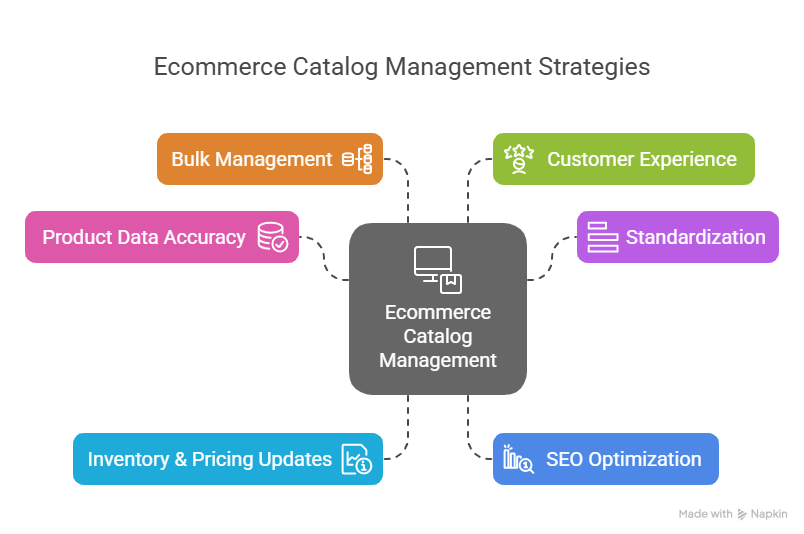
Ecommerce Catalog Management

One of the biggest headaches of an ecommerce business is managing an extensive complex product catalog. Product data, categories, and variations become unmanageable by selling through their site or online marketplaces like Amazon. I have seen so many organizations grapple with this challenge; I suspect you are in the same boat if you are pondering, "Is there an easier way to do it, especially as we scale?" Yes, there are ways to streamline ecommerce catalog management that can reduce headaches but support growth.

Problems in Ecommerce Catalog Management

Let's set the stage by first discussing what makes ecommerce catalog management so challenging in the first place. It is not merely the management of products; instead, it is the moving of the minute detail that may contribute to the profile of a product in terms of description, images, prices, and inventory. If all these factors don't fall into place, you will likely lose sales, destroy your brand's reputation, and incur operational inefficiencies.

Here are some of the most common issues I have seen that businesses struggle with:

  • Data Consistency: Most businesses find keeping their product data consistent challenging. For instance, an incorrect price on Amazon or a missing picture can lead to lost sales or negative reviews.
  • Scaling Issues: The more SKUs you have, the more complicated it gets. What works to manage 100 SKUs may not work for 10,000. I wish more businesses were planning for growth; they'd avoid a lot of inefficiency down the road.
  • Manual Processes: I believe most companies don't mind taking their catalogs with too much manual updating. This increases the possibility of errors concerning the company's products. According to Supply Chain Dive, spreadsheets have been found to contain a possibility of error in 88%, thereby causing various problems with product catalog management.

Why Simplifying Catalog Management is Critical for Scalability

Developing a streamlined way to manage your catalogs is not just about making your life easier today but rather about preparing for tomorrow. E-commerce is a dynamic environment in constant flux. Keeping up with your competition and customers requires a system that grows with your business.

Here are the top reasons why simplicity is essential:

  • Ease: Simplification will automatically involve more speed and swiftness for updating or changing the data. You will not spend hours updating the product description or prices; you can make quick corrections through a streamlined process.
  • Accuracy: When you use automation tools, the data in your product is correct on all platforms. Inconsistency will automatically put your business at risk.
  • Cost savings: Proper catalog management can save time and reduce operating costs. Using the right system also prevents you from recruiting excess staff to keep your catalog updated.

An article by Ecommerce Platforms concludes that businesses can save as much as 30% on operational costs by automating catalog management. For companies looking to scale, those savings can be plowed back into further growth initiatives, such as marketing or new product lines.

Image4 Image1 94

Catalog Management Simplification Tools for Ecommerce

If you want to make your ecommerce catalog management easy, then the right tool investment cannot be avoided. If you plan to rely on manual processes as your business grows, you have a recipe for disaster. Some tools that can help are as follows:

  • Product Information Management (PIM) Systems: PIM refers to centralizing all your product information in one place. This means that any updates you make in your PIM automatically get synced across all channels, creating consistency in data. Whether it be an Amazon product catalog or your website, having a PIM in place is a game-changer.
  • Catalog Management Software: Special platforms for catalog management allow companies to manage and update product information. These might also be linked to other software, such as inventory management or e-commerce platforms, for streamlined workflow.
  • Automation Tools: Tools like Zapier can automate specific tasks, such as syncing new products across multiple channels or automatically updating prices when your system changes.

As mentioned, many businesses use these tools to significantly reduce the time spent managing catalogs. According to McKinsey, with the help of automation tools, an organization can generate 20% more productivity, which is essential as you scale.

Best Practices for Your Amazon Product Catalog

A catalog manager must do one more thing if you sell on Amazon. Though maintaining an extensive catalog on Amazon would not be as easy because of their strict guidelines, here's how to do it correctly.

Here are some of my go-to tips for managing your Amazon catalog:

  • Utilize Amazon's Category-Specific Templates: Amazon's category-specific templates will make uploading and managing much more accessible. They are pre-programmed into your information, minimizing the possibility of listing errors.
  • Leverage Amazon's bulk upload tools: You cannot manually upload hundreds or thousands of SKUs one product at a time. Using Amazon's Bulk Upload Tools lets you add, update, or remove products in bulk, saving a little time you'd waste on manual uploads.
  • Regular Audits: I always recommend regular audits of your Amazon product catalog. This will help catch outdated information, mispriced products, or products that have become delisted by Amazon for unknown reasons.

A recent ChannelAdvisor study found that sellers who used catalog management tools on Amazon had 30% fewer listing errors and 25% faster product uploads, which allows the seller to focus more time on selling rather than sorting out technical issues.

Streamline Product Catalog Management for Long-Term Growth

If you're like me, you always think about the long term. Streamlining your catalog management is not just about solving problems today; it's about building a system that supports future growth. As your lines of products grow, so will the pain associated with your process. Once easy systems are in place, the effort to scale will be much less frustrating and hectic.

Here's what I would recommend for long-term growth:

  • Plan for Growth: Think about what your catalog should look like in a year or two. Will you be adding more complex product lines? Your system will need to handle all that new complexity.
  • Integrate with Other Systems: Your catalog management should be integrated with other backend systems, including inventory, order management, and fulfillment. This will prevent menial tasks such as manually re-entering data and ensure product information stays the same across all your platforms.
  • Prioritize Data Quality: The better the data, the better the ecommerce SEO and the better the customer experience. More importantly, invest in the proper tools for quality, consistent, and complete data.

This means that companies with clean and well-managed product data experience a rise in conversion rates between 15 percent and 25 percent. If you're looking for long-term success, you will want to pay attention to this statistic.

Frequently Asked Questions (FAQs)

1. What is ecommerce catalog management?

Ecommerce catalog management organizes, maintains, and updates product information for an online store. In other words, it comprises consistently managing product details, images, prices, and categories across all platforms.

2. How does Amazon catalog management differ from general ecommerce catalog management?

Amazon catalog management has sellers with only a predetermined type of guidelines for the listings, and they have to use Amazon tools alone. Also, Amazon has strict requirements for categories, product descriptions, and images, which go beyond the requirements of most traditional ecommerce websites.

3. How can I make the process of managing catalogs even easier?

Catalog management becomes much easier with PIM systems, catalog management software, or automation tools. This pools product data and then automatically updates it on the platforms.

Image1 94

Key Takeaways

Managing an ecommerce catalog can be simple and straightforward. Simplify how you do it and use the right tools in your arsenal, and you will reduce errors and save time to put your business on a trajectory for long-term growth. Here are three key takeaways:

  • Invest in the Right Tools: Product Information Management systems and catalog management software can help reduce the hours spent making manual updates.
  • Plan for Scalability: Establish systems that will continue to expand with your business, making the experience as painless as possible when your product lines multiply.
  • Quality Data Maintenance: You must ensure that your product information is accurate and consistent to optimize SEO and fulfill customer needs, thus generating quality conversions.

We have discussed the benefits of streamlining your catalog management process and how you set up for scalable growth. Are you ready to simplify your ecommerce catalog? Let's discuss how the right tools and strategies can transform your approach.

Want to know more and be updated with more relevant strategies in ecommerce management? Follow us on Facebook, Instagram, and Linkedin. Stay in touch, and let's keep ecommerce catalog management simple together!