
Last updated on August 8th, 2026
Optimizing product listings on modern e-commerce channels requires striking a balance between search engine indexing and persuasive sales copywriting. Crafting compelling Amazon product bullet points serves as the primary bridge between attracting shopper traffic and closing sales. These key features summarize vital product attributes quickly, helping mobile and desktop users make informed purchasing decisions in seconds.
Shoppers frequently skip long paragraphs to read concise bullet points that highlight product value and solve specific pain points. Partnering with specialized Amazon product description writing services allows growing brands to craft compliant, persuasive bullet points that elevate search rankings and drive consistent sales conversions. This detailed guide explores proven copywriting frameworks, category templates, compliance rules, and strategic keyword placement methods.
Table of Contents
How Amazon Uses Bullet Points for SEO
Amazon Product Bullet Point Guidelines
Anatomy of a High-Converting Bullet Point
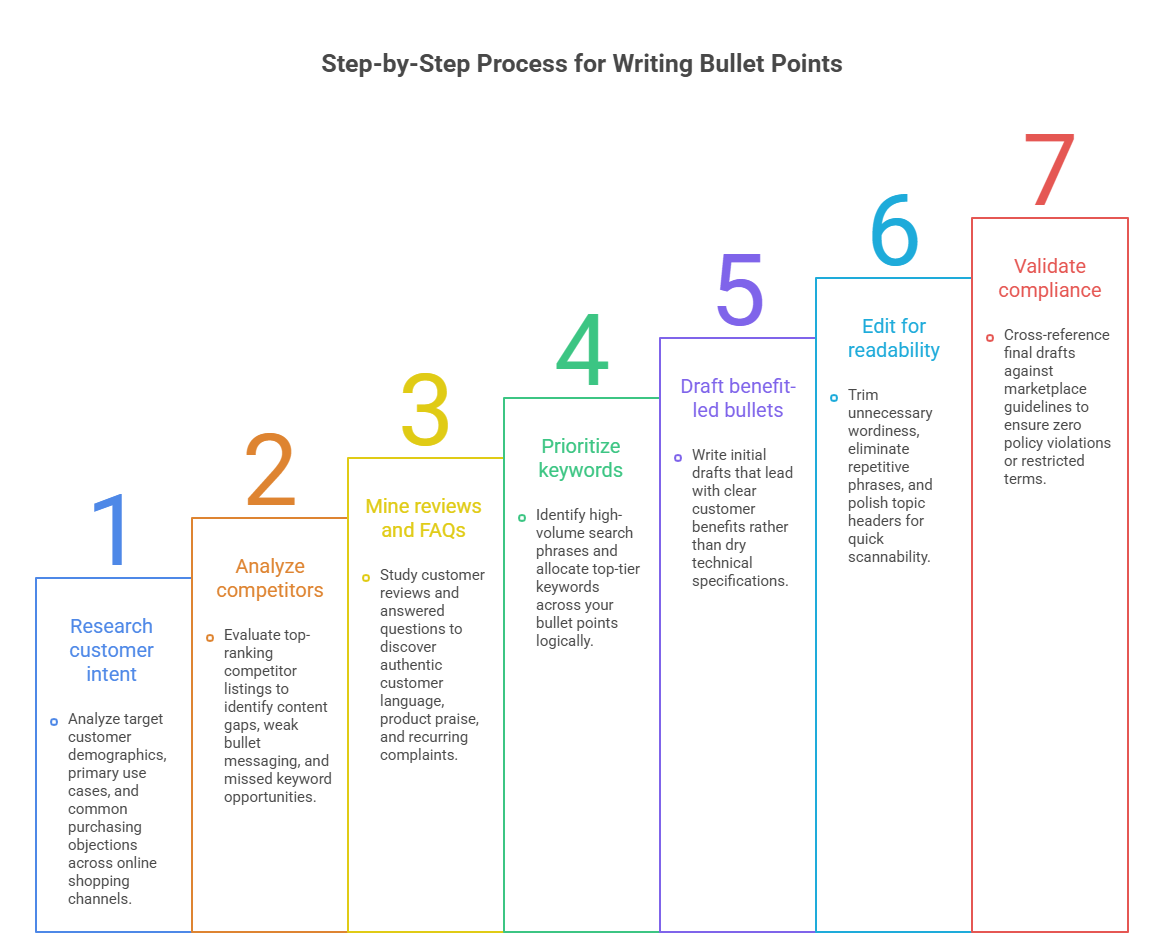
Step-by-Step Process for Writing Bullet Points
Why Bullet Points Matter
Key feature bullets act as the core persuasive engine on your product detail page, converting browsing traffic into paying customers. Understanding their impact across user touchpoints helps sellers craft content that drives immediate sales velocity.
- Conversion rate: Highlighting tangible customer benefits immediately lowers purchase friction, turning undecided visitors into confident buyers.
- User experience: Well-structured bullet points break down complex technical specifications into scannable chunks that improve overall page readability.
- Mobile visibility: Mobile shoppers view key product features immediately below product images, making bullet points essential for small-screen buying decisions.
- Product discoverability: Including primary keywords naturally inside bullet sections signals product relevance directly to search indexing systems.
How Amazon Uses Bullet Points for SEO
Amazon's search algorithm scans listing text continuously to determine item relevance for shopper search queries. Strategic keyword placement ensures your product displays prominently whenever potential customers search for related terms.
The A10 algorithm evaluates textual relevance by analyzing terms placed within bullet points alongside listing titles and backend search attributes. Integrating relevant search terms into key feature points boosts organic discoverability while preserving natural readability. Professional Amazon product description writing services optimize these text fields carefully to maintain high keyword indexation without triggering search algorithm penalties.
Elevate your search rankings by partnering with specialized Amazon product description writing services
Amazon Product Bullet Point Guidelines
Staying compliant with marketplace style guides prevents listing suppression and maintains brand integrity across product categories. Amazon enforces strict content and formatting rules that every brand must follow carefully.
- Character limits: Aim for 150 to 200 characters per bullet point, ensuring key details display fully without cluttering mobile screens.
- Formatting rules: Begin each point with a capitalized topic header using bold text or uppercase letters, avoiding special characters or emojis.
- Prohibited content: Never include pricing details, shipping promotions, seller information, environmental claims, or temporary promotional text.
- Compliance checklist: Verify that all feature claims align with category guidelines, health regulations, and federal advertising rules.
Anatomy of a High-Converting Bullet Point
Constructing high-converting Amazon product bullet points requires structuring each line to deliver maximum psychological impact. Combining technical features with real-world user benefits keeps shoppers engaged through every line.
Start by highlighting a specific product feature, such as a high-grade stainless steel component or a specialized ergonomic design. Immediately connect that feature to a practical advantage and explain the direct lifestyle benefit the user experiences daily. Conclude the bullet point with subtle social proof or a clear call to value that reinforces product quality.
Step-by-Step Process for Writing Bullet Points
Creating high-performing listing content requires a structured workflow that combines deep customer research with tactical keyword optimization. Following a repeatable process ensures consistency across your entire brand catalog.
- Research customer intent: Analyze target customer demographics, primary use cases, and common purchasing objections across online shopping channels.
- Analyze competitors: Evaluate top-ranking competitor listings to identify content gaps, weak bullet messaging, and missed keyword opportunities.
- Mine reviews and FAQs: Study customer reviews and answered questions to discover authentic customer language, product praise, and recurring complaints.
- Prioritize keywords: Identify high-volume search phrases and allocate top-tier keywords across your bullet points logically.
- Draft benefit-led bullets: Write initial drafts that lead with clear customer benefits rather than dry technical specifications.
- Edit for readability: Trim unnecessary wordiness, eliminate repetitive phrases, and polish topic headers for quick scannability.
- Validate compliance: Cross-reference final drafts against marketplace guidelines to ensure zero policy violations or restricted terms.By engaging experienced Amazon product description writing services, sellers can streamline this process while guaranteeing consistent listing quality.

Proven Copywriting Frameworks
Applying classic copywriting frameworks transforms bland technical details into persuasive sales messages that resonate with target audiences. Utilizing these frameworks brings structure and emotional resonance to your feature bullets.
- FAB (Features, Advantages, Benefits): State what the product has, explain how it functions, and highlight the ultimate personal value to the buyer.
- PAS (Problem, Agitation, Solution): Identify a common customer frustration, emphasize the pain it causes, and present your product as the ideal fix.
- AIDA (Attention, Interest, Desire, Action): Hook the reader with a strong header, build interest with facts, create desire via benefits, and prompt a purchase.
- Benefit-first: Lead every bullet point with the primary customer benefit, followed immediately by supporting product engineering details.
- Problem–Solution: Frame the bullet header around a specific customer problem and demonstrate how the product feature solves it instantly.
Real Examples
Reviewing side-by-side listing comparisons highlights how strategic copywriting turns simple product traits into persuasive sales points. Crafting optimized Amazon product bullet points improves listing clarity and encourages immediate customer action.
Weak Example:
The bottle is made of plastic. It holds 32 ounces of water. It has a flip-top lid so you can drink while running. Comes in blue.
Optimized Example:
HYDRATE ON THE GO: Massive 32 oz capacity ensures all-day hydration without frequent refills, helping you hit daily health goals effortlessly.
LEAK-PROOF FLIP LID: One-touch open cap allows single-handed drinking during workouts, featuring a secure lock that prevents gym bag spills.
BPA-FREE DURABILITY: Shatterproof Tritan plastic withstands accidental drops while keeping your water free from harmful chemical tastes.
Common Mistakes To Avoid
Avoiding frequent listing errors prevents customer confusion and protects your account from compliance flags. Steer clear of these operational pitfalls when creating key feature content.
- Keyword stuffing: Packing listing text with repetitive search phrases destroys readability and alienates shoppers.
- Feature-only writing: Listing technical specifications without explaining real-world user benefits leaves shoppers unimpressed.
- Generic claims: Using vague statements like highest quality or best value fails to build genuine product trust.
- Unsupported superlatives: Claiming your product is #1 or doctor-recommended without proof violates marketplace policies.
- Poor formatting: Presenting long, unformatted walls of text discourages mobile shoppers from reading essential product features.
How AI Can Help Write Better Bullet Points
Artificial intelligence tools accelerate initial content drafting and help writers generate creative benefit variations quickly. However, combining AI generation with human editorial oversight remains essential for maintaining brand voice and marketplace compliance.
- Benefits and limitations: AI generates diverse copywriting angles quickly, but often hallucinates features or uses repetitive buzzwords.
- Prompt examples: Instruct AI models to act as an expert Amazon copywriter, providing specific product specs, target customer personas, and key features.
- Human review checklist: Verify factual accuracy, check keyword placement, remove robotic language, and ensure compliance with Amazon policies.
Collaborating with professional Amazon product description writing services guarantees that AI-assisted content undergoes rigorous human refinement before publishing.
Frequently Asked Questions
1. How many bullet points should I use?
Amazon allows up to five key feature bullet points for standard retail listings, with vendor central accounts sometimes permitting more. You should utilize all five bullet slots to fully explain product features, address objections, and optimize search terms.
2. What is the ideal length?
The ideal length per bullet point is between 150 and 200 characters, providing enough detail without overwhelming readers. Keeping bullets concise ensures full visibility on mobile devices without requiring extra expanding taps.
3. Do bullet points affect rankings?
Yes, text placed inside key feature bullets is fully indexed by Amazon's search algorithm and influences organic rankings directly. Including relevant keywords within natural sales copy improves your listing's discoverability for target customer search queries.
4. Can I include keywords in every bullet?
You can include primary keywords across every bullet point provided they flow naturally within the sentence context. Avoid forcing irrelevant terms into your copy, as clear sales communication should always take priority over raw keyword density.
5. How often should I update them?
Review your bullet points every six months or whenever you notice declining conversion rates and shifts in customer search behavior. Updating bullets helps incorporate new customer feedback, highlight seasonal benefits, and adapt to competitor moves.
6. Are bullet point rules different by category?
While core formatting guidelines apply across the platform, specific categories like health, beauty, and apparel enforce distinct compliance rules. Certain categories restrict medical claims, material disclosures, or specific promotional phrasing.