



Last updated on June 22nd, 2026
Selling on Amazon has evolved into a highly competitive ecosystem where success depends on strategy, optimization, and continuous management. Businesses often struggle to keep up with listing updates, advertising performance, inventory control, and policy compliance.
Amazon Marketplace Management Services
This is where marketplace management services become essential. These services help sellers streamline operations, improve visibility, and increase profitability across Amazon’s ecosystem.
According to research on digital commerce transformation and evolving consumer behavior, businesses that adopt structured marketplace strategies and data-driven optimization are better positioned to scale efficiently and sustain long-term performance improvements:
Businesses that invest in Amazon Marketplace services gain structured operational support that helps them scale more efficiently and reduce costly errors.

Table of Contents
What Are Amazon Marketplace Management Services?
How Amazon Marketplace Management Services Work
Amazon Marketplace Management Services vs Self-Managed Selling
Fully Managed vs Unmanaged Amazon Marketplace Operations
Types of Amazon Marketplace Management Services
Challenges, Ideal Users, and Choosing the Right Amazon Marketplace Management Service Provider
What Are Amazon Marketplace Management Services?
Amazon marketplace management services refer to end-to-end solutions designed to manage and optimize a seller’s overall Amazon operations. These services cover a wide range of activities, including product listing optimization, keyword research, pricing strategy, inventory monitoring, customer service support, advertising management, and performance tracking. By handling these critical functions, providers help brands maintain a more efficient and competitive presence within Amazon’s marketplace.
Businesses increasingly use marketplace management services because managing Amazon operations requires continuous monitoring, data analysis, and strategic adjustments. By outsourcing these responsibilities, sellers can reduce operational complexity, improve efficiency, and focus more on business growth while experienced professionals handle day-to-day marketplace execution.
Streamline your product catalog with Amazon Marketplace management services.
How Amazon Marketplace Management Services Work
Amazon marketplace management services typically begin with a comprehensive account analysis and marketplace audit. During this stage, providers assess current performance, identify operational inefficiencies, and uncover growth opportunities. This evaluation serves as the foundation for developing a customized marketplace optimization strategy.
The initial audit often includes:
- Product listing quality assessment
- Keyword performance analysis
- Competitor and category benchmarking
- Advertising campaign evaluation
- Account health review
- Inventory and fulfillment analysis
Once performance gaps and optimization opportunities are identified, Amazon marketplace management services implement targeted improvements designed to increase visibility and conversions. These optimizations help align product listings with Amazon's search algorithm while improving the overall customer shopping experience.
Common optimization activities include:
- Product title optimization
- Bullet point restructuring
- Product description enhancements
- Image and creative improvements
- Backend search term optimization
- Catalog organization and variation management
- Pricing and promotion strategy adjustments
Following implementation, providers shift their focus to ongoing account management and performance monitoring. Amazon's marketplace is highly dynamic, requiring continuous adjustments to maintain competitiveness and adapt to algorithm changes.
Ongoing management typically includes:
- PPC campaign optimization
- Inventory monitoring and forecasting
- Account health management
- Performance tracking and reporting
- Customer service oversight
- Competitive analysis
- Conversion rate optimization
By combining strategic optimization with continuous operational support, Amazon Marketplace services help sellers improve visibility, increase sales performance, and maintain long-term marketplace growth. This ongoing cycle of analysis, optimization, and monitoring ensures that marketplace strategies remain aligned with changing customer behavior and Amazon's evolving platform requirements.
Amazon Marketplace Management Services vs Self-Managed Selling
For Amazon sellers, one of the most important decisions is whether to manage marketplace operations internally or work with a professional Amazon marketplace management service provider. Both approaches have advantages, but they differ significantly in terms of expertise, resource requirements, scalability, and long-term operational efficiency. Understanding these differences can help businesses choose the model that best aligns with their goals and available resources.
| Factor | Amazon Marketplace Management Services | Self-Managed Selling |
| Expertise | Provides access to specialists in Amazon SEO, PPC advertising, catalog management, inventory planning, and account optimization. | Relies on the seller's internal knowledge and ability to stay current with Amazon best practices and platform changes. |
| Time Commitment | Reduces the amount of time business owners and internal teams spend on daily marketplace operations. | Requires significant ongoing involvement in listing updates, advertising management, inventory monitoring, and compliance tasks. |
| Listing Optimization | Professional teams continuously optimize product titles, keywords, images, and content to improve visibility and conversions. | Optimization depends on internal resources and may be performed less frequently due to competing priorities. |
| Advertising Management | Dedicated specialists manage PPC campaigns, bidding strategies, budget allocation, and performance analysis. | Sellers must create, monitor, and optimize advertising campaigns themselves. |
| Inventory Management | Ongoing monitoring helps reduce stockouts, excess inventory, and fulfillment-related issues. | Inventory planning and forecasting must be handled internally, which can become challenging as sales volumes increase. |
| Scalability | Designed to support business growth, larger catalogs, and expanding product portfolios. | Scaling operations often requires additional staff, training, and internal systems. |
| Cost Structure | Involves management fees but provides access to specialized expertise and operational support. | Lower direct costs initially but may require significant investments in staffing, software, and training over time. |
| Performance Monitoring | Includes regular reporting, analytics, and strategic recommendations based on marketplace data. | Reporting and analysis depend on the seller's available tools, expertise, and time. |
Self-managed selling offers complete control over Amazon operations and may be suitable for smaller sellers with limited product catalogs or strong in-house marketplace expertise. However, managing SEO, advertising, inventory, customer experience, and compliance internally can become increasingly complex as a business grows.
In contrast, Amazon marketplace management services provide specialized knowledge, established processes, and ongoing optimization designed to improve operational performance. While outsourcing may involve higher upfront costs, many businesses find that professional management delivers greater efficiency, stronger marketplace visibility, and improved scalability over the long term. Ultimately, the best choice depends on a company's growth objectives, internal capabilities, and willingness to dedicate resources to Amazon marketplace management.
Fully Managed vs Unmanaged Amazon Marketplace Operations
Businesses selling on Amazon can either outsource marketplace management to a specialized provider or handle all operations internally. Each approach offers distinct advantages and challenges depending on a company's resources, expertise, and growth objectives. Understanding the differences can help sellers determine which model best supports their long-term success.
Fully Managed Amazon Marketplace Operations
With a fully managed approach, an Amazon marketplace management service provider oversees most day-to-day marketplace activities on behalf of the seller.
Key characteristics include:
- Complete operational support for Amazon marketplace activities
- Product listing optimization and ongoing catalog management
- Keyword research and SEO updates to improve visibility
- PPC campaign management and optimization
- Inventory monitoring and forecasting support
- Account health management and compliance oversight
- Performance tracking and reporting
- Access to Amazon marketplace specialists and industry expertise
- Scalable support as product catalogs and sales volumes grow
Best suited for brands seeking expert-driven execution, operational efficiency, and the ability to focus on broader business growth rather than daily marketplace management.
Unmanaged Amazon Marketplace Operations
With an unmanaged approach, the seller maintains full responsibility for all Amazon-related activities and decision-making.
Key characteristics include:
- Full internal control over marketplace operations
- In-house management of listings, content, and catalog updates
- Self-managed keyword research and SEO efforts
- Internal responsibility for PPC advertising
- Direct oversight of inventory planning and fulfillment
- Management of account health and compliance requirements
- Internal reporting and performance analysis
- Greater dependence on internal expertise and resources
- Additional staffing and training may be required as the business grows
Best suited for smaller sellers, startups, or businesses with experienced internal teams that have the time and expertise to manage Amazon operations independently.
Which Approach Is Right?
- Choose fully managed Amazon marketplace operations if you want specialized expertise, streamlined execution, and support for scaling your business.
- Choose unmanaged Amazon marketplace operations if you prefer complete control and have the internal resources to manage Amazon activities effectively.
- Many growing brands eventually adopt Amazon marketplace management services because they provide structure, consistency, and professional optimization across all marketplace functions. This often allows businesses to improve performance while freeing internal teams to focus on strategic initiatives.
Types of Amazon Marketplace Management Services
Effective Amazon marketplace management requires a combination of optimization, monitoring, and operational support to maintain strong performance. These services help sellers improve visibility, protect account health, manage operations, and maximize sales opportunities.
- Listing and Catalog Management: Focuses on improving product data, optimizing keywords, and enhancing listings to increase search visibility and conversions. This includes updating titles, descriptions, images, backend keywords, and catalog information to align with Amazon’s ranking factors.
- Security and Account Compliance Management: Ensures sellers follow Amazon’s policies, guidelines, and performance requirements to reduce the risk of account issues or suspensions. Providers monitor account health, compliance updates, and potential risks to help maintain a stable selling environment.
- Monitoring and Performance Management: Tracks important marketplace metrics such as conversion rate, click-through rate (CTR), sales performance, and ACOS. Regular performance analysis helps identify improvement areas and allows sellers to make data-driven decisions.
- Inventory and Order Management: Helps maintain proper inventory levels, prevent stockouts, and support smoother fulfillment operations. Effective inventory monitoring ensures products remain available while reducing the risk of overstocking or missed sales opportunities.
- Advertising and Cost Optimization: Manages Amazon PPC campaigns by improving targeting, keyword selection, bidding strategies, and budget allocation. The goal is to increase advertising efficiency, improve return on ad spend (ROAS), and reduce unnecessary spending.
All of these functions work together as core components of marketplace management services, helping brands improve operational efficiency, maintain marketplace performance, and achieve sustainable Amazon growth.
Challenges, Ideal Users, and Choosing the Right Amazon Marketplace Management Service Provider
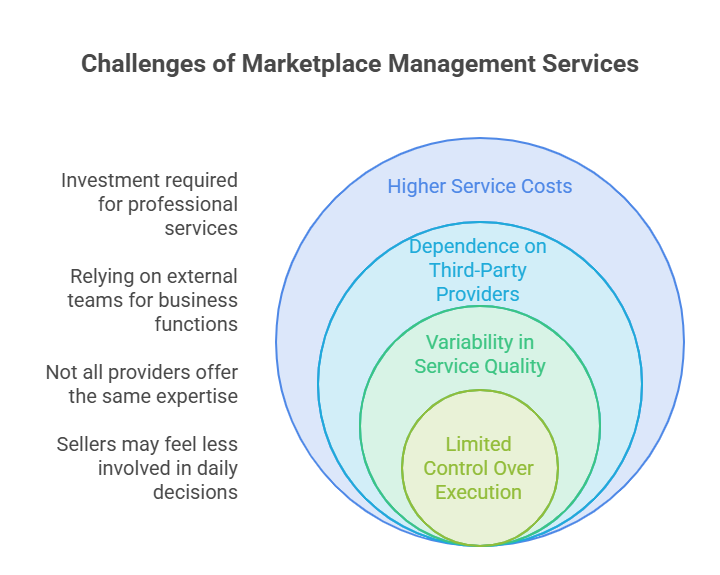
While Amazon marketplace management services provide significant advantages, businesses should also consider potential challenges before partnering with a provider. Service costs can vary depending on the scope of support required, and some companies may experience concerns around relying on third-party teams for critical marketplace activities. Other considerations include differences in service quality, communication processes, and the level of control businesses maintain over daily execution.
Common challenges include:
- Higher Service Costs: Professional marketplace management services require investment, which may be a consideration for smaller sellers with limited budgets. However, the cost can often be justified through improved efficiency, better optimization, and reduced operational workload.
- Dependence on Third-Party Providers: Outsourcing marketplace operations means relying on an external team for important business functions. Choosing a reliable provider with strong communication and reporting processes helps minimize this risk.
- Variability in Service Quality: Not all providers offer the same level of expertise, strategy, or execution quality. Businesses should evaluate experience, client results, and service capabilities before making a decision.
- Limited Control Over Execution: Some sellers may feel they have less direct involvement in daily marketplace decisions. Clear communication, regular reporting, and defined responsibilities can help maintain visibility and alignment.

Despite these limitations, Amazon marketplace management services remain a valuable solution for businesses looking to scale operations, improve marketplace performance, and access specialized expertise.
These services are especially beneficial for:
- Small businesses entering Amazon: New sellers can benefit from professional guidance when navigating listing optimization, advertising, compliance, and marketplace requirements.
- Growing brands scaling operations: Businesses expanding their product lines can use marketplace management support to handle increased complexity and maintain consistent performance.
- Enterprises managing large catalogs: Companies with extensive product inventories often require specialized support for catalog management, optimization, and performance tracking.
- Sellers struggling with performance optimization: Brands experiencing low visibility, weak conversions, or inefficient advertising can benefit from expert analysis and improvement strategies.
When selecting an Amazon marketplace management service provider, businesses should evaluate factors such as:
- Proven Amazon experience: Look for providers with demonstrated knowledge of Amazon’s marketplace ecosystem and proven results.
- Transparent reporting systems: Reliable providers should offer clear performance tracking, analytics, and regular updates.
- Advertising expertise: Strong PPC management capabilities are important for improving ad performance and controlling costs.
- Listing optimization capability: Providers should have experience improving keywords, content, images, and product page performance.
- Client success history: Reviewing case studies and previous results can help determine whether a provider can deliver measurable improvements.
The right Amazon marketplace management services partner should align with your business goals, operational requirements, and long-term growth strategy.
Conclusion
Amazon has become a highly competitive ecosystem where success depends on precision, optimization, and continuous management. Businesses that invest in marketplace management services gain a structured advantage in visibility, efficiency, and scalability.
As competition continues to grow, leveraging Amazon Marketplace services is no longer optional for serious sellers aiming for long-term success.
Frequently Asked Questions
1. Do Amazon marketplace management services guarantee sales growth?
No service can guarantee sales. However, structured optimization improves visibility, conversion rates, and advertising efficiency, which often leads to measurable performance improvements over time with consistent execution and strategy refinement.
2. Can these services manage international Amazon marketplaces?
Yes, many providers support global marketplaces. They help with localization, pricing strategies, and compliance requirements, making international expansion more manageable for sellers aiming to scale beyond their domestic market.
3. Are marketplace management services suitable for new sellers?
Yes, new sellers benefit significantly because these services reduce early-stage mistakes. They help establish strong listings, optimize product visibility, and ensure compliance from the beginning of the selling journey.
4. What metrics are most important in Amazon marketplace management?
Key metrics include conversion rate, click-through rate, advertising cost of sales, inventory turnover, and account health score. These indicators help measure performance and guide optimization strategies effectively.